
A chronological guide to the thinkers behind the series, what each contributed, and how they connect.
The purpose of this document is to provide a quick reference to some of the thinkers that may be referenced in an article you are reading but either has not been the subject of an article published (yet) or you just haven’t got to reading it yet…
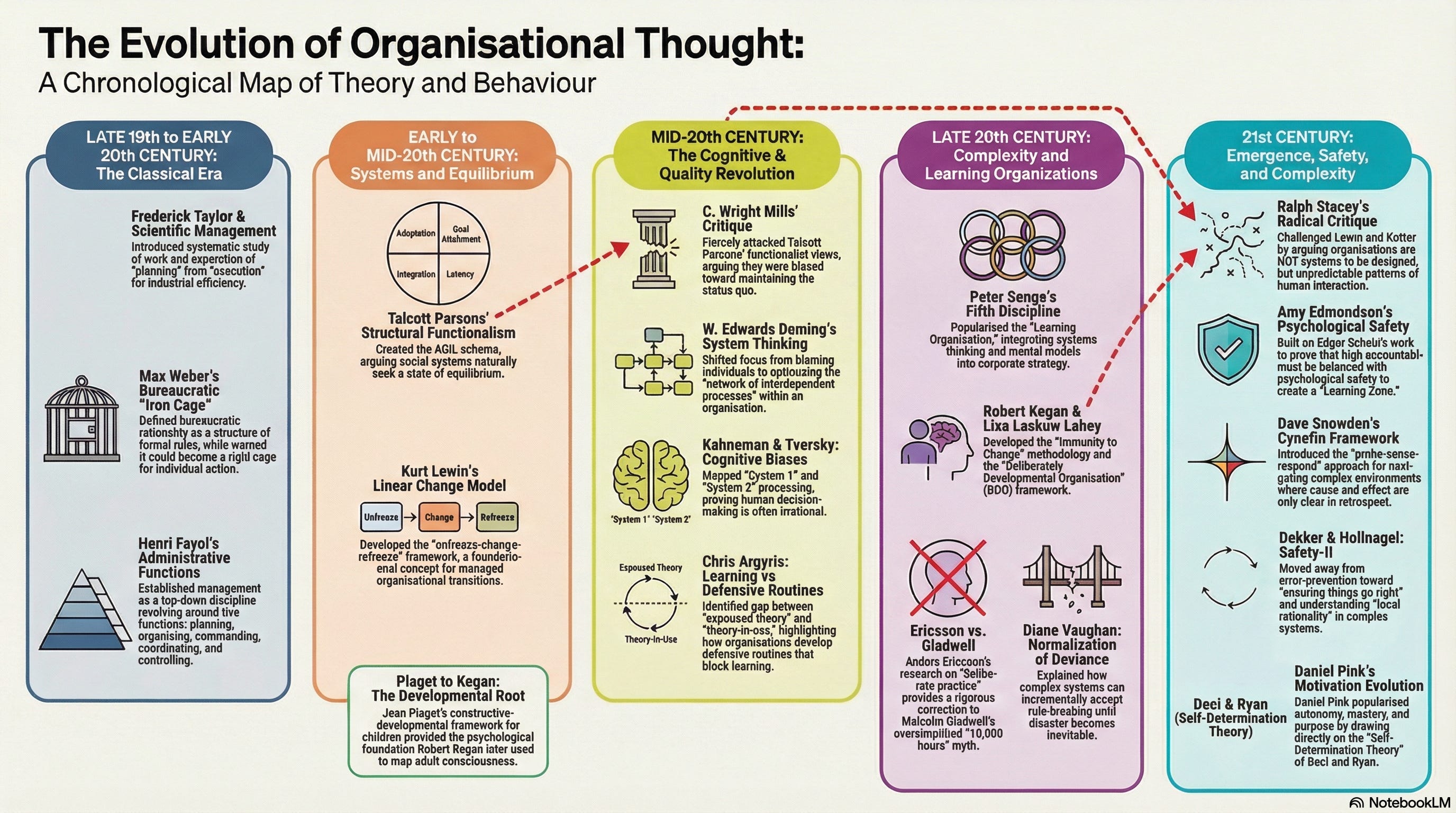
The Founders of Management (1840s–1920s)
Henri Fayol (1841–1925) Key insight: Management is a distinct, teachable discipline with five universal functions: planning, organising, commanding, coordinating, and controlling. Extends: nothing; Fayol wrote the first systematic account of what managers do. Criticised by: Mintzberg (showed managers actually work in fragments, not orderly functions); Stacey (rational planning fails in complexity); Giddens (Fayol’s functions are structures of domination reproduced in daily practice, not natural laws). Notable: his “gangplank” principle (lateral communication bypassing hierarchy) anticipated mission command by a century. Criticised Taylor’s functional foremanship as unworkable.
Frederick Winslow Taylor (1856–1915) Key insight: Work can be scientifically analysed, decomposed into elementary tasks, and optimised through standardised methods and measured output. Extends: nothing prior; Taylor invented industrial management. Criticised by: Deming (rejected Taylorism as root cause of industrial dysfunction); Argyris (shows why separating thinking from doing creates defensive routines); Giddens (Taylorist structures reproduce themselves through daily interaction); Stacey (Taylorism offers false certainty in uncertain conditions); Marquet and McChrystal (explicitly framed their work as overcoming the Taylorist separation of planning from execution).
Max Weber (1864–1920) Key insight: Bureaucratic rationality, based on rules, hierarchy, and impersonal authority, is the most efficient form of organisation; but it creates an “iron cage” that traps people in a system that serves its own logic rather than human purposes. Extends: historical analysis of why rational capitalism emerged in the West. Criticised by: Beer (proposed the Viable System Model as an alternative architecture); Peters (wants to break open the cage); Boyd (bureaucratic rationality is a trap in dynamic environments; produces closed systems that degrade). Complemented by: Giddens (Weber’s structures are reproduced through daily practice); Bourdieu (adds embodied dimension Weber lacked); Dweck (bureaucracy systematically selects for fixed mindset).
The Systems and Decision Pioneers (1900s–1920s)
W. Edwards Deming (1900–1993) Key insight: Quality is a system property, not an individual one. Transformation requires understanding four components: appreciation for a system, knowledge of variation, theory of knowledge, and psychology. “Drive out fear.” Extends: Shewhart’s statistical process control into a philosophy of management. Criticises: Taylor (explicitly; saw Taylorism as root cause of American industrial dysfunction). Complemented by: Senge (both emphasise systemic over individual explanations); Beer (both insist on understanding the whole before managing parts).
Karl Popper (1902–1994) Key insight: Knowledge advances through conjecture and refutation, not verification. A theory that cannot be falsified is not scientific. Piecemeal engineering beats utopian blueprints. Extends: Hume’s problem of induction (accepted it as conclusive; rejected induction entirely). Criticised by: Kuhn (ignored productive normal science); Lakatos (naive falsification is too simple; scientists rightly persist with theories through difficulties); Feyerabend (no single method works universally). Complemented by: Argyris (double-loop learning is Popperian critical rationalism applied to organisations); Heifetz (adaptive challenges require changing the framework, not solving within it); Taleb (extends falsification into decision-making; build systems that survive being wrong).
Talcott Parsons (1902–1979) Key insight: Social systems maintain themselves through four functions: Adaptation, Goal attainment, Integration, and Latency (AGIL). Systems tend toward equilibrium. Extends: Weber (translated and interpreted Weber for the English-speaking world, but stripped his pessimism). Criticised by: nearly everyone after him. Giddens (structure exists only in practice, not as external framework); Bourdieu (socialisation is embodied, not one-way norm transmission); Stacey (rejects equilibrium; organisations operate at the edge of chaos); Weick (goals are constructed retrospectively, not set rationally). Used in the series primarily as a diagnostic foil: when your transformation assumes equilibrium, you are thinking like Parsons.
Peter Drucker (1909–2005) Key insight: The knowledge worker must define the task before they can do it. The purpose of a business is to create a customer. Management by Objectives works only if you know the objectives; 90% of the time, you don’t. Extends: built the vocabulary of modern management from direct observation of organisations. Complemented by: Ackoff (idealised design is a method for answering Drucker’s “what is our business?” question); Simon (decision premises are the mechanism by which objectives reach individuals); Evans (knowledge crunching is how you define the task Drucker said must be defined).
Herbert Simon (1916–2001) Key insight: Real decision-makers face bounded rationality: limited information, limited cognitive capacity, limited time. They satisfice (find “good enough”) rather than optimise. Organisations are systems that shape the premises entering individual decisions. Extends: replaced classical “economic man” with “administrative man.” Complemented by: Kahneman (built directly on Simon’s foundation; System 1/System 2 is a descendant of bounded rationality); Beer (designs the channels; Simon explains what can flow through them given human limits); Evans (Domain-Driven Design is an applied Simonian programme; bounded contexts are near-decomposable systems). Challenges: Stacey (agrees on complexity but disagrees on designability; the Sciences of the Artificial is precisely about designing in complex environments).
The Identity and Development Thinkers (1919–1946)
G.E.M. Anscombe (1919–2001) Key insight: An agent’s knowledge of their intentional action is not based on observation; it is “practical knowledge,” the cause of what it understands. The question “Why?” applied to action reveals intention under a specific description. Extends: Wittgenstein (his student and literary executor). Complemented by: Argyris (espoused theory versus theory-in-use is a question of under which description the action is intentional); Beer (POSIWID is the organisational version of Anscombe’s test); Weick (sensemaking operates at the boundary of what Anscombe calls descriptions under which “Why?” has application).
Russell Ackoff (1919–2009) Key insight: Reality presents “messes” (systems of interacting problems), not discrete problems. Most organisations do the wrong thing righter; the highest form of problem treatment is dissolution: redesigning the system so the problem cannot recur. Extends: Churchman (co-founded the systems thinking movement); influenced by Deming. Complemented by: Beer (POSIWID diagnoses whether you are doing the wrong thing righter; VSM provides the structural template for idealised designs); Argyris (double-loop learning is dissolution applied to cognition); Drucker (acknowledged Ackoff’s contributions to his own thinking). Challenged by: Mintzberg (idealised design is too deliberate; real strategy is emergent); Stacey (the future cannot be designed).
Kuhn (1922–1996) Key insight: Science operates in two modes: “normal science” (productive puzzle-solving within a shared paradigm) and revolutionary science (paradigm shift when anomalies overwhelm the existing framework). Most work is normal; revolutions are rare and disorienting. Extends: historical analysis of how science actually progresses (contra Popper’s purely logical account). Criticises: Popper (described only the revolutionary episodes; ignored productive normal science). Criticised by: Popper (called normal scientists “victims of indoctrination”); Feyerabend (legitimising normal science legitimises dogmatism); Lakatos (paradigm choice must be rational, not “mob psychology”). Complemented by: Argyris (single-loop/double-loop maps exactly onto normal science/revolution); Heifetz (technical challenges are normal science; adaptive challenges require paradigm change).
Imre Lakatos (1922–1974) Key insight: Scientific theories exist within “research programmes” that have a hard core (non-negotiable assumptions) and a protective belt (adjustable auxiliary hypotheses). A programme is progressive if its adjustments generate novel predictions; degenerating if they merely defend the core. Extends: Popper (preserves commitment to rationality); Kuhn (incorporates insight that persistence with theories is rational). Complemented by: Heifetz (technical challenges are problems in the protective belt; adaptive challenges require changing the hard core); Beer (POSIWID tests whether a programme is progressive or degenerating); Drucker (systematic abandonment is the Lakatosian test: is this programme still progressive?).
Chris Argyris (1923–2013) Key insight: Organisations systematically prevent themselves from learning through “defensive routines”: skilled, automatic behaviours that protect individuals from embarrassment but prevent the organisation from questioning its assumptions. The gap between espoused theory (what people say) and theory-in-use (what people do) is where learning dies. Extends: developed Model I (unilateral control) / Model II (publicly testing inferences) distinction independently. Complemented by: Kegan (provides the developmental explanation for why defensive routines are so persistent: they express the person’s current order of mental complexity); Ackoff (provides the systems-level framework explaining why barriers persist: structural properties of messes, not individual pathologies); Giddens (theories-in-use live in practical consciousness; tacit knowledge that governs behaviour).
Paul Feyerabend (1924–1994) Key insight: There is no single scientific method whose rules are universally valid. Every methodological rule has been productively violated at some point. The renegades who break the rules may be generating precisely the evidence the formal process cannot produce. Extends: developed incommensurability independently from Kuhn; respected Lakatos but argued his methodology is “anarchism in disguise.” Criticises: Popper (there are no universal rules of method); Kuhn (legitimising normal science legitimises dogmatism). Complemented by: Peters (anti-bureaucratic evangelism); Stacey (real learning happens in the informal, unofficial, ungoverned); the series adds the caveat: Feyerabend’s exploration requires Popperian discipline at the evaluation stage.
Albert Bandura (1925–2021) Key insight: Self-efficacy (belief in one’s capability to perform) predicts performance more reliably than actual skill. People learn through observation, reciprocal determinism, and four sources of efficacy: mastery experience, vicarious experience, verbal persuasion, and physiological state. Extends: challenged behaviourism by showing that learning occurs through observation, not just direct reinforcement. Complemented by: Dweck (growth mindset is the belief system; self-efficacy is the performance mechanism); Seligman (learned helplessness is the destruction of self-efficacy through repeated uncontrollable failure).
Stafford Beer (1926–2002) Key insight: “The purpose of a system is what it does” (POSIWID). Viable organisations require a recursive structure of five systems managing autonomy, coordination, control, intelligence, and identity. The lethal variety attenuator is sheer ignorance. Extends: Ashby’s Law of Requisite Variety into organisational design. Complemented by: Ackoff (interactive planning provides the methodology; Beer provides the structural architecture); Argyris (defensive routines are variety attenuators); Westrum (information flow typology diagnoses how Beer’s channels are actually used). Criticised by: Stacey (still too structural; shadow conversations are where real variety management happens); Bourdieu (explains why people do not use the information architecture as designed: the field punishes those who disrupt the doxa).
John Boyd (1927–1997) Key insight: The quality of orientation (accumulated mental models, cultural traditions, new information, previous experience) determines the quality of everything else. The OODA loop (Observe-Orient-Decide-Act) is not a simple cycle but a complex web of feedback paths where orientation is the schwerpunkt. Organisations must destroy and create mental models continuously or they degrade. Extends: Sun Tzu, Clausewitz, the Prussian Auftragstaktik tradition. Complemented by: Argyris (defensive routines are closed orientations that prevent reorientation); Weick (sensemaking embodies the same act-then-interpret principle); Drucker (schwerpunkt is MBO made dynamic); Westrum (generative culture maps to Boyd’s organisational climate). Challenges: Stacey (agrees on complexity but disagrees on conclusion; you cannot plan every action but you can design an organisation that generates appropriate actions in real time).
Pierre Bourdieu (1930–2002) Key insight: Practice is generated by “habitus,” embodied dispositions acquired through experience that operate below conscious awareness. People do not choose how to act; their habitus generates practices shaped by the “field” (the competitive arena with its own rules and stakes) and the “capital” (economic, social, cultural, symbolic) they possess. Transformation that changes what people articulate without touching habitus changes nothing. Extends: Marx (capital theory); Weber (adds embodied dimension to rationalisation). Complemented by: Giddens (focuses on structural dimension; Bourdieu on embodied dimension); Kegan (Subject is structurally similar to habitus; both control behaviour without awareness); Argyris (defensive routines are habitus in action). Challenges: Peters (liberation without attention to habitus produces disorientation, not energy); Parsons (socialisation is not one-way transmission; habitus is generative and improvisational).
The Sensemaking and Complexity Generation (1934–1947)
Daniel Kahneman (1934–2024) Key insight: Human cognition operates through two systems: System 1 (fast, intuitive, automatic) and System 2 (slow, deliberative, effortful). Systematic biases (anchoring, availability, loss aversion, WYSIATI) are not random errors but predictable consequences of how cognition works. Extends: Simon’s bounded rationality (acknowledged building on Simon’s foundation). Complemented by: Ackoff (mess formulation counters the planning fallacy); Snowden (Cynefin domains map to where System 1 works and where it fails); Heifetz (adaptive challenges require System 2; technical challenges can use System 1).
Mihaly Csikszentmihalyi (1934–2021) Key insight: “Flow” occurs when challenge matches skill at the edge of competence, with clear goals and immediate feedback. This state produces optimal experience and highest performance. Complemented by: Kegan (the DDO’s “Edge” dimension is the organisational structure for maintaining flow conditions); Boyd (mission command creates flow conditions: clear goals via commander’s intent, immediate feedback via AARs, matched challenge and skill via Fingerspitzengefühl).
Karl Weick (1936–) Key insight: Sensemaking is retrospective, social, and grounded in identity. Action precedes understanding: “How can I know what I think until I see what I say?” Organisations enact the environments they then adapt to. Reliability comes not from rigid plans but from “mindful organising.” Extends: developed independently; influenced by pragmatism, phenomenology. Complemented by: Ackoff (sensemaking is synthesis); Boyd (OODA embodies the same act-then-interpret principle); Mintzberg (emergent strategy is the organisational result of sensemaking processes). Criticised by: Taleb (sensemaking is dangerous when retrospective narratives are mistaken for prospective knowledge).
Anthony Giddens (1938–) Key insight: Structure and agency are not separate; they are two sides of the same process (”structuration”). Social structures are both the medium through which people act and the outcome of their actions. Practical consciousness (what people know how to do but cannot articulate) reproduces structure in every interaction, across three dimensions: signification (meaning), domination (power), and legitimation (norms). Extends: resolves the structure-agency dualism Parsons never resolved. Criticises: Parsons (structure is not external framework; it exists only in practice); Kotter (structure cannot be “unfrozen” and “refrozen” because it is never frozen). Complemented by: Bourdieu (adds the embodied dimension); Argyris (theories-in-use live in practical consciousness); Mintzberg (provides the organisational anatomy Giddens’ theory requires).
Ron Westrum (1938–) Key insight: Organisations fall into three information flow cultures: pathological (information suppressed, messengers shot), bureaucratic (information channelled through fixed routes, messengers tolerated), and generative (information actively sought, messengers trained). The type determines learning capacity. Complemented by: Edmondson (psychological safety is the behavioural precondition for generative culture); Beer (VSM provides structural architecture; Westrum diagnoses how it is actually used); Boyd (generative culture maps to Boyd’s organisational climate).
Henry Mintzberg (1939–) Key insight: Most realised strategy is emergent, arising from accumulated action rather than implemented plans. Strategy is craft: the potter’s hands on the clay, not the planner’s model on the wall. Organisations fall into structural configurations (machine bureaucracy, professional bureaucracy, adhocracy, etc.) that determine what they can and cannot do. Extends: empirical study of what managers actually do (contra Fayol’s prescriptions). Criticises: Fayol (functions don’t describe real managerial work); Drucker’s MBO (objectives are often ambiguous and emergent); Taylor (standardisation works for routine work but kills adhocracy). Complemented by: Weick (sensemaking explains how strategy emerges cognitively); Stacey (Mintzberg demonstrates empirically what Stacey argues theoretically); Giddens (provides the structural theory for why configurations reproduce themselves).
The Action and Motivation Thinkers (1942–1947)
Tom Peters (1942–) Key insight: Excellent companies share a bias for action, closeness to customers, autonomy and entrepreneurship, productivity through people, and “simultaneous loose-tight properties” (maximum autonomy within cohesive purpose). Bureaucracy is the enemy of everything good. Extends: popularises Drucker operationally where Drucker was philosophical. Criticised by: Stacey (cannot destroy structure and expect better patterns to emerge); Deming (telling individuals to improve while leaving the system unchanged is the fundamental error); Bourdieu (liberation without attention to habitus produces disorientation). Complemented by: Boyd (mission command principles match “loose-tight”); Mintzberg (diagnostic framework tells you which of Peters’ recommendations are relevant to your configuration).
Martin Seligman (1942–) Key insight: Learned helplessness is not fatigue but a cognitive model: “my actions don’t matter.” When people repeatedly experience that effort produces no change, they stop trying, even when conditions improve. “Change fatigue” in organisations is learned helplessness, and it is rational. Extends: original animal studies; applied to human explanatory styles. Complemented by: Weick (small wins directly counter helplessness by providing evidence that effort leads to outcomes); Dweck (growth mindset is the belief system; helplessness is what happens when the belief collapses); Kegan (developmental capacity determines whether someone can overcome helplessness).
Ralph Stacey (1942–) Key insight: Organisations are not systems that can be observed from outside and redesigned; they are complex responsive processes of human interaction. The future cannot be designed. Strategy emerges from ongoing conversational patterns; the leader is not above the system but a participant with a louder voice. Criticises: Senge (you cannot design a learning organisation; learning emerges or doesn’t from interaction); Parsons (rejects equilibrium; genuine novelty emerges from instability); Kotter/Lewin (unfreeze-change-refreeze assumes a designer standing outside the system); Ackoff (idealised design is a modernist fantasy). Complemented by: Weick (agrees that action precedes understanding); Argyris (agrees defensive routines block learning but goes further: you cannot fix them from outside); Bourdieu (adds explanatory power for why certain patterns persist).
Richard Normann (1943–2003) Key insight: Organisations navigate by “maps” (mental models of their environment) that may bear no relation to the actual “landscape.” The deepest maladaptation is adapting efficiently to the wrong landscape. Reframing, not incremental improvement, is the path to transformation. Complemented by: Ackoff (idealised design is a method for producing reframing); Beer (the map attenuates variety from the landscape; if the map is wrong, you eliminate exactly the information you need); Kegan (reframing is a Subject-to-Object move at the organisational level; for Order 3 people it feels like self-annihilation).
Carol Dweck (1946–) Key insight: People hold implicit theories about ability. A “fixed mindset” treats ability as innate and immutable; a “growth mindset” treats ability as developable through effort. The mindset, not the ability, predicts behaviour under challenge. Organisations develop collective mindset cultures that determine whether failure produces learning or blame. Complemented by: Kegan (growth mindset is necessary but not sufficient; you also need developmental complexity); Seligman (learned helplessness is what happens when growth mindset collapses); Bourdieu (the reliability bias toward fixed mindset is habitus, not conscious choice; reproduced through hiring, training, and promotion systems). Extends: attribution theory; experimental findings on how praise shapes mindset.
Robert Kegan (1946–) Key insight: Adults develop through qualitatively different orders of mental complexity. What is “Subject” (invisible, controlling the person) versus “Object” (visible, examinable) determines what someone can and cannot see about themselves and their situation. Most modern work demands Order 4 (Self-Authoring) capacity, but approximately 58% of adults have not yet reached it. This is a developmental gap, not a skill gap. Extends: Piaget’s stages into adult development. Complemented by: Argyris (Kegan operationalises what Argyris diagnoses; governing variables are Subject); Heifetz (adaptive work is developmental work); Bourdieu (habitus is structurally similar to Subject); Giddens (practical consciousness maps to Subject; discursive consciousness maps to Object). Challenges: Dweck (growth mindset alone is insufficient without the developmental infrastructure to act on it).
John Kotter (1947–) Key insight: Transformation requires an eight-step sequence: establish urgency, form a guiding coalition, create vision, communicate vision, empower action, generate short-term wins, consolidate gains, anchor in culture. Criticised by: Popper (utopian engineering applied to change; how do you know your vision is right?); Giddens (structure cannot be unfrozen and refrozen; it is reproduced in every interaction); Stacey (assumes a designer standing outside the system); Deming (exhortation and vision cannot overcome a poorly designed system).
Peter Senge (1947–) Key insight: The “learning organisation” requires five disciplines: personal mastery, mental models, shared vision, team learning, and systems thinking. Most performance problems are systemic, not individual. Systems archetypes (shifting the burden, limits to growth, fixes that fail) produce predictable dysfunctional patterns. Extends: systems dynamics; Deming’s emphasis on systemic causes. Criticised by: Stacey (you cannot design a learning organisation; it emerges or doesn’t from interaction); Kegan (explains why the five disciplines are so hard: they require Order 4 or 5 capacity). Complemented by: Deming (both emphasise that most problems are systemic); Popper (mental models discipline is the closest management concept to Popperian critical rationalism); Beer (systems archetypes can be diagnosed using variety framework).
The Leadership and Safety Thinkers (1950s–1960s)
James Mattis (1950–) Key insight: “Centralized vision, decentralized planning and execution.” Reading is the foundation of leadership preparation. Build “cognitive muscle memory” through rehearsal until improvisation is possible. Tolerance for honest mistakes prevents learned helplessness; punishing risk-takers retains only the risk-averse. Extends: Boyd’s framework (the most explicit high-ranking military advocate); Auftragstaktik tradition. Complemented by: Bourdieu (cognitive muscle memory is habitus formation by design); Csikszentmihalyi (improvisation connects mastery of fundamentals to flow); Edmondson (the reading list builds shared language and “teaming” capability).
Ronald Heifetz (1951–) Key insight: The most important distinction in leadership is between technical challenges (solvable with existing expertise) and adaptive challenges (requiring the people with the problem to change themselves). Most leadership failure comes from treating adaptive challenges as technical ones. The leader’s job is not to provide answers but to create conditions where people can do adaptive work. Extends: developed independently from evolutionary biology, music, and political leadership. Complemented by: Kegan (adds the developmental dimension; adaptive challenges are hard because people lack mental complexity, not motivation); Lakatos (technical challenges are problems in the protective belt; adaptive challenges require changing the hard core); Popper (piecemeal engineering, not utopian blueprints).
Clayton Christensen (1952–2020) Key insight: Well-managed organisations rationally fail when confronted with disruptive innovation; not through incompetence but through the disciplined application of management practices that made them successful. Capabilities migrate from resources (flexible) to processes (less flexible) to values (rigid). Separation, not reform, is the path for the incumbent. Extends: empirical study of the disk drive industry showed displacement happens despite capability, not because of its absence. Complemented by: Argyris (the resource allocation process that filters out disruptive opportunities is a defensive routine at the strategic level); Bourdieu (organisational “values” in the RPV framework are habitus); Beer (POSIWID maps directly: the system’s actual purpose is to maximise within the existing model, not to innovate); Weick (”drop your tools” explains disruption blindness: organisations die because they cannot let go of identity-constituting processes).
Dave Snowden (1954–) Key insight: Situations fall into distinct domains (Clear, Complicated, Complex, Chaotic) each requiring different response logic. The critical error is complexity denial: treating complex situations (where cause and effect are only coherent in retrospect) with complicated-domain tools (analysis and planning). In complexity: probe-sense-respond; run safe-to-fail experiments, not fail-safe plans. Extends: develops Cynefin from complexity science and anthropological methods. Complemented by: Stacey (complex problems require probe-sense-respond); Taleb (complex and chaotic domains are Extremistan); Boyd (OODA is the decision-making process for complex and chaotic domains); Popper (piecemeal engineering matches probe-sense-respond).
Stanley McChrystal (1954–) Key insight: In networked, fast-moving environments, the old hierarchy must be replaced by a “team of teams” built on shared consciousness (radical transparency) and empowered execution (decentralised decision-making). The leader shifts from chess player to gardener. Extends: Boyd’s organic design implemented at scale. Complemented by: Westrum (transformation from compartmentalised silos to radical transparency is a shift from bureaucratic to generative culture); Heifetz (the “humble gardener” is the adaptive leader who gives work back to the people); Stacey (self-awareness about role change is skilled participation); Taylor (anti-pattern: McChrystal explicitly frames his transformation as moving away from Taylorist separation of planning from execution).
Nassim Nicholas Taleb (1960–) Key insight: The true opposite of fragile is not robust but antifragile: systems that gain from disorder. Most transformation programmes are fragile by design (dependent on accurate predictions and linear progression). Build systems that survive being wrong, not systems that depend on being right. The barbell strategy: extreme safety on one side, small speculative bets on the other, nothing in the dangerous middle. Extends: Popper (extends falsification into decision-making); Simon (explains why bounded rationality is not merely imprecise but systematically dangerous in fat-tailed domains). Complemented by: Snowden (safe-to-fail experiments are options with bounded downside); Weick (small wins are antifragile experiments); Peters (liberation of frontline workers is an optionality argument); Beer (POSIWID is a via negativa diagnostic).
Amy Edmondson (1960–) Key insight: Psychological safety (the shared belief that the team is safe for interpersonal risk-taking) is the foundation for team learning. But safety alone does not predict performance; safety plus high standards creates the learning zone. Safety without challenge produces comfort; challenge without safety produces fear. Complemented by: Kegan (DDO adds the critical nuance: safety without developmental challenge produces comfort, not growth); Westrum (generative culture is the organisational equivalent of Edmondson’s learning zone); Argyris (defensive routines are what emerges when safety is absent).
Sidney Dekker (1970s–) Key insight: People do not come to work to do a bad job. “Local rationality” means that actions, even those contributing to accidents, made sense to the actors at the time given their knowledge, goals, and pressures. Hindsight bias, drift into failure (incremental normalisation of deviance), and the gap between “work-as-imagined” and “work-as-done” are the real sources of organisational failure; not individual error. Extends: Hollnagel’s Safety-II (studying why things go right, not just why they go wrong); Vaughan’s normalisation of deviance. Complemented by: Kahneman (System 1 dominance under pressure explains local rationality; WYSIATI explains hindsight bias); Argyris (the gap between work-as-imagined and work-as-done is the organisational version of espoused theory versus theory-in-use); Bourdieu (habitus explains why procedures are adapted in practice; formal rules are resources, not scripts).
The Strategy Thinkers
Richard Rumelt Key insight: Good strategy has three elements: a diagnosis (what is the challenge?), a guiding policy (what is the approach?), and coherent actions (what specifically will we do?). Bad strategy substitutes goals for analysis, avoids difficult choices, and mistakes ambition for direction. The “crux” is the single decisive challenge; address it or fail. Complemented by: Boyd (crux is Boyd’s schwerpunkt); Weick (diagnosis is sensemaking; how you frame the challenge determines what you can see); Kahneman (bad strategy is System 1 thinking applied to strategic challenges); Popper (insistence on diagnosis and testing is Popperian; a good strategy is a testable hypothesis). Challenges: Stacey (kernel assumes the challenge can be diagnosed; Stacey argues that in truly complex situations, the challenge itself is emergent).
Roger Martin Key insight: Strategy is a cascading set of choices (aspiration, where-to-play, how-to-win, capabilities, management systems) where each level constrains the next. Organisations systematically favour reliability (exploiting what works) over validity (exploring what might work), killing innovation. “Integrative thinking” generates new options from opposing models rather than choosing between them. Extends: Peirce’s abductive reasoning; developed with A.G. Lafley at Procter & Gamble. Complemented by: Argyris (integrative thinking is the antidote to either/or defensive routines); Boyd (knowledge funnel parallels Destruction and Creation); Kahneman (reliability bias is organisational System 1 dominance); Bourdieu (the reliability preference is habitus, not conscious choice); Popper (strategy-as-hypothesis is explicitly Popperian).
The Practitioners
Eric Evans Key insight: Software systems fail when the code diverges from the domain. “Knowledge crunching” through continuous collaboration between developers and domain experts produces a shared “ubiquitous language” and domain model. Bounded contexts define the boundaries within which a model is consistent. A trained language model is a bounded context. Extends: Simon (DDD is an applied Simonian programme; bounded contexts are near-decomposable systems). Complemented by: Weick (knowledge crunching is enacted sensemaking); Drucker (provides the method for defining the task Drucker said must be defined); Argyris (ubiquitous language surfaces hidden assumptions by forcing contradictions into the open); Mintzberg (the model emerges from implementation, not upfront analysis; craft, not planning).
Gene Kim Key insight: High-performing technology organisations share three patterns (”Three Ways”): fast flow from development to operations, rapid feedback from right to left, and a culture of continuous experimentation and learning. Core versus context: focus ruthlessly on what creates advantage, minimise everything else. Extends: Deming (the Three Ways are Deming’s PDCA applied to software delivery); Goldratt’s Theory of Constraints. Complemented by: Westrum (generative culture is Kim’s Fourth Ideal); Edmondson (psychological safety is prerequisite for the feedback loops of the Second Way).
David Marquet Key insight: Replace the leader-follower model with leader-leader. Change the language: “I intend to” replaces “request permission.” Three pillars: push control to where the information lives, build competence to handle that control, ensure clarity of organisational purpose. Extends: Boyd’s Auftragstaktik (clarity is Einheit; competence is Fingerspitzengefühl; control is Auftragstaktik). Complemented by: Argyris (shift from permission to intent is Model I to Model II); Edmondson (”I intend to” creates psychological safety); Giddens (the language change is a structural change across all three dimensions); Dweck (”improve not prove” is growth mindset applied to organisational language).
Jocko Willink Key insight: “Extreme ownership”: the leader takes total responsibility for everything that happens. Effective leadership lives in dichotomies (confident but humble, aggressive but cautious, disciplined but free). “No bad teams, only bad leaders.” Extends: Auftragstaktik tradition; direct combat experience. Complemented by: Stacey (the dichotomies are paradoxes of organisational life; the tension cannot be resolved, only navigated); Heifetz (extreme ownership is “giving work back to the people” turned inside out); Kahneman (”focused but detached” is the System 1/System 2 tension); Beer (the dichotomies are variety management problems).
Stephen Bungay Key insight: Three gaps prevent organisations turning strategy into results: a knowledge gap (between what the situation demands and what leaders know), an alignment gap (between what leaders intend and what subordinates understand), and an effects gap (between what people do and what actually happens). “Directed opportunism” closes all three simultaneously. Extends: Boyd (the most explicit translator of Boyd’s ideas into business strategy; the three gaps are the friction Boyd’s OODA loop navigates). Complemented by: Mintzberg (directed opportunism is emergent strategy given a mechanism); Argyris (instinctive reactions to the gaps, i.e. more detail, more control, more reporting, are defensive routines); Giddens (the three gaps operate across signification, domination, and legitimation).
Patrick Lencioni Key insight: Team dysfunction is sequential: absence of vulnerability-based trust leads to fear of conflict, which leads to lack of commitment, which leads to avoidance of accountability, which leads to inattention to results. Fix them in order, starting with trust. Note: explicitly fable-based, not research-based. CAS critique: treats learning as compliance (diagnose, train, fix, maintain); suppresses adaptive capacity.
Ken Blanchard Key insight: Situational Leadership (SLII): there is no single best leadership style. Match the style (directing, coaching, supporting, delegating) to the follower’s development level on the specific task. Development level combines competence and commitment. Note: widely applied but criticised for assuming leaders can accurately diagnose development level and switch styles fluidly.
Matthew Skelton & Manuel Pais (Team Topologies) Key insight: How you organise teams directly determines the software architecture you can achieve (Conway’s Law). Use the “Reverse Conway Maneuver”: define the architecture you want, then design the team structure to produce it. Four fundamental team types: stream-aligned, enabling, complicated-subsystem, and platform. Extends: Conway’s Law (1967); DevOps community wisdom.
This cheat sheet covers the thinkers profiled in the Organisational Prompts research base.