
Henry Mintzberg spent fifty years watching traditional linear approaches to strategy fail. While other management thinkers described how strategy should work, Mintzberg studied how it actually works. His conclusion was radical and remains uncomfortable: strategy is not a plan you design in a boardroom. It is a pattern that emerges from the daily decisions of the people doing the work. If you are leading AI transformation by enforcing a roadmap, Mintzberg has bad news.
His ten “schools” of strategy formation represent the most comprehensive taxonomy of strategic thought ever produced. He has been criticised for descriptive bias, for underweighting analytical planning, and for a romantic attachment to craft. These criticisms have force. But descriptive accuracy is not a weakness when every prescriptive model keeps producing the same failures. Mintzberg watched what actually happened, and what actually happened was not what the strategy documents said would happen.
1. The Potter at the Wheel: Why Thinking Cannot Be Divorced from Doing
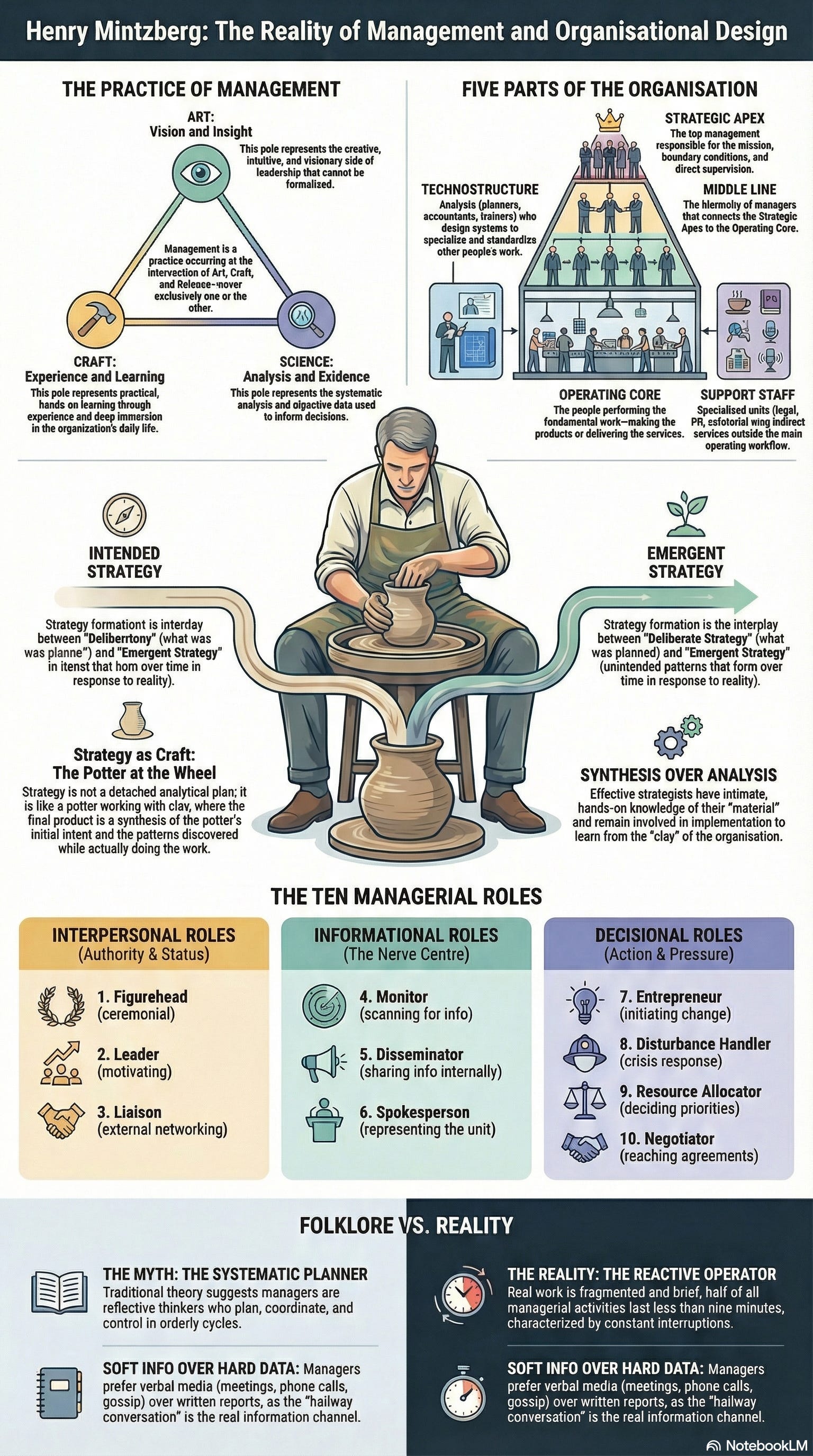
Mintzberg’s most vivid metaphor is the potter at the wheel. The potter does not begin with a blueprint. She begins with a lump of clay, an intention, and the skill of her hands. As the wheel turns, the clay responds: sometimes cooperating, sometimes resisting, sometimes suggesting possibilities she had not imagined. The final product is a combination of intention and emergence: what she planned, what the clay allowed, and what she discovered along the way.
The metaphor does double duty. It is an identity argument: the potter knows through her hands, through the practical consciousness that Giddens describes as the tacit knowledge governing most skilled behaviour. Her expertise is not in her plan but in her dispositions, formed through years of practice. Bourdieu would call this the habitus of the craftsperson: the accumulated feel for the material that generates practice below the level of conscious deliberation. You cannot separate the potter from the clay without destroying the knowledge that only their interaction produces.
It is also an information argument. The clay talks back. The material provides information that the plan cannot contain, because the information only exists in the interaction between potter and clay. Bateson’s definition is precise: information is “a difference which makes a difference,” and the differences that matter in strategy only become visible through engagement with the material. The organisation that plans its AI strategy without touching the clay, without writing specifications, seeing what AI generates, and adjusting its understanding based on what it discovers, is hallucinating a strategy from information that does not yet exist.
The separation of formulation from implementation is therefore the core error. If strategy is a craft, then the person who formulates cannot be different from the person who implements, because implementation generates the information that shapes formulation. Drucker arrived at the same point: the knowledge worker must define the task. Heifetz adds the leadership dimension: adaptive challenges cannot be solved by experts in a back room. They require the people with the problem to do the learning. The AI strategist who formulates the plan from a PowerPoint deck is doing precisely what Heifetz warns against: taking back the work that belongs to the people who must live with its consequences.
2. Strategy as Pattern, Not Plan
Mintzberg defined strategy as “a pattern in a stream of decisions.” He distinguished between intended strategy (what you wrote in the document), deliberate strategy (what you planned and executed), and emergent strategy (the successful patterns that formed without being intended). His key finding, drawn from decades of empirical research: most realised strategy is emergent, not deliberate.
This does not mean planning is useless. It means planning is one input to strategy, not the mechanism by which strategy is created. The plan is valuable as a starting gesture; its primary value is in the conversations it forces and the alignment it creates. But it is not a blueprint.

Weick provides the cognitive mechanism: understanding follows action. People act, patterns form, and retrospective sensemaking gives those patterns meaning. Stacey provides the theoretical explanation: plans are gestures that call forth responses. The forty-seven-page AI roadmap is an intended strategy whose actual effect will be determined by thousands of responses the planners cannot predict. The teams quietly using AI outside the governance framework are not insubordinate. They are the emergent strategy trying to tell you where the value is. The leader’s job is not to enforce the roadmap. It is to detect the successful patterns and amplify them.

Normann extends this with his map-landscape dialectic. When leaders fight emergent AI usage, they are defending an obsolete map. The teams experimenting are exploring a landscape the map cannot yet represent. Leadership is the willingness to let the landscape redraw the map. Bateson would add that the emergent patterns are Learning II in action: the organisation is questioning its own frame, revising what “strategy” means, through the accumulated actions of the people doing the work. Suppressing those patterns is suppressing Learning II and locking the organisation at Learning I: executing within a frame that may no longer fit the territory.
3. The Craft of Specification
Mintzberg argued that management is not a science, nor a profession, but a craft: learned through experience, context, and intimate knowledge of the material. He was deeply critical of education that separates learning from practice, producing graduates who can analyse but cannot manage.
This applies directly to specification-driven development. Writing a specification for an AI agent is a craft in exactly Mintzberg’s sense. It requires practical consciousness: the domain expert who has spent fifteen years understanding how insurance claims are adjudicated carries knowledge that no requirements template can capture. But they can learn to express that knowledge as a specification, if they are given the right tools and the psychological safety to experiment. Bandura adds the precondition: self-efficacy, the domain-specific belief in one’s capability, predicts whether someone will persist through the inevitable early failures or interpret them as confirmation that the craft is beyond them.
If you treat AI adoption as the scientific implementation of a vendor tool (select, configure, deploy, measure) you will fail. You must treat it as the cultivation of a new craft: the ability to articulate intent with precision. And like all crafts, it is learned by doing, not by reading the manual. The planning function that was created to support strategy becomes, over time, the structure that strategy must serve: a function that produces plans, reviews plans, governs plans, and evaluates the organisation against the plan rather than against the reality the plan was supposed to address. Mintzberg documented this institutional drift with precision. The remedy is not better planning. It is restoring the connection between the planner and the clay.
4. Configuration Determines Transformation
Mintzberg identified that organisations fall into distinct configurations, each with a dominant coordinating mechanism and a characteristic set of resistance patterns. You cannot transform them all the same way.
A Machine Bureaucracy coordinates through standardisation of work processes. AI here threatens the technostructure, the middle-management layer whose power derives from defining and controlling those processes. This layer will create AI governance frameworks and risk assessments that add procedural burden without enabling capability. This is not malice; it is the technostructure doing what it was designed to do. Weber diagnosed this a century ago: the rational-legal system works perfectly for the problems it was designed to solve. AI transformation is not one of those problems.
A Professional Bureaucracy coordinates through standardisation of skills. Most enterprise technology organisations are this. The developers hold the power because they hold the knowledge. If you try to transform a Professional Bureaucracy using Machine Bureaucracy tactics, mandates, process charts, top-down governance, the professionals will reject it. Bourdieu explains the mechanism: each configuration is a field with its own forms of capital. In a Professional Bureaucracy, the professionals’ capital (their embodied skill, their technical judgement, their peer recognition) is the dominant currency. Transformation that devalues this capital without providing a credible path to new capital will be met with rational resistance, not irrational stubbornness. The specification must be positioned as a professional instrument, not a management control mechanism.

Seligman adds that the learned helplessness accumulated from failed change manifests differently in each configuration and must be addressed differently. The professional’s helplessness is not the bureaucrat’s helplessness. The first is about devalued expertise. The second is about disrupted process. The leader who applies the same intervention to both has misread the configuration.
5. The Manager’s Reality
Mintzberg’s earliest research exploded the myth of the reflective, strategic manager. He found that managers work in short bursts, are interrupted constantly, prefer verbal communication to written reports, and spend almost no time in reflective analysis. There is no flow. There is only fragmentation.
If your transformation governance relies on long written reports and formal steering committees, you are designing for a manager who does not exist. Real coordination happens in hallway conversations, Slack threads, and five-minute stand-ups. Kahneman explains why: the fragmented manager is operating in System 1, fast, intuitive, pattern-matching. The strategic report is written for System 2. You are communicating in the wrong cognitive register.
The proximity probe in this series follows directly. The manager who reads the dashboard is too far from the work for sensemaking to operate. The manager who sits with a team, watches them struggle with a specification, and asks what happened, is close enough for the clay to talk back. If you want to change how your organisation adopts AI, change the conversations that happen every day, not the strategy document. Change the language and you change the thinking. Change the thinking and the patterns shift. And when the patterns shift, that is the strategy.
Where this sits: Learning, the first of four phases; Learning, Deciding, Building, Transforming. Mintzberg's emergent strategy is a Learning claim before it is a strategy claim, because a pattern can only be recognised by somebody close enough to the work to notice it. What comes out of it is proximity and the noticing that proximity permits. Deciding is where a noticed pattern becomes something you can design against, and From Learning to Clarity is the bridge. Mintzberg himself returns in Transforming.
(An Organisational Prompt is something you can do now....)
Organisational Prompt
Look at the last three months of decisions your teams have made about AI: the tools they adopted, the experiments they ran, the workarounds they built. Do not consult the roadmap. Consult the commit logs, the messaging channels, and the procurement requests. Map what actually happened, not what was supposed to happen.
Ask: “What pattern do these decisions reveal about what we actually value?” Then ask the harder question: “Am I amplifying that pattern, or fighting it?” If you are fighting it, Mintzberg would ask why you trust the plan more than you trust the people. The clay is talking. The question is whether you are listening.
Further Reading
Henry Mintzberg, The Rise and Fall of Strategic Planning (1994). The definitive demolition of the idea that strategy can be formalised. If you read one Mintzberg book, read this one.
Henry Mintzberg, Mintzberg on Management (1989). The best single-volume overview: configurations, coordination, and the craft of management.
Henry Mintzberg, Bruce Ahlstrand, and Joseph Lampel, Strategy Safari (2nd edition, 2009). The ten schools of strategic thought, and why none of them alone is adequate.
Henry Mintzberg, Managers Not MBAs (2004). His critique of management education as divorced from practice. Uncomfortable reading for anyone with an MBA.
I write about the industry and its approach in general. None of the opinions or examples in my articles necessarily relate to present or past employers. I draw on conversations with many practitioners and all views are my own.