
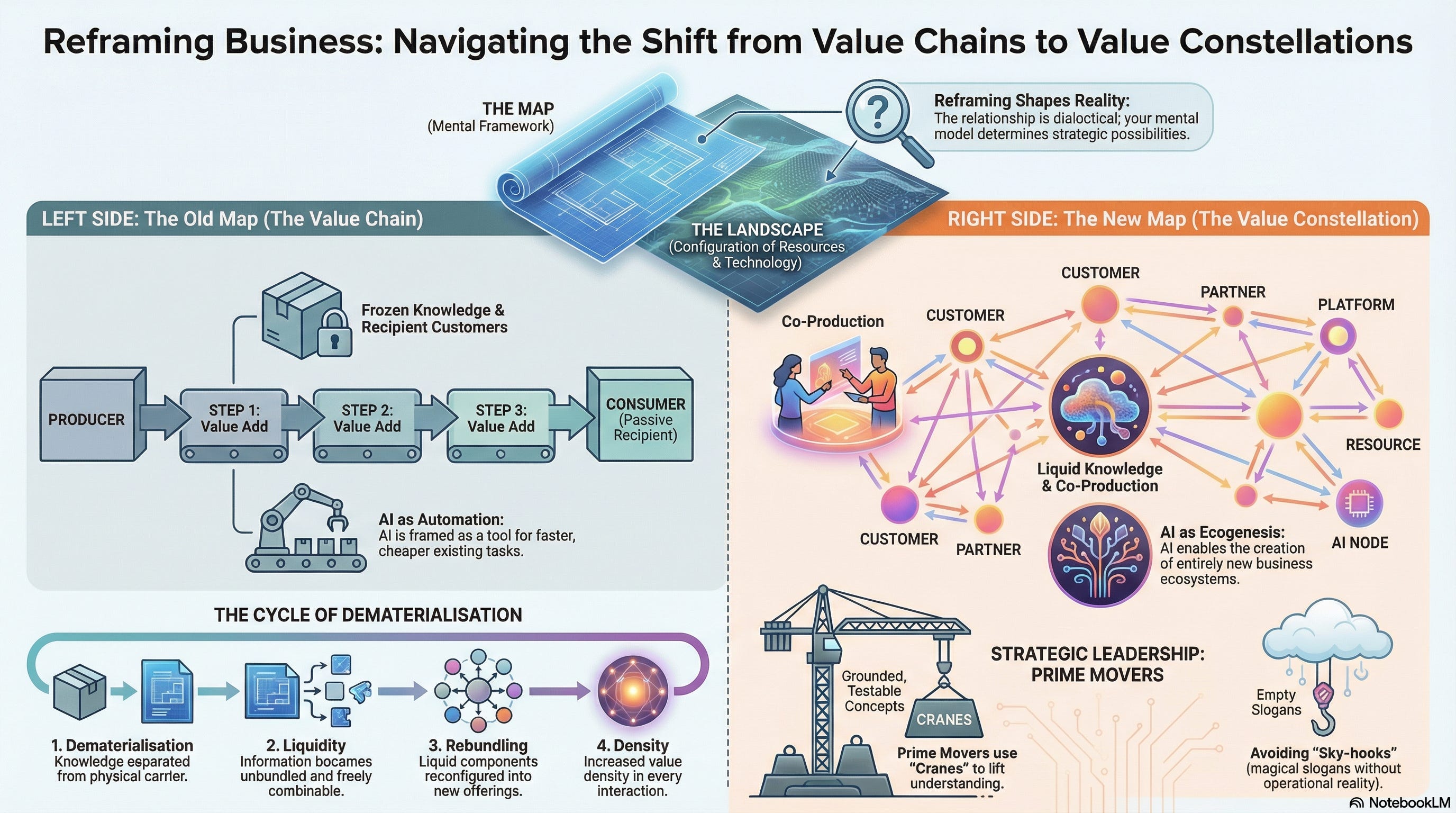
Richard Normann spent his career arguing that the traditional strategy model, the value chain, the competitive position, the sequential logic of production and delivery, is not merely incomplete. It is a mental prison. Not because it was ever wrong, but because the world it described has been replaced by one that operates on entirely different principles. And the greatest danger is not that your strategy is failing. It is that your mental model of what strategy means is preventing you from seeing what is actually happening around you.
Normann’s work integrates theory and practice in a way that places him squarely in the tradition this series has been building. His central argument is that the map, the conceptual framework through which leaders interpret their situation, is itself the strategic variable. Not the position on the map. Not the execution of the plan derived from the map. The map. And when the map no longer describes the landscape, every optimisation within it produces the wrong kind of excellence: brilliant execution of the wrong strategy, arrived at with great efficiency.
1. The Map and the Landscape
Normann’s central metaphor is the relationship between the map and the landscape. The landscape is the actual logic of value creation: the real configuration of actors, resources, relationships, and technologies. The map is the conceptual framework in the leader’s head: the mental model used to interpret the landscape, decide what matters, and determine what is possible.
The relationship is dialectical. Your map is shaped by the landscape you inhabit. But the landscape is also shaped by the maps the actors within it carry. When IKEA reimagined furniture retail, it did not optimise the existing value chain. It reframed the relationship between manufacturer, retailer, and customer, turning the customer into a co-producer. The new landscape could not have been seen from within the old map.

Bateson’s epistemology grounds this. The map is a description, and Bateson’s framework explains when descriptions become pathological: when the map is confused with the territory, when a description at one logical level is treated as though it operates at another. The organisation that treats its AI strategy document as though it were the reality of AI adoption, rather than a description of a reality that may or may not exist, is confusing logical types. The map feels like the territory because WYSIATI, as Kahneman describes, ensures that the coherent story the map tells suppresses awareness of what the map leaves out.
The proximity probe in this series follows directly. The further a leader is from the work, the more they rely on the map, and the less they notice when the map is wrong. The leader who sits with a team attempting to use AI on a real problem will have a less coherent map and a more accurate one. Proximity is the antidote to map-territory confusion, because proximity introduces the messy, contradictory details that prevent the map from feeling complete.

Argyris diagnosed the mechanism that prevents reframing. Defensive routines, the skilled incompetence by which professionals protect their existing theories-in-use, are the cognitive habits that keep the old map in place. Bourdieu deepens this: the map is not just in the head. It is in the habitus. The leader whose career was built on the value chain model does not merely think in value chain terms. Their professional dispositions generate value chain responses automatically. The map is embodied, and embodied maps do not yield to better arguments. They yield to sustained practice under new conditions.
2. From Value Chain to Value Constellation
In 1993, Normann and Rafael Ramírez directly challenged Porter’s value chain. Porter’s model assumes a linear sequence: raw materials flow in one end, finished products come out the other, each step adding value. Normann argued this describes a world that was already disappearing. In its place was the value constellation: a network of actors who co-create value through complex, reciprocal relationships rather than sequential handoffs.
The value chain assumes value is created by producers and consumed by customers. The value constellation assumes customers are co-producers. IKEA does not deliver furniture. It provides a configuration of design tools, flat-pack components, and assembly instructions that enables customers to create their own living environment. The value is not in the product. It is in the reconfigured relationship between IKEA’s capability and the customer’s participation.
For AI transformation, this is not a metaphor. It is a literal description. Consider specification-driven development: the domain expert specifies, AI generates, the team validates, the customer provides the knowledge that makes the specification meaningful. This is not a chain. It is a constellation of human and machine actors co-producing value through reciprocal interaction. The organisation that manages this as a sequential handoff (requirements → development → testing → acceptance) is imposing the old map on a landscape that has already reconfigured.

Drucker anticipated this: his insistence that the purpose of a business is to create a customer, and that marketing is “the whole business seen from the customer’s point of view,” prefigures the value constellation. But where Drucker still assumed the firm as the primary agent, Normann dissolves the boundary between firm and customer entirely.
3. Frozen Knowledge and Dematerialisation
Normann introduced a concept that anticipates the AI era with uncanny precision: offerings are frozen knowledge. A product is not a physical thing. It is knowledge about materials, processes, and customer needs encoded into a particular form. A software application is frozen knowledge about a domain, a workflow, and a set of user needs.
The strategic chain runs: dematerialisation (knowledge separated from its carrier) → unbundleability (components freed from their integration) → liquidity (components freely combinable) → rebundleability (new configurations) → increased density (more value per interaction).
This is precisely what AI does to knowledge work. The knowledge frozen into a software application is being dematerialised. A specification unbundles that knowledge from its code implementation. The specification becomes liquid, combinable with different AI models, different validation frameworks, different deployment targets. And the rebundled result is denser: more value created per unit of human attention.

Mintzberg’s craft metaphor connects. The specification returns to the craftsperson for validation. The loop closes. The potter’s hand still touches the clay, even if the wheel now turns faster. But Normann warned that dematerialisation creates a trap for organisations whose identity is bound to the physical form. When Giddens’s structures, the routines and roles that reproduce the organisation daily, are built around the frozen form rather than the underlying knowledge, dematerialisation threatens the entire identity structure. The development team whose identity is “we write code” experiences specification-driven development as existential threat. The code was never the value. The knowledge was. But identity was attached to the code. Bourdieu would say: the habitus was formed around the frozen form, and the habitus will defend the form even after the knowledge has been liquefied and rebundled elsewhere.
4. Cranes, Not Sky-hooks
Normann borrowed Daniel Dennett’s distinction between cranes (legitimate conceptual tools grounded in evidence) and sky-hooks (magical explanations that provide the feeling of leverage without the substance). The reframing Normann describes requires cranes. A new map is useful if it reveals patterns the old map concealed and generates actions that produce results the old map could not have predicted.
The AI transformation landscape is littered with sky-hooks. “AI will transform everything” is a sky-hook. “We need an AI strategy” is a sky-hook. “We will become an AI-first organisation” is a sky-hook. These provide the feeling of conceptual change without the substance. A crane would be: “The knowledge currently frozen in our codebase can be dematerialised into specifications, making it liquid enough to be recombined with AI generation capabilities for new customer experiences.” That is testable. It can be validated or falsified through action. It is a crane.

Dweck’s growth mindset is the individual precondition: reframing requires treating your conceptual framework as a tool that can be improved, not a fixed property of your intelligence. The fixed mindset clings to the existing map because the map is the competence. Admitting the map is wrong feels like admitting you are incompetent. Seligman’s learned helplessness warns that in organisations with a history of failed conceptual transformations, another reframe, however brilliant, will be received as just another sky-hook. The emotional precondition for reframing is not intelligence. It is trust: the belief, grounded in recent experience, that new thinking leads to new results.
5. Normann and His Limits
Normann must be read with his limitations visible. His work is extraordinarily cerebral: a strength for the quality of the conceptual framework, a weakness for its applicability to the messy, emotional, political reality of organisations. He understood that reframing requires grounding in authentic human experience, but his framework provides more guidance on how to think than on how to lead through the anxiety that thinking differently produces.

Stacey would argue that Normann overestimates the power of conceptual leadership. A brilliant reframe is still a gesture within a web of interaction, and its fate depends on the responses it provokes, not on its elegance. Argyris’s defensive routines do not yield to better concepts. They yield to the slow work of making the undiscussable discussable. Peters provides what Normann lacks: the emotional energy that makes people care enough to act on the diagnosis. The synthesis remains what Peters called disciplined liberation: Normann’s conceptual elegance combined with Stacey’s respect for emergence, Argyris’s diagnostic rigour, Peters’s energy, and Weick’s insistence that action must precede understanding. The reframe must be grounded, but the ground is found through movement, not through analysis.
Where this falls: Learning, the first of four phases, followed by Deciding, Building and Transforming. Reframing is a Learning move in the exact sense the series means it, because it changes what an organisation is able to see before it changes anything it does. What comes out of it is a better map and nothing more, and the map is only worth having if the next phase designs against it. From Learning to Clarity is that next step.
(An Organisational Prompt is something you can do now....)
Organisational Prompt
Draw your current AI development value chain on a whiteboard. Put your organisation at the centre. Draw arrows showing the sequential flow: business requirements → development → AI tools → testing → deployment → customer. Now erase the arrows. Replace them with bidirectional lines. Add the actors you left out: the domain experts whose tacit knowledge shapes the specification, the customers whose feedback reshapes the offering, the AI systems whose capabilities constrain and expand what is possible.
Ask: “What does this constellation reveal that the chain concealed?” The gap between the chain you drew first and the constellation you drew second is the gap between your current map and the landscape you actually inhabit.
Further Reading
Richard Normann, Reframing Business: When the Map Changes the Landscape (2001). His final and most ambitious work. The map-landscape dialectic, the dematerialisation chain, and the concept of Prime Movership. The foreword by Mintzberg is itself worth the price.
Richard Normann and Rafael Ramírez, Designing Interactive Strategy: From Value Chain to Value Constellation (1994). The full development of the value constellation concept.
Richard Normann, Service Management: Strategy and Leadership in Service Business (3rd edition, 2000). The foundational insight that services are co-produced and the customer is always a participant in value creation, even more relevant when the “service” is an AI system that depends on human specification.
I write about the industry and its approach in general. None of the opinions or examples in my articles necessarily relate to present or past employers. I draw on conversations with many practitioners and all views are my own.