
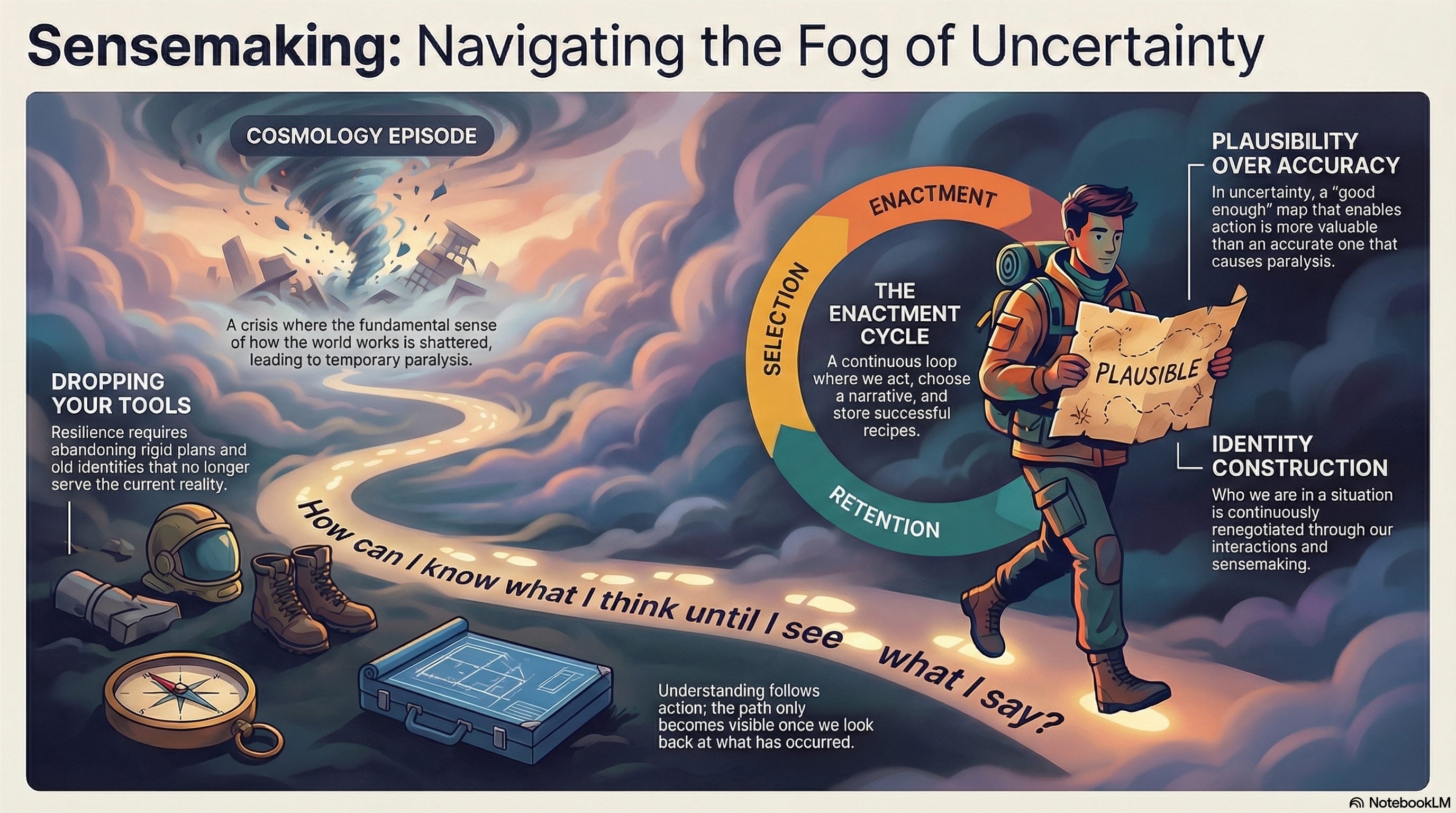
Your organisation has a learning strategy. It has post-implementation reviews, lessons-learned repositories, communities of practice, and maybe a knowledge management platform. It believes, fundamentally, that learning is something that should happen before you act, so you can act better. Karl Weick spent his career demonstrating that this is backwards.
We do not think and then act. We act, and then we make sense of what we did. Learning is not the precursor to action. It is the retrospective interpretation of action that has already occurred. The organisation that waits until it has “learned enough” before acting on AI will never act at all, because the learning it needs can only come from action it has not yet taken. Weick’s body of work spans sensemaking theory, enactment, high reliability, and a philosophically rich account of how meaning is constructed in organisations. This article focuses on the core insights most directly relevant to anyone leading organisational change, and on a single image from his work that captures what transformation actually demands: the willingness to drop your tools.
1. The Great Reversal: Action Precedes Understanding
Traditional management logic assumes a linear sequence: analysis, then strategy, then execution. Gather the data, formulate the plan, implement the solution. Weick argues this is a fallacy. In complex environments, you cannot analyse your way to the truth because the truth is emerging from your actions.
“How can I know what I think until I see what I say?” This is not a clever paradox. It is a description of how cognition works in practice. You discover what you believe by observing what you do, and what you do changes the situation you are trying to understand. Thought and action are not sequential phases. They are interrelated and mutually constitutive.

This is the cognitive mechanism behind Snowden’s Probe-Sense-Respond. You must act (probe) to generate the reality that you can then interpret (sense). Stacey explains what happens next: the meaning of a strategic gesture is only discovered retrospectively, based on the responses it elicits. You do not know what your AI strategy means until you see how the organisation responds to it. Bateson provides the epistemological foundation: information is “a difference which makes a difference,” and differences can only be perceived through interaction with the environment. Until you act, there are no differences to perceive, and therefore no information to process. The twelve-month readiness assessment is not generating information. It is generating data in the absence of the action that would give that data meaning.
For transformation leaders, the consequence is immediate. The organisation that commissions a twelve-month AI readiness assessment before taking any action is not being prudent. It is performing the appearance of learning while systematically preventing the only kind of learning that matters: the learning that comes from doing something and paying close attention to what happens.
2. Enactment: You Create the Environment You Complain About
Most organisations treat their environment, the market, the competitive landscape, the regulatory context, the “culture,” as an external reality they must analyse and adapt to. Weick argues that this is a fundamental misunderstanding. We enact our environments. We create the constraints we face through our own actions, attention, and language.
Consider the organisation that approaches AI adoption through extensive governance. It creates an AI approval board, a risk assessment framework, a mandatory review process for every use case. These structures were designed to manage risk, but they enact a particular environment: one in which AI is dangerous, experimentation is suspect, and the default answer is “not yet.” The leadership team then surveys the organisation and finds that people are cautious, resistant, and slow to adopt. They conclude that the culture is the problem. Weick would say: you created that culture. The governance apparatus enacted the very resistance it was supposed to overcome.

This directly extends Argyris’s analysis of defensive routines. If a leadership team acts with secrecy and defensiveness, what Argyris calls Model I behaviour, they enact an environment of mistrust. Giddens describes the mechanism: the duality of structure, where a governance framework both constrains and enables action, and the people who created it are simultaneously constrained by the structures they produced. The implication for transformation is direct: stop treating “culture” as an external obstacle to be overcome. You are co-creating that culture in every meeting, every policy decision, every communication. If you want to change the environment, you must change your own gestures, because, as Stacey would remind us, those gestures are all you have.
3. Retrospective Coherence: The Trap of the Clean Narrative
Weick warned that life is understood backwards but lived forwards. When we look at a successful transformation, we strip away the confusion, the luck, the wrong turns, and the failed experiments to create a clean, linear narrative. First we did A, which led to B, which enabled C. The story is compelling. It is also largely fictional.
This is the mechanism by which “best practice” becomes dangerous. What looks like a brilliant strategy in hindsight was likely a series of messy probes and sensemaking moments in real time. The people involved did not know it would work. They were acting under uncertainty, interpreting ambiguous signals, and adjusting as they went. Kahneman’s WYSIATI explains why we are so vulnerable to these narratives: the mind constructs the best possible story from whatever information is available, and the coherence of the story feels like evidence that the story is true. Snowden calls the same phenomenon retrospective coherence and warns against importing it as methodology: the rituals of another organisation’s success can be reproduced, but the context that made them work cannot.

Your “lessons learned” are contaminated by outcome knowledge: knowing how it all turned out. The post-implementation review that identifies “what went right” is constructing a retrospectively coherent narrative, not recovering the actual process of discovery. Be deeply suspicious of AI transformation case studies. The vendor who presents a seamless adoption journey is selling you a retrospective narrative, not a methodology you can replicate.
4. Dropping Your Tools: When Identity Prevents Escape
In his famous analysis of the 1949 Mann Gulch fire disaster, Weick noted that firefighters died because they refused to drop their heavy tools to run faster from an advancing blaze. Why? Because without their tools, they were no longer firefighters. Their identity was bound to their equipment. To drop the tools was to lose not just weight but self.
The case does double duty. It is an information collapse: the firefighters could not make sense of what was happening because the situation had moved beyond the frame their training had prepared them for. And it is an identity collapse: their roles dissolved, the social structure that held them together as a team disintegrated, and they could not interpret the foreman’s escape fire because the role structure that made interpretation possible had been destroyed. When the frame breaks, sensemaking breaks with it, and people fall back on the only thing they have left: their tools, their training, the familiar actions that tell them who they are, even when those actions are killing them.
Under transformation, organisations cling to their own heavy tools: legacy reports, obsolete metrics, governance rituals, architectural review boards. Everyone knows they are obstacles. Nobody stops them. Because stopping them would require someone to say: “This thing I have spent my career perfecting is no longer necessary.” And that is an identity loss, not a process change. Bourdieu would recognise this as the habitus defending its accumulated capital. The tools are not just objects; they are extensions of the professional dispositions formed through years of practice. The weekly status report, the stage-gate process designed for a world where code was written by hand, the architecture review that adds three weeks to every initiative: these are the embodied routines through which the professional knows themselves as competent. Dropping them does not feel like efficiency. It feels like annihilation.

Stacey’s insight connects here directly: the question people are actually asking is not “Is this new approach better?” but “Am I still competent?” and “Do I still belong here?” Heifetz names what the leader must do: identify and name the losses. Not minimise them. Not pretend the future will be costless. But name what is being given up, honour its value, and create the conditions in which people can discover that competence in the new mode is possible.
5. Small Wins: Proximity and Plausible Progress
Weick proposed the concept of small wins as a strategy for tackling problems that feel overwhelming. Instead of framing the challenge as a massive transformation programme, recast it as a series of achievable experiments. Each small win is concrete, visible, and within reach. Each one changes the conditions for the next.
The concept is grounded in sensemaking theory. People cannot make sense of abstractions. They make sense of events: specific, tangible things that happened. A forty-page AI strategy document does not create sensemaking. It creates anxiety. But a team that used an AI agent to generate a working prototype in an afternoon is an event. People can see it, talk about it, argue about it, and learn from it. It changes what feels possible.
Small wins also address the proximity probe that runs through this series. Sensemaking requires closeness to the work because abstract information has lost the cues that make interpretation possible. The leader who reads a dashboard about AI adoption rates is processing data that has been stripped of context. The leader who sits with a team and watches them use AI on a real problem is close enough to the work for sensemaking to operate. They can see the hesitations, the workarounds, the moments of surprise, the signals that no metric captures. Proximity is not a management technique. It is a precondition for sensemaking.

Seligman’s research on learned helplessness reinforces why small wins matter. When people repeatedly experience a lack of control, when transformation programmes are imposed, when their input is ignored, when they see no connection between their effort and any outcome, they stop trying. Small wins restore the connection between effort and outcome. They are the antidote to the learned helplessness that accumulates from years of failed change initiatives.
6. High Reliability: A Preoccupation with Failure
Weick’s study of High Reliability Organisations, aircraft carriers, nuclear plants, wildfire crews, revealed that they do not succeed because they have better plans. They succeed because they have a preoccupation with failure. They treat every small anomaly, every weak signal, as a potential symptom of a systemic issue. They do not explain away near-misses. They investigate them.
Weick identified five principles of mindful organising: preoccupation with failure, reluctance to simplify interpretations, sensitivity to operations, commitment to resilience, and deference to expertise. All are relevant to transformation, but deference to expertise is key. In HROs, when a crisis occurs, decision authority migrates to the person with the most relevant expertise, regardless of rank. The admiral defers to the petty officer who understands the specific system that is failing. Hierarchy is maintained in routine operations but relaxed when expertise matters more than authority.

This is the operational expression of what Westrum calls a generative culture: one where information flows to where it is needed, weak signals are amplified rather than suppressed, and anyone who notices something wrong is empowered to raise it. Dekker’s just culture provides the safety mechanism: the response to the anomaly determines whether the organisation learns or merely reacts. When a team discovers that their AI-generated code contains an error, what happens? In a pathological culture, the error is used as evidence that AI is dangerous and should be restricted. In a bureaucratic culture, it triggers a new governance requirement. In a generative culture, it triggers curiosity: “What does this tell us about our specifications? What did we fail to make explicit? How do we improve the feedback loop?” The response to the anomaly reveals the culture. And the culture determines whether the organisation can learn from what its own actions have produced.
Where this falls in the series: Learning, the first of four phases, followed by Deciding, Building and Transforming. Weick states that claim in its sharpest form, that perception runs backwards, so an organisation learns by acting and then reading what happened. What an organisation gets out of Learning is a capacity to notice, and noticing is not yet a decision. From Learning to Clarity is the route into Deciding, which begins by turning what was noticed into a description that can be designed against.
(An Organisational Prompt is something you can do now....)
Organisational Prompt
Identify one AI use case in your organisation where the team is waiting for “more information” before proceeding. Write a one-paragraph story, not a business case, not a specification, just a story, of what success might look like in three months. Make it plausible, not precise.
Then ask two questions: “What is the smallest thing we could do this week to test whether this story is heading in the right direction?” and “What signal would tell us the story needs to change?” The point is not to get the story right. The point is to get the team acting, because action is the only thing that generates the sensemaking data you need. A plausible story that produces movement is worth more than an accurate analysis that produces paralysis.
Further Reading
Karl Weick, Sensemaking in Organizations (1995). The foundational text on how organisations construct meaning. Dense but essential. Every page rewards careful reading.
Karl Weick, The Social Psychology of Organizing (2nd edition, 1979). Where the enactment theory is developed most fully. Weick’s argument that organising is a verb, not a noun, starts here.
Karl Weick and Kathleen Sutcliffe, Managing the Unexpected (3rd edition, 2015). The practical application of high reliability principles to everyday organisations. The most accessible entry point to Weick’s work.
Karl Weick, The Collapse of Sensemaking in Organizations: The Mann Gulch Disaster (Administrative Science Quarterly, 1993). The essay on dropping your tools. One of the most cited papers in organisational studies, and one of the most readable. Freely accessible.
I write about the industry and its approach in general. None of the opinions or examples in my articles necessarily relate to present or past employers. I draw on conversations with many practitioners and all views are my own.