
Every enterprise that has attempted more than one transformation programme carries invisible scar tissue. It is not in the strategy documents or the retrospectives. It is in the people: in what they have learned, through repeated experience, about the relationship between their effort and any outcome that matters.
Martin Seligman spent decades studying what happens when people learn that their actions have no effect. Edward Deci and Richard Ryan, working in parallel, spent equally long studying what happens when people’s fundamental psychological needs are met, or crushed. Read separately, each is illuminating. Read together, they provide a diagnosis of why transformation programmes generate compliance instead of commitment, and why that difference determines everything. The scar tissue is real. Understanding how it formed is the first step toward creating the conditions in which it can heal.
1. Learned Helplessness: When Not Trying Is the Smart Move
Seligman’s foundational insight emerged from experiments in which subjects exposed to inescapable adversity learned to stop attempting escape, even when conditions changed and escape became possible. The mechanism was not emotional but cognitive: the subjects had learned a mental model. My actions do not affect outcomes. Once this model was established, it generalised. Helplessness learned in one context bled into unrelated domains.
The transfer to organisational life is sobering. Employees who have repeatedly proposed improvements that were ignored learn to stop proposing. Teams that have survived three “transformational” programmes, each launched with fanfare and quietly abandoned, learn that the safest strategy is to wait for the enthusiasm to pass while appearing to comply. Middle managers who have watched their honest assessments be overruled by executive optimism learn to produce the numbers executives want to see. This is not cynicism. It is learning. And it is precisely the kind of learning that Argyris described as the enemy of organisational adaptation: a single-loop response that protects the individual but prevents the organisation from confronting its own dysfunction.

Bourdieu provides the structural depth. The habitus formed by repeated failed transformations does not merely carry a memory of failure. It generates the expectation that the next transformation will also fail. This expectation is not a conscious belief that could be argued away. It is inscribed in the body: in the posture of polite attentiveness, in the practised phrases of apparent engagement, in the automatic withholding of genuine effort. The person is not choosing to be disengaged. Their habitus is producing the only response that years of experience have taught it is safe.
Bateson illuminates the depth of the problem. Learned helplessness is a pathological form of Learning II. The person has not just learned that this particular initiative will fail (Learning I). They have “learned to learn” that effort in transformation contexts is futile (Learning II). The frame through which they interpret all transformation activity has shifted. Reversing this requires a Learning II intervention: changing the frame itself. Providing new information within the existing frame (”this time it is different,” “leadership is committed,” “we have a new methodology”) is a Learning I response to a Learning II problem. It will fail, and its failure will deepen the helplessness it was designed to address.
2. Explanatory Style: The Story People Tell Themselves
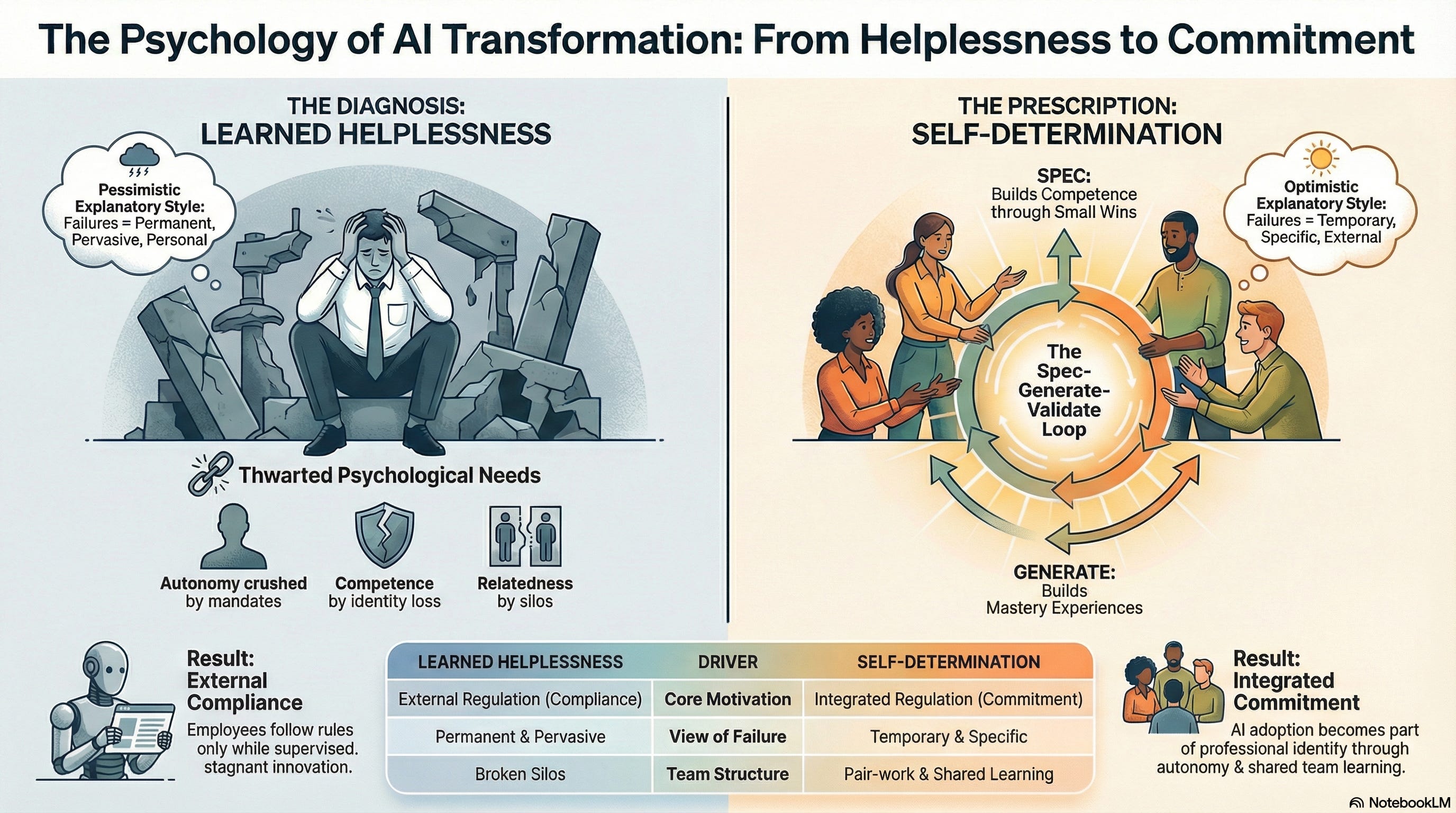
Seligman’s later work moved from helplessness to resilience. The bridge between them is explanatory style: the habitual way people explain bad events to themselves. It operates along three dimensions. Permanence: “This will never change” versus “This is a setback.” Pervasiveness: “Everything is broken” versus “This particular thing went wrong.” Personalisation: “It is my fault” versus “The circumstances were against us.” A pessimistic explanatory style, permanent, pervasive, personal, sustains helplessness. An optimistic style, temporary, specific, situational, predicts recovery.

Dweck’s mindset research connects directly. The fixed mindset provides the belief system; the pessimistic explanatory style provides the narrative engine that reinforces it after every setback. A failed pilot is not “an experiment that revealed something about our requirements” (temporary, specific, external). It is “proof that we are not capable of this” (permanent, pervasive, personal).
Weick’s sensemaking theory illuminates why explanatory style matters so much. Sensemaking is retrospective: people look back at what happened and construct a plausible narrative. The explanatory style is the filter through which that narrative is constructed. Two teams can have the same experience and construct entirely different meanings from it. One says: “Our specification was ambiguous in section three; we need to tighten the constraints.” The other says: “AI-generated code cannot be trusted; we need more governance.” Same event. Different sensemaking. Different future.
Dekker’s substitution test operationalises the shift. It moves attribution from personal to systemic, from permanent character flaw to temporary situational constraint. It does not remove accountability. It redirects accountability from individual blame to systemic learning. Seligman would recognise this as the organisational equivalent of cognitive restructuring: changing the explanatory habit that sustains helplessness.
3. The Three Needs That Transformation Programmes Destroy
Deci and Ryan’s Self-Determination Theory identifies three innate psychological needs whose satisfaction produces intrinsic motivation and whose frustration produces disengagement, regardless of external incentives. Autonomy is the need to feel that one’s actions are self-directed and freely chosen. Competence is the need to feel effective: challenge at the right level, not so easy that it bores, not so hard that it overwhelms. Relatedness is the need to feel connected to others through mutual respect and shared purpose.
The synthesis with Seligman is this: learned helplessness is what happens when all three needs are thwarted simultaneously over time. When your actions have no effect (autonomy destroyed), when your existing skills become irrelevant and no support is provided for new ones (competence threatened), and when the team structures you relied on are disrupted without replacement (relatedness severed), the rational response is disengagement.
Transformation as typically implemented thwarts all three with remarkable efficiency. Autonomy is destroyed when governance frameworks dictate precisely how AI may be used, when tool selection is centralised, and when experimentation requires approval through layers of management. Peters would recognise this: the bureaucratic reflex to control the new technology before anyone has understood it. Competence is threatened in two directions simultaneously: existing competence is devalued (the developer whose mastery was in code is told their future is in specifications), while the new competence is not yet available. Giddens would call this a disruption of ontological security: the stable sense of self that comes from routines that confirm who you are. In a fixed mindset culture, this temporary incompetence is experienced as permanent inadequacy. Relatedness is disrupted when team structures change, when new roles create unfamiliar reporting lines, and when the transformation creates a perceived in-group of enthusiasts and an out-group of everyone else. Stacey would say the pattern of interaction that constituted the team’s identity has been broken, and no new pattern has yet formed.
4. Reversing Helplessness: Small Wins and Mastery Experience
The prescription follows from the diagnosis: reverse the helplessness by creating conditions that satisfy the three basic needs.
Restore autonomy by offering genuine choice. Not the false choice of “adopt the mandated tool or explain why not,” but real choice about which problems to tackle, which approaches to try, and how to evaluate results. Mintzberg’s emergent strategy provides the framework: instead of designing the AI adoption plan and instructing teams to execute it, create conditions for teams to experiment and detect the patterns that emerge.
Rebuild competence through mastery experience. The most powerful source of self-efficacy is actually doing the thing and succeeding. Not being told you can do it. Not watching a vendor demonstration. Doing it yourself. Seligman’s research on helplessness reversal shows that even a small number of experiences where effort produces results can reverse helplessness, but the experiences must be authentic, not manufactured.

This is why Weick’s small wins are not merely a tactical recommendation but a motivational necessity. Each small win is simultaneously a sensemaking event (Weick), a competence-satisfying moment (Deci and Ryan), and an evidence point against the helplessness narrative (Seligman). A team that writes a specification and watches AI generate working code from it has experienced something no strategy document can provide: the felt connection between their effort and an outcome. That felt connection is the antidote to helplessness. Csikszentmihalyi’s flow conditions describe when this connection becomes self-sustaining: clear goals, immediate feedback, and progressive challenge matched to growing skill.
Protect relatedness by making AI adoption a team practice, not an individual mandate. Pair specification writing. Team-based validation. Shared reflection on what worked and what did not. The goal is not merely knowledge sharing. It is the maintenance of the social bonds that sustain motivation when competence is temporarily disrupted and autonomy is under pressure.
5. When Incentives Backfire
Deci and Ryan’s research contains a finding that most transformation leaders find counterintuitive: extrinsic rewards can undermine intrinsic motivation. This is the overjustification effect. When you pay someone to do what they previously did for interest, they reframe the activity as work. Remove the reward and the activity stops. The reward has become the reason.
Offering bonuses for “AI adoption targets” reframes engagement with AI from “an interesting new capability worth exploring” to “something management wants me to do for which I will be compensated.” The extrinsic reward displaces whatever intrinsic interest might have existed. Peters intuited this decades before the experimental evidence was clear: his insistence that excellence requires passion, that procedure kills intrinsic motivation, is the managerial expression of what Deci and Ryan demonstrated in the laboratory. Bureaucracy does not merely slow organisations down. It systematically converts intrinsic motivation into external regulation, and in doing so, destroys the only form of motivation that produces genuine learning.
The alternative is what Deci and Ryan call autonomy-supportive leadership: explaining the rationale for the change rather than mandating it, acknowledging that the transition is difficult, providing choice within structure, and offering informational feedback rather than controlling evaluation. This is not soft management. It is the only approach that produces the internalised commitment that transformation requires. Between pure extrinsic motivation (”I will use AI because my manager told me to”) and pure intrinsic motivation (”I use AI because it is inherently satisfying”) lie intermediate stages where the person has genuinely endorsed the goal even if the activity is not always enjoyable. Reaching those stages requires autonomy, competence, and relatedness. There is no shortcut.
This sits in Learning, the first of the four phases; Learning, Deciding, Building, Transforming. The Learning articles ask whether an organisation can perceive its own situation, and learned helplessness is the condition in which people stop reporting what they see because reporting has never changed anything. What an organisation gets out of that work is the willingness to try again, which is a precondition rather than a result. In Deciding the question becomes what can be designed under constraint; the route is From Learning to Clarity.
(An Organisational Prompt is something you can do now....)
Organisational Prompt
Ask a team you want to engage with AI a single question: “If you could use AI to solve one problem that actually matters to you, not the organisation, what would it be?”
This is Deci and Ryan’s intervention in one sentence. You are restoring autonomy (their choice of problem), targeting competence (a problem they understand deeply enough to specify well), and building relatedness (you are listening, which is itself a relational act). The answer they give will tell you where the intrinsic motivation lives. The difference between their answer and what your transformation programme has asked them to do is the measure of how far your programme has drifted from the conditions that produce genuine engagement.
Further Reading
Martin Seligman, Learned Optimism: How to Change Your Mind and Your Life (revised edition, 2006). The accessible version of the helplessness and explanatory style research. The diagnostic framework for why people have stopped trying is the most useful tool for leaders.
Edward Deci and Richard Ryan, Self-Determination Theory: Basic Psychological Needs in Motivation, Development, and Wellness (2017). The comprehensive academic statement. Dense but essential for understanding why autonomy, competence, and relatedness are non-negotiable.
Albert Bandura, Self-Efficacy: The Exercise of Control (1997). The bridge between Seligman’s helplessness reversal and Deci and Ryan’s competence need. Mastery experience is the most powerful source of belief in one’s own capabilities.
Daniel Pink, Drive: The Surprising Truth About What Motivates Us (2009). The popular synthesis of SDT applied to the workplace. Useful as an introduction, but read the original research for the nuance that Pink necessarily compresses.
I write about the industry and its approach in general. None of the opinions or examples in my articles necessarily relate to present or past employers. I draw on conversations with many practitioners and all views are my own.
Point 7 is more salient, as AI or process reengineering is generally implemented with an implicit cost-cutting mandate rather than a productivity mandate. It needs to be clear to staff that implementation is not about replacement, but about enabling the completion of the large backlog of demand.