
A senior consulting leader described a pattern she had seen in three different enterprises. Each had adopted AI coding tools. Each had seen productivity gains within weeks: faster delivery, fewer routine tasks, measurable throughput improvement. Each had presented the results to the steerco as evidence of successful AI transformation. And in each case, she said, the teams were using AI to accelerate exactly the work they should have been questioning. “They got 40% faster at building the thing that was already the wrong thing to build.”
March would have recognised this instantly. James March, the political scientist and organisational theorist who co-founded modern decision theory with Herbert Simon at Carnegie in the 1950s, spent sixty years studying how organisations learn, decide, and fail. His central finding is that organisations face a tension they can never fully resolve: the tension between exploitation (getting better at what you already do) and exploration (discovering what you should be doing instead). Both are essential. Both compete for the same scarce resources. And the mechanisms of organisational life, the incentives, the measurement systems, the career structures, systematically favour exploitation. AI, March’s framework predicts, will make this asymmetry catastrophically worse.
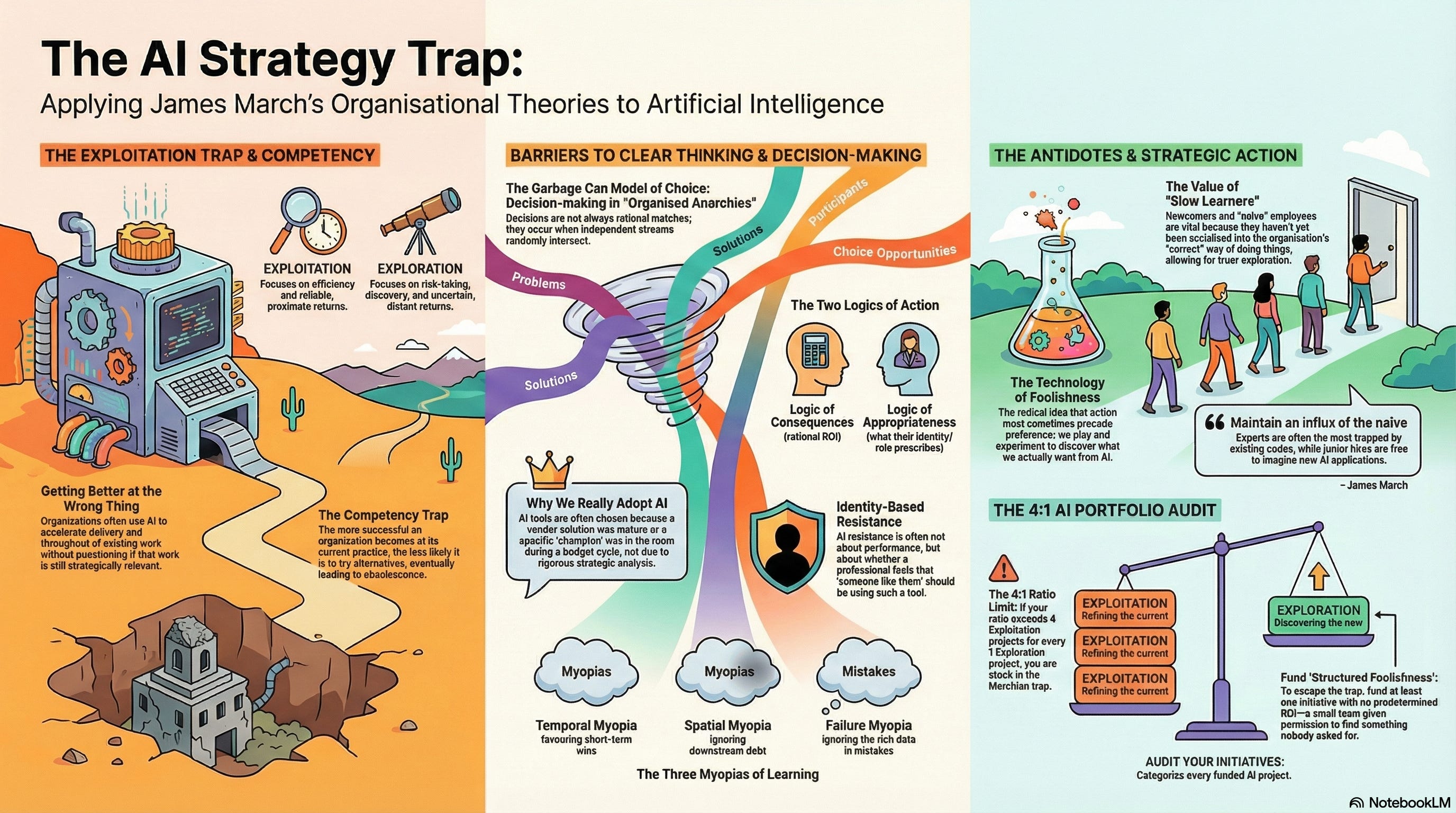
1. The Garbage Can: How Decisions Actually Happen
March’s first major contribution to decision theory, developed with Michael Cohen and Johan Olsen in 1972, was the garbage can model of organisational choice. It describes how decisions happen in what March called “organised anarchies”: organisations characterised by problematic preferences (people do not agree on what they want), unclear technology (people do not fully understand their own processes), and fluid participation (who shows up to which meeting is somewhat random).
In a garbage can, four streams flow through the organisation independently: problems, solutions, participants, and choice opportunities. A meeting is a choice opportunity. The people who happen to attend bring whatever problems and solutions they are currently carrying. Decisions arise not from rational matching of problems to solutions but from the timing of when these streams happen to intersect. Solutions go looking for problems. Problems go looking for solutions. What gets decided depends as much on who happens to be deciding and what is on their mind as on the quality of the analysis.
This is not a cynical observation. It is an empirical one. And it describes AI adoption in most enterprises with uncomfortable accuracy. The team that adopted the AI coding tool did so not because a rigorous analysis determined it was the highest-value use case. It adopted it because the tool was available, a champion happened to be on the team, and the timing coincided with a budget cycle. The enterprise that chose to invest in a customer service chatbot did so not because customer service was the strategic priority. It did so because the vendor’s solution was mature, the customer service head was an early adopter, and the board had asked for visible AI wins. The garbage can is not a failure of rationality. It is how organisations with bounded rationality, contested preferences, and fluid attention actually function.

Mintzberg would recognise this as emergent strategy: the pattern formed by the accumulation of garbage can decisions over time. Lindblom would call it muddling through. March adds what neither provided: a formal model of why rational decision-making in organisations is structurally impossible under common conditions, and why this is not necessarily a problem to be solved but a reality to be navigated.
2. Exploration and Exploitation: The Tension That Never Resolves
March’s most cited work, published in 1991, names the tension at the heart of every AI strategy. Exploration is search, experimentation, play, risk-taking, variation, discovery. Its returns are uncertain, distant, and diffuse. Exploitation is refinement, efficiency, selection, implementation, execution. Its returns are reliable, proximate, and precise.
Organisations must do both. They cannot survive by exploiting alone, because the environment changes and what they are good at becomes obsolete. They cannot survive by exploring alone, because exploration without consolidation produces endless experimentation with no payoff. The problem is that the two compete for the same resources: time, attention, money, and talent. And three forces systematically tilt the balance toward exploitation.
Temporal proximity: exploitation returns come sooner. A team using AI to accelerate its existing delivery pipeline shows results this quarter. A team experimenting with AI to discover entirely new capabilities might show results next year, or never. Spatial proximity: exploitation returns are captured locally, by the team that did the work. Exploration returns may benefit other parts of the organisation, or other organisations entirely.
Precision: exploitation returns are measurable and attributable. You can show the board a graph. Exploration returns are ambiguous and hard to attribute. You cannot put “discovered something unexpected” in a quarterly review.
The consequence: organisations systematically over-exploit and under-explore. They become astonishingly effective in the short run and self-destructive in the long run. March’s phrase for this is the competency trap. The better you get at something, the less likely you are to try alternatives. Success reinforces current practice. Failure is ambiguous and avoided. The organisation converges on a local optimum and mistakes it for the global one.
Christensen described the market-level consequence: incumbents over-exploit existing value networks while disruptors explore new ones. Taleb’s barbell strategy is the structural response: extreme safety (exploitation) combined with small speculative bets (exploration). Boyd’s OODA loop requires periodic destruction of existing orientation (exploration) before rebuilding (exploitation). March provides the organisational learning theory that explains why all of this is so hard: the adaptive mechanisms of organisational life refine exploitation more rapidly than exploration, and reason itself inhibits the foolishness that exploration requires.
3. The Technology of Foolishness: Why You Must Act Before You Know What You Want
In 1971, March published a short essay called “The Technology of Foolishness.” Its argument is deceptively radical. Rational decision-making assumes you know your preferences before you choose your actions. First you decide what you want, then you figure out how to get it. March argued that this assumption is often false, and that the most important preferences are sometimes discovered through action, not prior to it.
Playfulness and experimentation are not failures of rationality. They are essential mechanisms for discovering new possibilities. An organisation that insists on knowing the ROI before it experiments has already foreclosed the discoveries that experimentation would produce. You cannot calculate the return on something you have not yet imagined.
Ackoff’s idealised design is institutionalised foolishness in March’s sense: it deliberately suspends existing preferences to discover new ones. Lindblom’s muddling through is the modest, everyday version. March provides the theoretical justification: sometimes the only way to find out what you want is to do something and see what happens. This does not mean acting randomly. It means creating structured opportunities for play, where the consequences of failure are small and the potential for surprise is high.
For AI adoption, the technology of foolishness is the antidote to the business case-first approach. The organisation that demands a three-year ROI projection before approving an AI experiment will never discover what AI can do for it, because the most valuable applications are precisely the ones nobody can predict in advance. The business case for the iPhone could not have been written in 2004. The business case for AI-augmented professional work cannot be written in 2026. It must be discovered through structured foolishness: cheap experiments, reversible bets, and the organisational tolerance for not knowing the answer before you start.
4. Two Logics: Why People Do What Their Role Prescribes
With Johan Olsen, March distinguished two fundamental logics guiding decision-making. The logic of consequences asks: “What outcome do I want, and how do I achieve it?” This is rational calculation. The logic of appropriateness asks: “Who am I, and what does someone like me do in a situation like this?” This is identity-based reasoning.
Most organisational behaviour follows the logic of appropriateness. Professionals do what their role prescribes, not what calculation optimises. The senior architect reviews code because that is what senior architects do, not because a cost-benefit analysis determined it was the highest-value use of their time. The governance committee requires an impact assessment because governance committees require impact assessments, not because this particular assessment will produce information that changes the decision.

Bourdieu called this habitus: the embodied dispositions that generate practice without conscious calculation. Kegan showed that Order 3 professionals (the socialised mind) operate almost entirely through the logic of appropriateness; the capacity to step back and use the logic of consequences independently requires Order 4 development. Weber showed that bureaucratic rationality is an institutionalised logic of appropriateness: roles, rules, and procedures define correct behaviour regardless of outcomes.
For AI adoption, the logic of appropriateness explains resistance that the logic of consequences cannot. The professional who refuses to use AI is not making a rational calculation that AI produces worse outcomes. They are responding to a deeper question: “Is someone like me, a person with my expertise and standing, the kind of person who uses AI to do their work?” If the answer is no, no amount of evidence about AI’s capability will change the behaviour. The resistance is not irrational. It is operating under a different logic entirely. Until the identity changes, the behaviour will not.
5. The Myopia of Learning: Why Success Teaches the Wrong Lessons
With Daniel Levinthal, March identified three forms of learning myopia that explain why organisations draw the wrong conclusions from their own experience. Temporal myopia: favouring proximate consequences over distant ones. The AI pilot that produced quick wins gets funded; the long-term capability investment that would produce larger but slower returns does not. Spatial myopia: favouring effects felt locally over effects felt elsewhere. The team that benefits from AI adoption reports success; the downstream teams that inherit the technical debt do not. Failure myopia: learning more readily from success than from failure, even though failure contains richer information.
Organisations cope with confusing experience through simplification (reducing complex events to simple stories) and specialisation (assigning different parts of the organisation to learn different things). Both contribute to myopia. The simplified story of the successful AI pilot obscures the conditions that made it successful, conditions that may not exist in the next context. The specialised learning of the AI centre of excellence does not transfer to the teams that must actually use AI in their work.

Senge’s beer game demonstrates spatial myopia: rational local decisions produce systemic irrationality. Dekker showed that organisations learn the wrong lessons from failure because they simplify systemic causes into individual error. March adds the temporal dimension: the lessons that matter most are the ones whose consequences are furthest away, and those are precisely the ones organisations are worst at learning.
6. Slow Learners and the Value of Naïveté
March’s most counterintuitive finding concerns the relationship between individuals and what he called the organisational code: the established beliefs, procedures, and strategies that constitute the organisation’s collective knowledge. In his model, individuals learn from the code (socialisation) and the code learns from individuals (updating). The problem is speed.
If individuals are socialised too quickly, the code converges on a local optimum before sufficient exploration has occurred. The organisation settles on an answer before it has asked enough questions. Fast learners, the people who absorb the organisation’s norms most efficiently, accelerate this convergence. Slow learners, the people who resist socialisation, maintain diversity longer. They keep exploring possibilities that the fast learners have already abandoned.
March’s conclusion is striking: “The development of knowledge may depend on maintaining an influx of the naive and ignorant.” The newcomer who asks “why do we do it this way?” is not a nuisance. They are a source of the variation that the system needs to avoid premature convergence. The experienced professional who has fully absorbed the organisation’s code is, paradoxically, less valuable for exploration than the junior hire who has not yet learned what is supposed to be impossible.
For AI adoption, this inverts the conventional wisdom. The standard approach is to start with the experts: the senior architects, the experienced engineers, the domain specialists. March’s model suggests that the experts are the most trapped by the competency trap. Their deep investment in the existing code makes them the fastest to converge on the existing way of doing things, now with AI bolted on. The junior practitioners, the newcomers, the people who do not yet know the rules, may discover the uses of AI that the experts cannot imagine, precisely because they are not yet socialised into what the organisation already believes.
7. What March Means for Your AI Strategy
March’s work assembles into a single, uncomfortable diagnosis. Your AI strategy is probably a garbage can decision (the timing was right, the champions were available, the board wanted visible action). It is almost certainly biased toward exploitation (making existing processes faster) at the expense of exploration (discovering what AI changes about what you should be doing). It is being evaluated through the logic of appropriateness (is this what organisations like ours do?) rather than the logic of consequences (will this produce the outcome we need?). Your organisation is learning myopically from early successes, drawing conclusions from small samples, favouring proximate results, and ignoring the distant consequences. And your most experienced people, the ones you have put in charge of AI adoption, are the most likely to be caught in the competency trap.
None of this means your AI strategy is wrong. It means it is normal. March’s contribution is not to prescribe a better decision process. It is to describe how decisions actually happen in organisations and to suggest that the gap between how we decide and how we think we decide is itself the thing most worth understanding.
Beer’s POSIWID applies: the purpose of your AI strategy is what it does, not what the strategy document says. If it accelerates exploitation while starving exploration, that is its purpose. If it rewards fast learners who converge on the existing code while marginalising the slow learners who maintain diversity, that is its purpose. The first act of intelligence, March would say, is to see the system as it is, not as the strategy deck describes it.
Where this falls: Deciding, the second of the series' four phases, after Learning and before Building and Transforming. March belongs here because exploration and exploitation is a decision about what a description is allowed to leave open. What comes out of it is a commitment, and March's warning is about committing so cleanly that nothing is left to discover. Why Your Organisation Can't Decide is the synthesis, and From Deciding to Building the bridge.
(An Organisational Prompt is something you can do now....)
Organisational Prompt
Audit your AI portfolio for the exploitation trap.
List every AI initiative your organisation has funded. For each one, ask: does this make us better at what we already do (exploitation), or does it help us discover what we should be doing instead (exploration)? Count the ratio. If it is more than 4:1 in favour of exploitation, you are in the trap March described. You are using AI to converge faster on your current strategy. The antidote is not to stop exploiting; it is to fund at least one initiative whose purpose is structured foolishness: an experiment with no predetermined ROI, a small team given permission to discover something nobody asked for, a bet whose value cannot be calculated in advance because the thing it might find does not yet have a name.
Further Reading
James March: Exploration and Exploitation in Organizational Learning - The most cited paper in organisational learning. The exploration-exploitation tension, the competency trap, and the model of mutual learning between individuals and organisational code. Full text freely available as PDF via NTNU.
Michael Cohen, James March, and Johan Olsen: A Garbage Can Model of Organizational Choice - The formal model of decision-making in organised anarchies. Four streams, no rationality, and a description of organisational decision-making that most practitioners find uncomfortably accurate.
James March: A Primer on Decision Making: How Decisions Happen - The most accessible single volume. Covers bounded rationality, the garbage can, exploration and exploitation, and the technology of foolishness in clear, often witty prose. Start here.
James March: The Technology of Foolishness - The short essay arguing that organisations need structured playfulness to discover preferences they do not yet know they have. The theoretical justification for experimentation before business cases. Freely available.
I write about the industry and its approach in general. None of the opinions or examples in my articles necessarily relate to present or past employers. I draw on conversations with many practitioners and all views are my own.