
Every large enterprise that attempts AI transformation discovers the same thing: the obstacle is not the technology. It is the organisation itself. Not the people, who are frequently talented and motivated, but the structures, procedures, approval chains, governance frameworks, and reporting hierarchies that were designed to produce precisely the qualities that transformation requires organisations to suspend: predictability, consistency, control, and the elimination of individual discretion.
The issue was diagnosed over a century ago by a German sociologist who never saw a computer. Max Weber described the mechanism by which rational organisations become incapable of the very adaptation their survival requires. He called the result the iron cage. It may seem odd to return to so early a thinker after the accumulated insight of this series, but his diagnosis is grounding in a way that more modern frameworks are not. Weber is not describing something that happened in the past. He is describing the thing that is happening to your AI transformation right now: a rational system that has become its own purpose, producing the appearance of progress while the real problems go unaddressed.
1. Why People Follow: The Basis of Authority
Weber began with a question most transformation leaders never ask: why do people in this organisation do what they are told? The answer determines what kinds of change are possible.
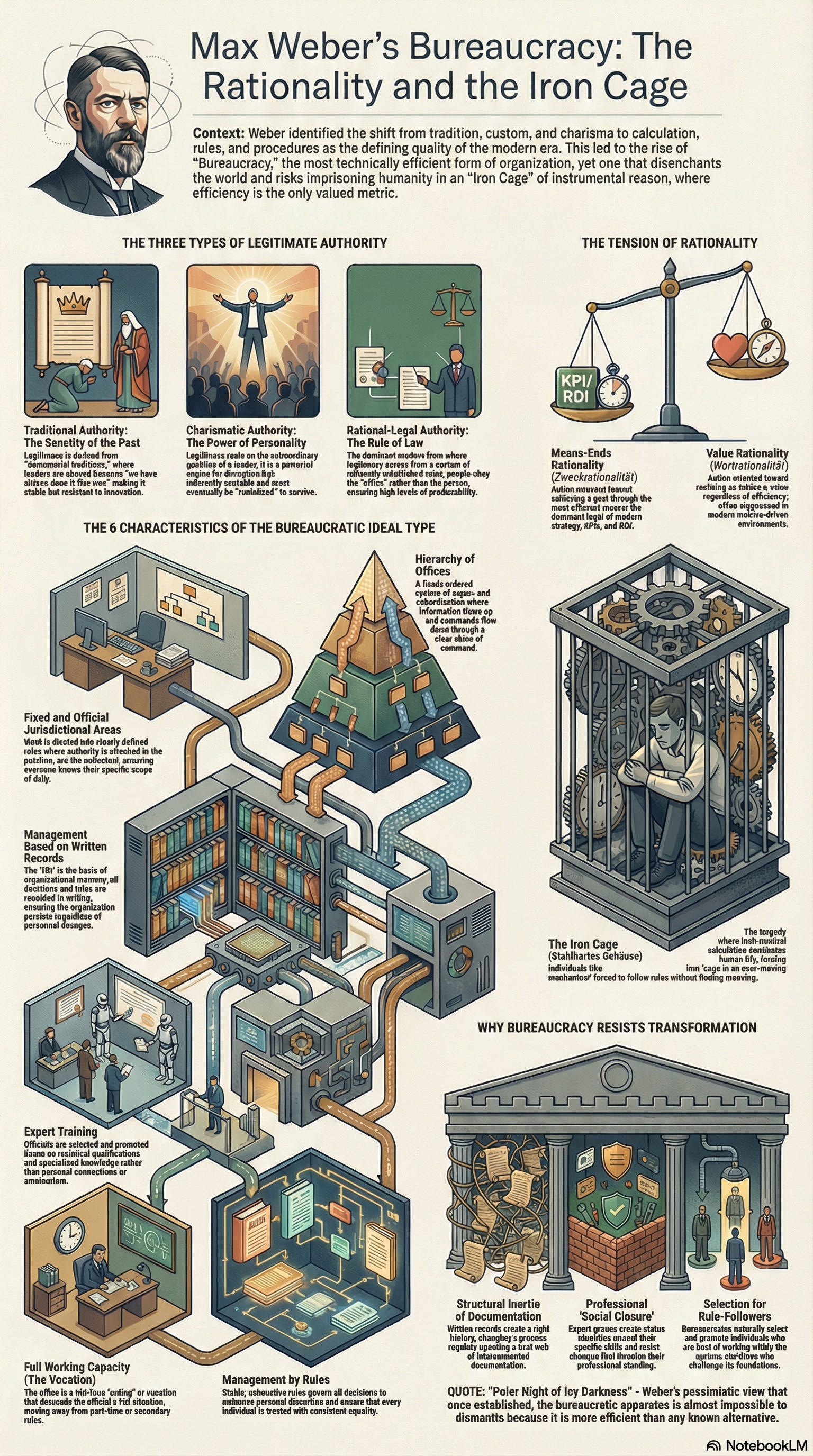
Traditional authority derives from custom: “the way we do things here” offered as sufficient justification. Charismatic authority derives from the extraordinary personal qualities of the leader: people follow because they believe in the individual. Rational-legal authority derives from a system of rules that apply equally to everyone: people follow because the role has legitimate power, regardless of who occupies it.
Rational-legal authority dominates modern organisations, and Weber argued it was historically inevitable because capitalism requires above all one thing: predictability. Every element of the system, approval processes, role definitions, budget cycles, performance metrics, exists to reduce variation and ensure consistency. Transformation requires the opposite: experimentation, tolerance for failure, the suspension of established procedures. You are asking a system designed to eliminate surprise to embrace it.

Heifetz would recognise the dilemma. The existing authority structures are not failing. They are succeeding at something that is no longer sufficient. This is an adaptive challenge: the rational-legal system works perfectly for the problems it was designed to solve. AI transformation is not one of those problems.
2. The Iron Cage: When Rationality Becomes Its Own Prison
Weber described bureaucracy not as a pejorative but as the most technically efficient form of organisation ever devised: precision, speed, continuity, strict subordination, reduction of friction. He summarised it as a machine. These are exactly the qualities that resist transformation, because transformation requires their opposites: imprecision (experimentation), slowness (learning), ambiguity (exploration), and discontinuity (abandoning what no longer works). The bureaucratic machine is not broken. It is doing precisely what it was designed to do. And that is the problem.
The iron cage operates through a specific mechanism. Weber distinguished between means-ends rationality (”given this goal, what is the most efficient way to achieve it?”) and value rationality (”is this the right goal?”). In a fully rationalised organisation, means-ends rationality progressively displaces value rationality. The question “are we achieving our targets efficiently?” crowds out the question “are these the right targets?” The system persists regardless of whether it serves its original purposes.
This is the lived experience of AI governance in most enterprises. The governance framework asks whether AI tools are being adopted according to plan, whether risk assessments are completed, whether usage metrics are on track. It does not ask whether the plan makes sense, whether the risk framework captures actual risks or manufactures procedural compliance, or whether the metrics measure anything that matters. Drucker saw this with characteristic clarity: his concept of systematic abandonment, regularly asking “if we were not already doing this, would we start now?”, is a practical tool for reintroducing value rationality into an organisation that has lost the capacity for it.
The iron cage is what institutional inversion looks like when it is complete. The governance function that was created to serve the organisation’s purposes has become the purpose the organisation serves. The approval process that was designed to manage risk now produces risk, because it prevents the experimentation through which the organisation would learn what actually works. Bateson would classify this as a Learning I lock: the organisation can optimise within the cage (correcting errors within the bureaucratic frame) but cannot question whether the cage itself is the problem (Learning II). The cage is the frame, and the frame is invisible from inside.
3. Status Groups: Why Professionals Defend What Transformation Threatens
Weber’s concept of status groups and social closure explains professional resistance with precision. Status groups derive collective identity from shared expertise, credentials, and practices. Social closure is the process by which they protect their position by restricting access to the resources that define their standing.
Developers derive status from coding skill. Architects derive status from system design knowledge. Managers derive status from controlling development resources. Each group’s identity is bound to their current way of working. When AI threatens to change what is valued, each group engages in closure: protecting the activities and knowledge that sustain their standing.

Bourdieu provides the mechanism beneath Weber’s observation. Each status group is a field with its own forms of capital. In a professional bureaucracy, the professionals’ capital, their embodied skill, their technical judgement, their peer recognition, is the dominant currency. Transformation that devalues this capital without providing a credible path to new capital will be met with rational resistance. The developer who resists specification-driven development is not being stubborn. They are defending the skill that defines their professional identity, and their habitus, formed through years of practice in the old field, generates that defence automatically, below the threshold of conscious choice.
Weick’s Mann Gulch analysis provides the vivid case: the framework within which the new practice would make sense has not yet formed, and the framework it is replacing has already begun to dissolve. The professional cannot adopt the new approach from within the old identity. They need a new identity, and identities are not adopted through training. They are formed through practice, over time, in conditions that support the transition. Heifetz names the leader’s task: acknowledge the loss. The accumulated capital is real. The expertise is genuine. Pretending the transition is costless produces the cynicism Seligman describes.
4. The Routinisation of Charisma: Why Transformative Energy Dissipates
Weber identified only one force capable of disrupting the iron cage: charismatic authority. A transformative leader or event can override established rules through the force of direct experience and conviction. But charisma is inherently unstable. It cannot scale, survive succession, or sustain itself once the initial energy fades. Weber called the inevitable process routinisation: the disruptive energy is channelled back into bureaucratic structures.
The pattern is visible in every AI transformation. The moment when a sceptical executive watches a domain expert’s specification become working software in minutes is a charismatic event. It creates a burst of energy that, for a moment, overrides the cage. But then the energy must be routinised. And the existing structures will absorb the disruption into their own logic. “We need to fundamentally rethink how we build software” becomes “we need an AI governance framework, an AI Centre of Excellence, an AI risk assessment process, and an AI adoption metric on the quarterly scorecard.” The iron cage does not open. It reconfigures.

Giddens provides the mechanism. The bureaucratic structures that need to change are the same structures shaping the behaviour of the people who would need to change them. You cannot step outside the iron cage to redesign it, because the cage is not merely around you. It is in your habits, your assumptions, your reflexive responses to uncertainty. Stacey offers a partial corrective to Weber’s pessimism: complex responsive processes, the unpredictable interactions between people, operate within and despite bureaucratic structures. The cage constrains but does not eliminate creativity, improvisation, and resistance. Change happens, though never in the way the planners intended.
5. Using Weber Diagnostically
Weber’s value for practitioners is not as a prescription but as a diagnostic. He does not tell you what to do. He tells you what you are dealing with.
What type of authority dominates? If traditional authority is strong, transformation requires challenging sacred customs while preserving genuine institutional knowledge. If rational-legal authority dominates, transformation requires creating sanctioned experimental spaces within the rule system. If charismatic authority is driving the initiative, transformation will be easy to start and very difficult to sustain, because everything depends on continued executive attention.
What is the means-ends vs value rationality balance? If the organisation speaks exclusively in efficiency language, value arguments will not land. Frame AI adoption in terms the existing rationality can process while simultaneously creating spaces where the deeper questions can be asked. Peters diagnosed this as “rational-analytic management”: organisations so committed to analysis and measurement that they lose the capacity for judgement and action.
Which status groups are threatened? Map the professional groups whose identity is bound to practices AI will change. Understand that their resistance is rational given the current incentive structures. Then change the incentive structures before demanding new behaviour. The developer whose performance review measures lines of code is being perfectly rational within a bureaucratic system that has not updated its definition of value. Dweck’s fixed mindset is not individual psychology in this context. It is reinforced by bureaucratic structures that treat ability as static and measurable, that reward being right over being curious, and that make visible struggle a career risk. Weber would argue that bureaucratic organisations select for fixed mindset, because fixed mindset produces the predictable behaviour the machine requires.
On placement: Learning, the first of four phases; Learning, Deciding, Building, Transforming. Weber belongs here because bureaucracy is the machinery that decides in advance what an organisation is able to notice about itself. Learning leaves an organisation with the capacity to see the cage as a cage rather than as the natural shape of work. In Deciding the question becomes what can be designed inside it and against it, and From Learning to Clarity is where the question changes.
(An Organisational Prompt is something you can do now....)
Organisational Prompt
Take your AI transformation initiative and trace the path of a single new idea from inception to implementation. Map every approval, review, sign-off, governance checkpoint, and committee discussion it must pass through. For each step, ask two questions: “Does this step exist to reduce risk, or to distribute accountability?” and “Was this step designed for the kind of work AI transformation involves, or was it inherited from a different era?”
You will almost certainly find that the majority of steps were designed for predictable, sequential software development and have been applied, without modification, to a domain that is experimental, iterative, and unpredictable. Each step made sense when it was created. Together, they form what Weber recognised: a rational system that has become its own purpose. The iron cage is not visible from inside. It feels like “how things work.” The diagnostic task is to make the cage visible.
Further Reading
Max Weber, Economy and Society (1922/2019). The foundational text on bureaucracy, authority, and rationalisation. Read the sections on legitimate domination and the ideal type of bureaucracy. Dense but indispensable.
Max Weber, The Protestant Ethic and the Spirit of Capitalism (1905/2003). Weber’s account of how a religious ethic became the cultural foundation for rational capitalism. Read it for the “iron cage” passage and for the argument that modernity’s defining feature is not technology but rationalisation.
Peter Baehr, The Iron Cage and Its Alternatives (2001). Corrects decades of misreading and recovers what Weber actually argued. Essential context for anyone citing Weber in a transformation setting.
I write about the industry and its approach in general. None of the opinions or examples in my articles necessarily relate to present or past employers. I draw on conversations with many practitioners and all views are my own.