
Every other thinker in this series has diagnosed a condition. Argyris diagnosed defensive routines. Stacey diagnosed the fantasy of control. Weick diagnosed the paralysis of waiting for certainty. Dweck diagnosed the beliefs about ability that determine who learns and who freezes. Dekker diagnosed the blame dynamics that prevent organisations from learning from failure. Each of them tells you what is wrong. None of them tells you what to do on Monday morning when you walk into a room full of people who are frightened, defensive, and looking directly at you for an answer you do not have.
Ronald Heifetz does. A physician and cellist turned leadership theorist at Harvard, Heifetz developed the most practical framework in this series. His core argument is that the single most common cause of leadership failure is not a lack of vision, courage, or competence. It is this: leaders treat adaptive challenges as if they were technical problems. They provide answers when they should be raising questions. They lower the temperature when they should be holding the heat. They take back the work that belongs to the people who must live with its consequences, and in doing so, they prevent the very learning that transformation requires.
1. Technical Problems and Adaptive Challenges
A technical problem is one where the problem is well-defined, the expertise to solve it exists, and the authority to implement the solution sits with the leader or an expert. A server crashes; you call the infrastructure team; they apply a known fix. The people with the problem do not need to change. They need someone with the right knowledge to act on their behalf.
An adaptive challenge is one where the problem itself is unclear, the solution is unknown, and the solution requires the people with the problem to change their own values, beliefs, habits, or ways of working. No external expert can do this work for them. The leader who tries to solve an adaptive challenge with a technical fix is not just choosing the wrong approach. They are actively preventing the learning that would produce a real solution.

Bateson’s learning levels make the distinction epistemologically precise. Technical problems operate at Learning I: correcting errors within an established frame. The frame is correct; the execution needs fixing. Adaptive challenges operate at Learning II: the frame itself must change. When Argyris describes organisations full of smart people who cannot learn, he is describing organisations that treat defensive routines as technical problems, solvable by better training or clearer communication, rather than as adaptive challenges requiring people to confront the gap between what they say they value and how they actually behave. Most organisations default to technical fixes because Learning I is more comfortable. Learning II requires questioning the governing assumptions, and the governing assumptions are the ones that provide the organisation’s identity.
AI transformation is saturated with this misdiagnosis. The leader who responds to resistance by purchasing better tooling, commissioning another training programme, or restructuring the reporting lines is applying technical fixes. The problem may look technical (”our teams don’t know how to use AI”), but the real challenge is adaptive: people must renegotiate their professional identity, their sense of competence, and their understanding of what makes their work valuable. No tool, training course, or org chart redesign can do that for them.
2. The Balcony and the Dance Floor
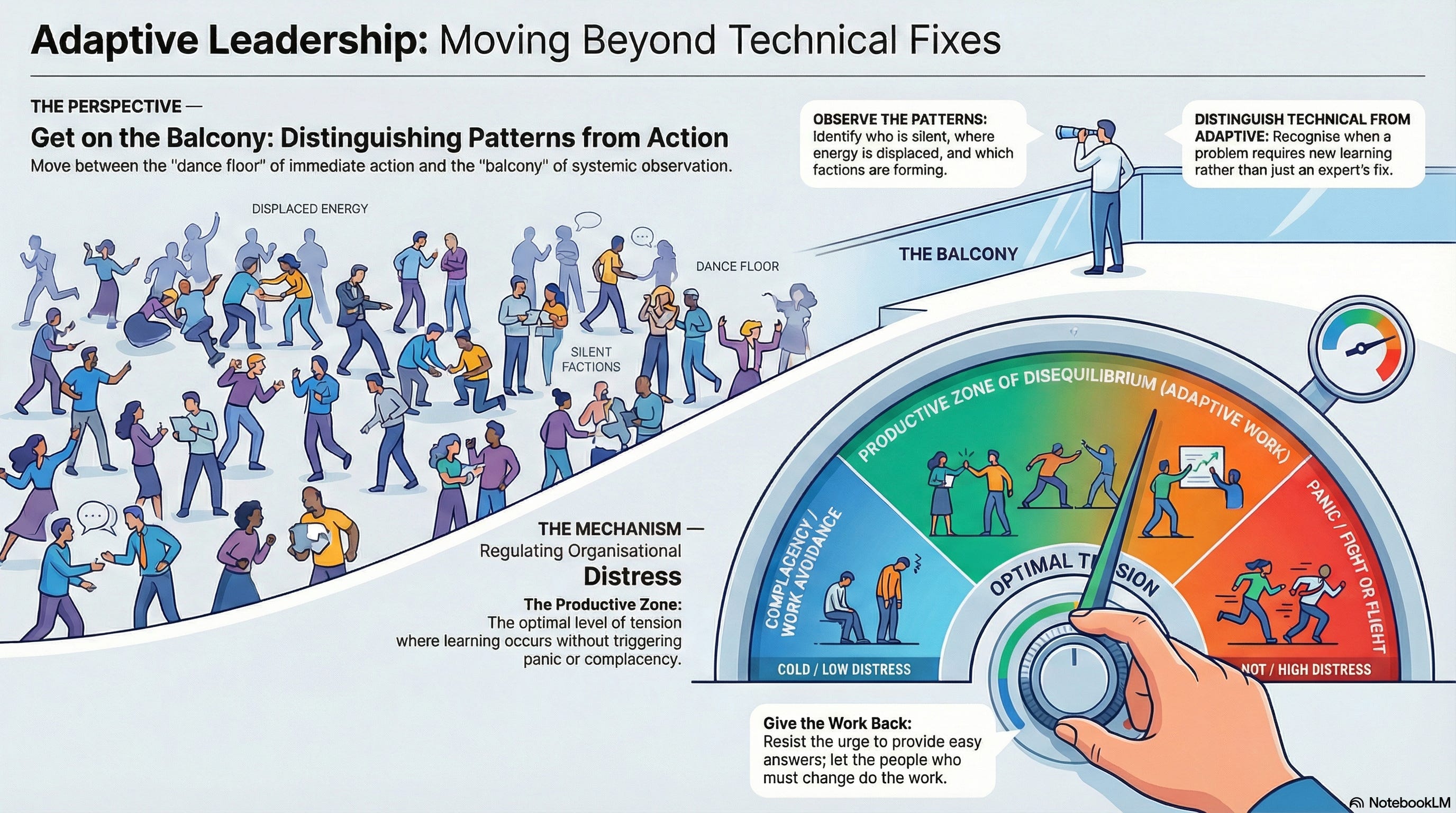
Heifetz offers a spatial metaphor for the cognitive discipline adaptive leadership requires. When you are in the middle of a transformation, you are on the dance floor: swept up in the immediacy of decisions, emails, escalations, and the pressure to act. From the dance floor, all you see is the person in front of you and the steps you need to take right now.
Adaptive leadership requires the capacity to move to the balcony: to step back, in the midst of action, and observe the patterns playing out below. Who is doing the talking? Who is looking at the floor? Which topics generate engagement and which generate avoidance? Where is the stated narrative diverging from the lived experience? This is the operational version of what Kahneman describes as the difference between System 1 and System 2. On the dance floor, System 1 dominates: fast, automatic, reactive. On the balcony, System 2 engages: slow, deliberate, pattern-seeking.

From the balcony, Argyris’s defensive routines become visible. You can see the moment a senior engineer changes the subject rather than engage with the implication that specification writing might replace their coding practice. You can see the team that performs enthusiasm in the all-hands and expresses despair in the private channel. You can see the gap between espoused theory and theory-in-use playing out in real time. Stacey would issue a caveat: you cannot fully reach the balcony, because you are part of the pattern you are observing. Your presence changes the dance. The balcony is never a neutral observation point; it is a better vantage, not a God’s-eye view. The discipline is not to achieve perfect observation but to oscillate: moving between engagement and observation, between participating in the dance and noticing what the dance is doing.
3. Regulate the Heat
Adaptive work generates distress. It has to, because the distress is the signal that identity, competence, and familiar routines are being challenged. The question is not how to eliminate the distress but how to regulate it.
Too little heat and nothing changes: people remain comfortable, and the transformation stalls. Too much heat and the pot explodes: people panic, regress to fight-or-flight, and retreat into the defensive routines Argyris described. The productive zone lives between comfort and crisis. Dweck’s research illuminates what happens in this zone: in a growth mindset culture, the discomfort of not yet being competent at the new thing is experienced as the normal sensation of learning. In a fixed mindset culture, the same discomfort is experienced as evidence of inadequacy. The leader’s job is not to remove the discomfort but to frame it, and the framing the culture provides matters as much as anything the leader says.

To raise the heat: surface the contradiction between what the organisation says it values and what it actually does. Bring the conflict out into the open rather than allowing it to fester in the corridors where Stacey locates the real conversations. To lower the heat: slow the pace, provide structure, break the work into smaller pieces. This is Weick’s small wins in a leadership frame: progress concrete enough to be visible and small enough to be achievable. Peters provides the energy; Heifetz provides the thermostat. Energy without regulation produces chaos. Regulation without energy produces stagnation. The leader’s art is holding both.
4. Name the Loss
This is Heifetz’s most humane insight, and the one most frequently ignored by leaders who think transformation is about “opportunity.” People do not resist change. They resist loss.
When you ask a senior engineer to stop writing code and start writing specifications for AI systems, you are not merely changing a job description. You are taking away the daily experience of competence that has sustained their professional identity for years. You are disrupting the routines that Giddens identifies as the foundation of ontological security. You are asking them to drop the tools that, as Weick showed in Mann Gulch, feel like the only source of safety even when they have become the source of danger.

Bourdieu explains why the resistance is so deep and so invisible to the person it governs. The habitus formed through decades of practice in the old field generates dispositions calibrated to the old rules. The expertise that provided cultural capital, the routines that confirmed professional identity, the automatic responses that produced daily experiences of competence: these are not conscious preferences that can be updated through argument. They are embodied structures that generate practice below the threshold of awareness. Heifetz does not provide the structural theory that Bourdieu does. He provides what Bourdieu does not: a practice for addressing the loss that the habitus cannot process on its own.
If you sell the transformation only as gain, efficiency, innovation, competitive advantage, you will be met with the cynicism that Seligman predicts. Heifetz argues that leadership requires naming the loss explicitly: “This change means that some of what you have built and take pride in will become less central. That is a real loss, and it deserves to be acknowledged.” People can tolerate significant loss if three conditions are met: the loss is named rather than denied, the value of what is being given up is honoured rather than dismissed, and the purpose behind the loss is clear enough to justify the pain. The leader who cannot name the loss will find that the loss names itself: as passive resistance, as talent attrition, as the quiet compliance that looks like adoption but produces none of the learning.
5. Give the Work Back
When the heat rises and distress becomes acute, people will look to the leader to lower it. They will ask for clearer direction, more resources, a definitive decision. They want the leader to take the adaptive work off their shoulders and convert it into a technical problem that authority can solve.
Heifetz warns: do not take it. If the challenge is adaptive, solving it for them robs them of the learning. You cannot renegotiate someone else’s professional identity. You cannot learn a new skill on their behalf. You cannot make them believe they are capable of the new way of working; only their own experience of attempting it and succeeding can do that.
This connects directly to Stacey’s skilled participation. The leader is not an architect standing above the system but a participant with a louder voice. Heifetz operationalises this: the skilled participant’s discipline is knowing which work is theirs and which belongs to the people they lead. Technical work, securing resources, removing obstacles, creating time and space, that is the leader’s job. Adaptive work, changing beliefs, building new competencies, renegotiating identity, that belongs to the people who must live with the transformation.
The hardest version of this discipline is protecting the voices that emerge from below. The junior developer quietly experimenting with specification-driven approaches. The business analyst who has figured out something about human-AI collaboration that the strategy document does not describe. These are Stacey’s shadow conversations trying to surface. Heifetz argues that protecting these voices, especially when they are uncomfortable, is one of the most important things a leader can do. Silencing them is not just a failure of inclusion. It is a failure of intelligence: you have cut off the signal that tells you where the real adaptation is happening.
6. Heifetz and His Limits
Heifetz must be read with his limitations visible. His framework is primarily interpersonal: it operates at the level of the leader’s relationship with those they lead. It does not provide the structural analysis that Giddens offers (why organisations systematically produce technical fixes for adaptive challenges through their daily practices) or the ontological radicalism that Stacey provides (the leader’s own capacity to regulate distress is shaped by the power dynamics they are trying to observe). Normann would note that Heifetz helps leaders navigate adaptive challenges within the current landscape but is less helpful at the more radical task of recognising that the landscape itself has been reconfigured.
These are real limits. But what Heifetz provides is something no other thinker in this series offers with the same precision: a framework for the daily practice of leading through transformation. Not a theory of what organisations are. Not a diagnosis of what is wrong. A set of disciplines for what to do when you are standing there, the heat is rising, and everyone is looking at you.
Heifetz sits in Learning, the first of four phases; Learning, Deciding, Building, Transforming. The placement is deliberate, because holding the heat is what makes perception possible when the thing to be perceived is unwelcome. Learning leaves an organisation with the capacity to stay in a question long enough to see it, not a plan for resolving it. Heifetz returns in Transforming, where the question becomes what a leader can hand back. From Learning to Clarity is the bridge out of this phase.
(An Organisational Prompt is something you can do now....)
Organisational Prompt
Identify the question your teams ask you most frequently about AI adoption. Write it down. Now apply Heifetz’s diagnostic: is this a technical problem or an adaptive challenge?
If it is technical, answer it, or find someone who can. If it is adaptive, resist the urge to answer. Instead, ask what specific loss the question is really about. “How will this affect my role?” is not a question about organisational design. It is a question about identity. “Will this replace what I do?” is not a question about technology. It is a question about competence. Name the loss the question contains. Then design the conditions in which the people asking it can discover the answer for themselves: a safe experiment, a peer who has made the transition, a space where the real anxiety can be spoken rather than suppressed.
Further Reading
Ronald Heifetz, Alexander Grashow, and Marty Linsky, The Practice of Adaptive Leadership (2009). The field guide. Practical, specific, and designed to be used rather than admired. Start here.
Ronald Heifetz, Leadership Without Easy Answers (1994). The original theoretical foundation. Denser and more philosophical, but essential for understanding why Heifetz defines leadership as an activity rather than a position.
Robert Kegan and Lisa Laskow Lahey, Immunity to Change (2009). The psychological companion to Heifetz. Kegan’s immunity map reveals the hidden commitments that prevent people from making the adaptive changes they consciously want to make.
Marty Linsky and Ronald Heifetz, Leadership on the Line (2002). The book about the personal risks of adaptive leadership. Leading adaptively makes you a target, because you are asking people to confront losses they would rather avoid.
I write about the industry and its approach in general. None of the opinions or examples in my articles necessarily relate to present or past employers. I draw on conversations with many practitioners and all views are my own.