
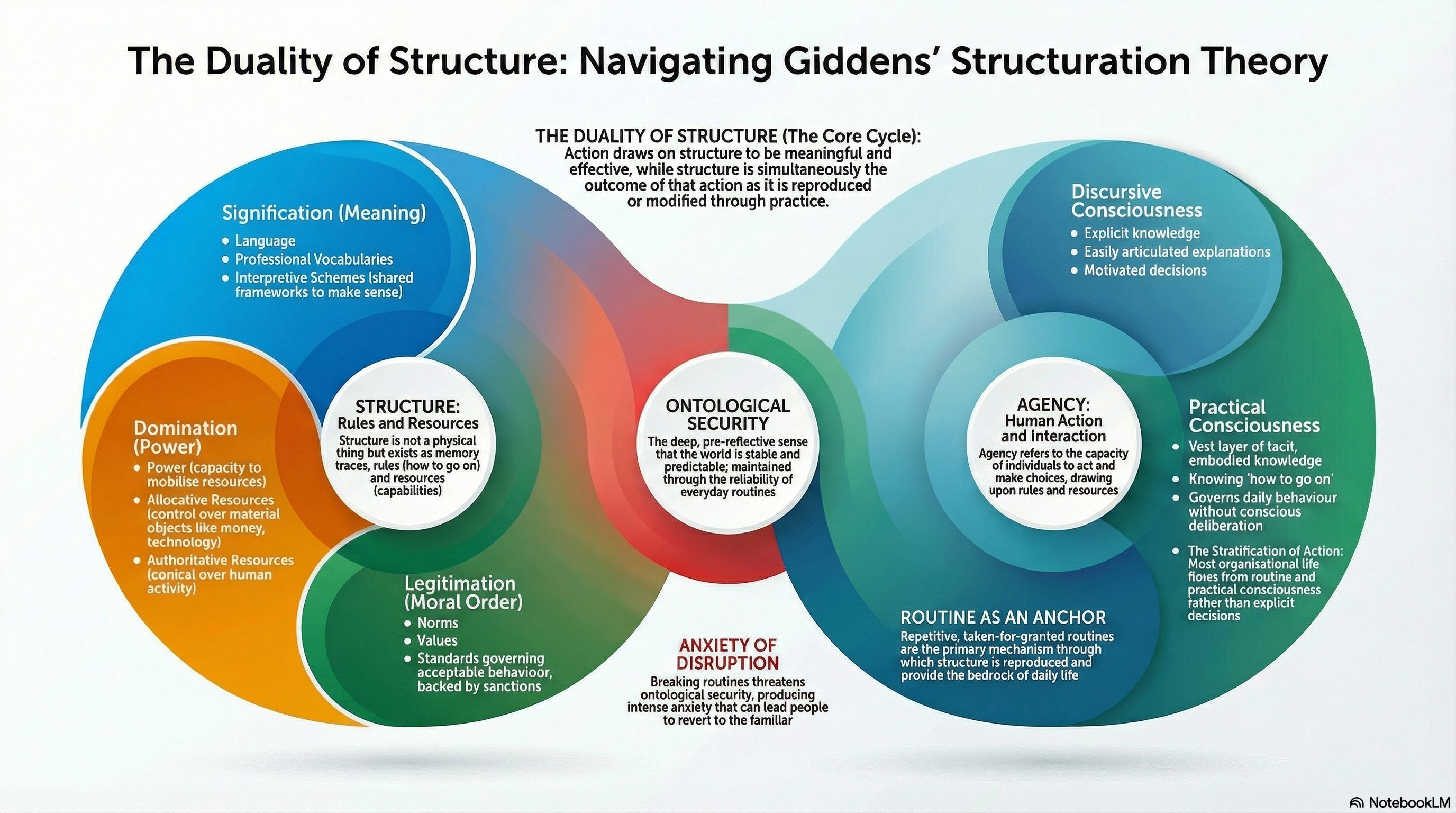
Anthony Giddens, the sociologist behind Structuration Theory, explains why the structure you drew on the whiteboard is not the structure that governs behaviour. The real structure lives in the daily interactions of the people who constitute the organisation: the meetings they hold, the decisions they defer, the topics they avoid, the people they consult, and the shortcuts they take. You changed the diagram. The diagram is not the organisation. The organisation is a pattern of interaction that reproduces itself every day, through the actions of the very people you are asking to change it.
Why does it reproduce? This is the question that makes Giddens essential to the learning argument.
Every other thinker in this series diagnoses a barrier to learning: Argyris’s defensive routines, Stacey’s anxiety, Dweck’s fixed mindset, Seligman’s helplessness. Giddens reveals the structural mechanism beneath all of them.
People reproduce the structures that prevent learning because those structures provide ontological security: the basic sense that the world is predictable, that they know how to navigate it, and that their identity is stable. The routines that obstruct transformation are the same routines that tell people who they are. You cannot remove the obstruction without threatening the identity. This is why every barrier to learning diagnosed in this series is, at root, an identity barrier, and why Giddens’ account of how structure and identity co-produce each other is the theoretical spine of the entire Learning phase.
1. The Duality of Structure: Why the Pattern Holds
Giddens’ central insight is the duality of structure. Structure is both the medium through which people act and the outcome of their action. It is both, simultaneously, in every interaction.
The analogy is language. Grammar exists only because we speak it. When we speak, we draw on grammatical rules (structure as medium). In speaking, we reproduce those rules (structure as outcome). An organisation works the same way. The reporting line exists because people report along it. The approval process exists because people submit to it. The architecture review board has authority because architects present to it and accept its verdicts. Stop doing any of these things and the structure dissolves. Continue doing them and the structure reproduces, regardless of what the new org chart says.
But Giddens adds something that a purely mechanical account of reproduction misses: the reason people continue. They continue because the routines provide ontological security. The morning stand-up, the weekly status report, the governance review: these are not merely processes. They are the mechanisms through which people maintain a continuous sense of who they are and what they are for. The senior developer does not follow the code review process because the process is efficient. She follows it because within that process she knows herself to be competent, valued, and purposeful. The process is her professional identity in action. Asking her to stop is not asking her to change a habit. It is asking her to become, temporarily, nobody in particular.
This is why reorganisations fail with such predictable regularity. You change the diagram, but people continue to interact in the same patterns, because the patterns are where their identity lives. Bateson’s learning levels illuminate the depth. Changing the org chart is Learning I: adjusting elements within the existing frame. The frame itself, the set of assumptions about how work gets done and who you are within it, is reproduced through practical consciousness every day. Changing the frame requires Learning II: questioning the governing assumptions. And the governing assumptions are invisible to the people they govern, because they are not beliefs held in the mind. They are routines held in the body, and the routines provide the ontological security that makes daily life bearable.
2. Three Dimensions: Why Changing One Is Changing None
Giddens argued that every social interaction involves three inseparable dimensions of structure. Transformation fails because leaders typically address one while leaving the other two untouched.
Signification concerns meaning: the interpretive schemes people use to make sense of the world. “What does ‘AI-first’ mean here?” Signification governs how information is processed: which signals are noticed, which are filtered out, which are given weight. When the organisation changes its language but not its information architecture, it has moved signification without moving anything beneath it.
Domination concerns power: the allocation of resources and the exercise of authority. Who controls the budget? Who can say no? Domination governs how the parts of the organisation relate: how teams interact, who coordinates with whom, and whether structures serve the work or the work serves the structures.
Legitimation concerns norms: what gets people promoted, fired, praised, or punished. Legitimation defines the boundaries of acceptable conduct, and in doing so, it governs identity: what it means to be good at your job, what counts as valuable work, which professional dispositions are rewarded and which are suspect. Bourdieu would say legitimation is what the field enforces and the habitus internalises. It is the dimension that determines which identities the organisation permits its members to hold.
This is why legitimation is the most important of the three for anyone concerned with learning. Signification tells people what to think. Domination tells people what they can do. Legitimation tells people who they are allowed to be. If the legitimation structure rewards being right over being curious, then being curious is an identity risk. If it rewards predictable delivery over learning through experimentation, then experimentation is an identity risk. Dweck’s fixed mindset is not an individual failing. It is the psychological expression of a legitimation structure that has made learning unsafe for identity. The performance review, the talent matrix, the hero narrative of the person who “just knew” the right answer: these reproduce a fixed mindset culture in every cycle, and they do so because they define which identities are legitimate.
Consider the most common transformation pattern. Leadership announces that teams are “empowered” to experiment with AI (signification). But the same teams still need three levels of approval (domination). And the performance review still rewards predictable delivery (legitimation). The identity of the “reliable performer” remains the legitimate identity. The identity of the “experimental learner” remains illegitimate. The transformation exists in language only. Argyris would call this the gap between espoused theory and theory-in-use. Giddens explains why the gap persists: you changed signification but left the identity structure, embedded in legitimation, untouched.
3. Practical Consciousness: Identity in the Body
Why do people nod at the strategy presentation and go back to doing exactly what they did before? Giddens distinguishes between discursive consciousness, what we can articulate, and practical consciousness, the vast domain of tacit knowledge that governs how people actually behave.
Practical consciousness is not merely knowledge about how to do things. It is knowledge about who you are while doing them. It is knowing, without thinking about it, that you should not challenge the VP; that the real decision happens in the hallway; that writing code is what makes you an engineer. This knowledge is not hidden or secret. It is simply unspoken. People know how to “go on” in their daily organisational life without being able to articulate the rules they are following, and the rules they are following include rules about identity: what it means to be competent, what it means to belong, what it means to be good at this.
Most organisational knowledge lives in practical consciousness. Most transformation programmes target discursive consciousness. This is why PowerPoints do not produce change. They update what people can say about the organisation without touching what people know about how the organisation works, and without touching who people understand themselves to be within it.

Bourdieu provides the complementary concept. What Giddens calls practical consciousness, Bourdieu calls habitus: the embodied dispositions that generate practice without conscious deliberation. Giddens describes the mechanism (structure reproduced through practice). Bourdieu describes the medium (the habitus carries the reproduction in the body, in professional reflexes, in the automatic responses that feel like common sense). Together they explain why training programmes change vocabulary without changing capability, and why the change in capability, when it comes, feels like a change in identity: the habitus is not just how you do the work. It is how the work tells you who you are. Transforming the habitus means becoming someone different, not just doing something different. This is the deepest reason that learning is a condition, not a process: the condition is an identity that permits the learning to occur.

Mintzberg’s craft metaphor illuminates the positive dimension. The domain expert carries enormous knowledge in practical consciousness that cannot be captured in a requirements document but can be expressed through the craft of specification writing. Specification-driven development makes practical consciousness productive: giving tacit domain knowledge a form through which it can be articulated, tested, and refined. Weick’s insistence that action precedes understanding is structurally necessary: new practical consciousness, new identity, follows new practice. It does not precede it.
4. Why Resistance Is Not What You Think
Leaders label pushback as “resistance to change,” implying stubbornness or insufficient commitment. Giddens offers a deeper and more sympathetic explanation. People are seeking ontological security, and transformation threatens it on every front.
Routines provide ontological security. They tell us that the world will behave tomorrow the way it behaved today. When a transformation breaks a routine, it does not just create confusion. It creates existential anxiety. The senior developer asked to stop writing code is not merely being asked to learn a new tool. They are being asked to relinquish the activity through which they know who they are. The project manager asked to abandon milestone-tracking is not merely being asked to adopt a new methodology. They are being asked to let go of the practice that gives their role meaning.

Heifetz names what must happen: the loss must be acknowledged. People do not resist change. They resist loss. And the losses are real: the daily experience of competence, the routines that confirm identity, the professional capital accumulated under the old rules. Bourdieu explains why the loss is so deep: the habitus does not merely carry knowledge. It carries the identity formed through decades of practice. The old routines are not preferences. They are who the person has become.
Weick’s Mann Gulch study provides the most vivid illustration. The firefighters who died could not drop their tools; the tools were the physical embodiment of “I am a firefighter.” The weight was not the problem. The identity was. Seligman adds a further dimension: in organisations with a history of failed transformations, people have learned that the safest strategy is to maintain existing routines and wait for the initiative to pass. This is not cynicism. It is a rational adaptation, and it is a defence of the ontological security that previous failed changes have threatened without replacing.
The response is not to push harder. It is to help people construct new sources of ontological security: new routines, new competencies, new identities that incorporate the change rather than being destroyed by it. This is the practical meaning of Learning hypothesis. Learning is a condition, not a process, because the condition is an identity secure enough to permit the disruption that learning demands.
5. The Dialectic of Control
No leader has absolute power. Even the most subordinate employee retains the capacity to “act otherwise.” This is the dialectic of control, and it is identity in action.
You cannot mandate transformation. If the change threatens the identities of those who must implement it, they will use their practical consciousness to subvert it while appearing to comply. They will attend the training and return unchanged. They will adopt the language in meetings and revert to old practices in daily work. This is not malice. It is the exercise of agency by people whose ontological security is under threat. Mintzberg’s professional bureaucracies make this concrete: the professionals’ power derives from their embodied skill. Transformation that deskills their work will be resisted through the quiet, skilled exercise of practical consciousness. The resistance is identity defending itself, using the only tools it has.

Stacey would frame this as inevitable. The leader’s mandate is a gesture that provokes responses shaped by local politics, personal anxiety, and power dynamics the leader never fully sees. The responses are the transformation, not the mandate.
6. Disruption as Structural Opportunity
Giddens’ framework is not counsel of despair. The duality of structure means that the same mechanism that reproduces existing patterns contains the possibility of transformation. Because structure is produced through practice, changed practice produces changed structure. And because identity is formed through practice, changed practice produces changed identity.
Disruption creates a window where existing routines break down. Practical consciousness is momentarily destabilised. People do not know what to do, and for a brief period, they do not know who to be. The window is narrow. If new routines are not established quickly, old ones rush back to restore the ontological security that was disrupted.

Weick’s small wins are the mechanism for exploiting this window. A small win changes what people do, which changes what they know (practical consciousness), which changes the structure they reproduce, which changes who they understand themselves to be. Practice first, understanding second, structure third, identity fourth. The sequence cannot be reversed.
This is why pilot programmes matter, but only if they change routines rather than merely test technology. A pilot that proves AI “works” but leaves team structures, approval processes, and performance metrics intact has changed nothing structural and nothing about identity. A pilot that gives a team genuine authority to specify, generate, and validate without the usual approval chain has changed the daily experience of domination. If the results are visible, that changes signification. If the team is recognised for the approach, not just the outcome, that changes legitimation, which changes which identities are permitted. All three dimensions must move. Otherwise, you have produced theatre.
Where this falls: Learning, the first of the four phases, followed by Deciding, Building and Transforming. Giddens sits here because structuration is a claim about what an organisation can see of itself, and the answer is that the real structure is invisible precisely to the people producing it every day. Learning leaves an organisation with the ability to notice a routine as a routine. Deciding is where a noticed structure becomes something you can design against, and From Learning to Clarity is the turn.
(An Organisational Prompt is something you can do now....)
Organisational Prompt
Map your most recent change initiative to Giddens’ three dimensions.
Signification: have you changed the language, and do people share an interpretation of what it means for their daily work? Can a team member explain, in their own words, what “AI-first” or “specification-driven” means for what they do tomorrow morning?
Domination: have you actually redistributed decision rights and resources? Does the team that is supposed to be “empowered” control its own tooling, its own deployment, its own experiments? Or does the same approval chain exist with new labels?
Legitimation: have you changed what gets people promoted, recognised, or fired? Does the performance review reward experimentation and learning, or predictable delivery against plan? What happened to the last person who tried something new and failed? The answer tells you which identities your organisation currently permits, and it is more powerful than any strategy document.
If you have moved signification but not domination or legitimation, you have changed the story without changing the structure, and you have not changed who people are allowed to be. The belief that changing what people say will change what people do is the most persistent and most expensive error in transformation leadership. The belief that changing what people do will change who they are is the deeper truth that Giddens reveals.
Further Reading
Anthony Giddens, The Constitution of Society: Outline of the Theory of Structuration (1984). The definitive statement. Dense but essential. The chapters on practical consciousness and the duality of structure are the most directly relevant.
Anthony Giddens, Central Problems in Social Theory (1979). The earlier, more concise statement. More accessible and a better entry point for practitioners.
Pierre Bourdieu, The Logic of Practice (1990). The concept of habitus provides the complementary lens. Giddens describes how structure is reproduced through practice. Bourdieu describes how practice is generated by embodied dispositions. Read them together for the full picture of how structure becomes identity.
Pierre Bourdieu and Loïc Wacquant, An Invitation to Reflexive Sociology (1992). The most accessible introduction to Bourdieu’s conceptual triad of habitus, field, and capital.
I write about the industry and its approach in general. None of the opinions or examples in my articles necessarily relate to present or past employers. I draw on conversations with many practitioners and all views are my own.