
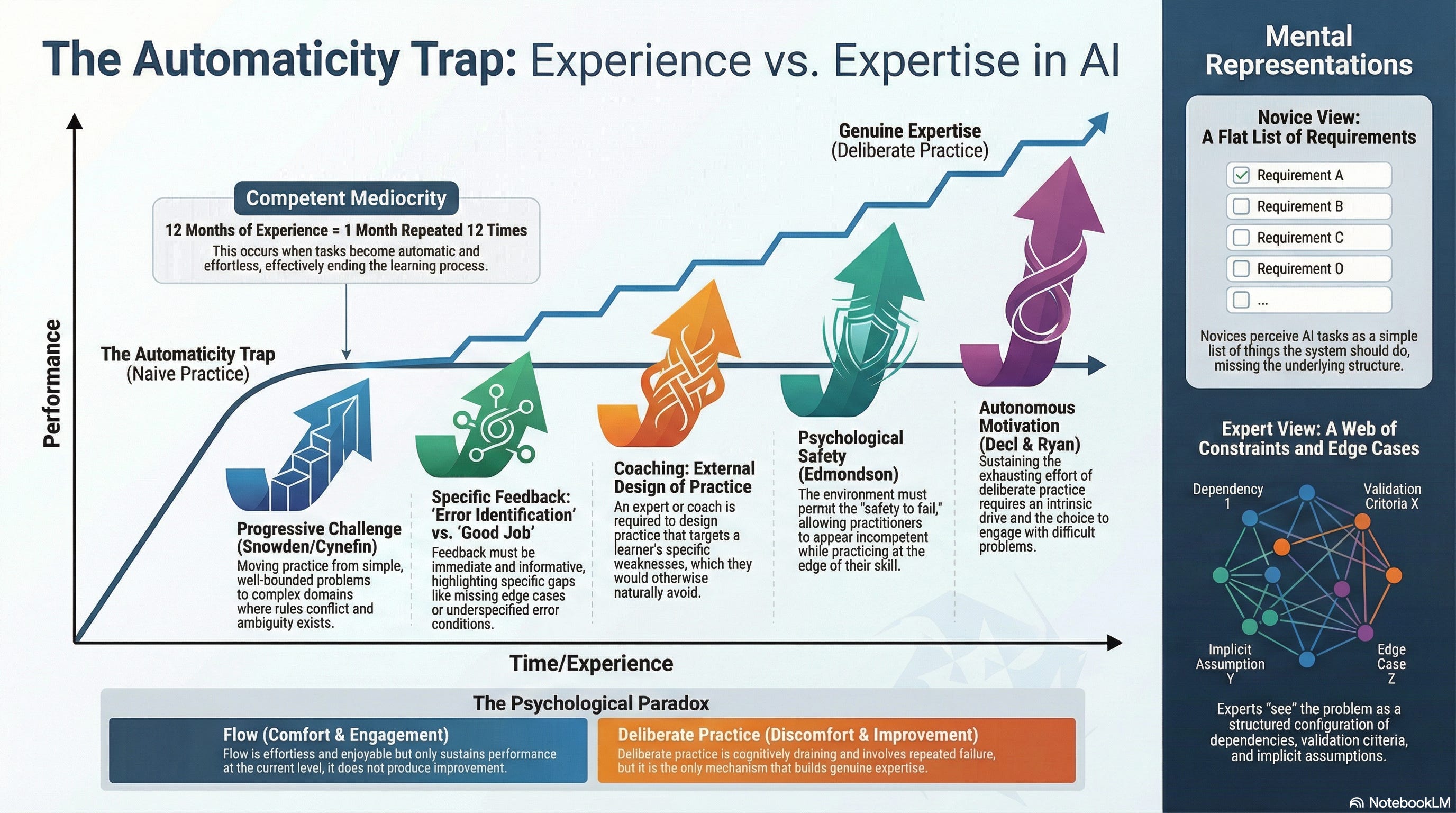
Most organisations that have been “doing AI” for six months have six months of experience. They do not have six months of expertise. The distinction is not semantic. It is the central finding of one of the most important bodies of research in the psychology of performance, and it explains why enterprise AI adoption is producing familiarity without capability.
K. Anders Ericsson devoted four decades to studying how people become genuinely excellent at things. His conclusion, supported by studies across chess, music, surgery, sport, and dozens of other domains, overturns a comforting assumption: that doing something for long enough makes you good at it. It does not. Doing something for long enough makes you automatic at it: fast, fluent, and permanently stuck at whatever level you reached when you stopped effortfully improving. Experience produces automaticity. Only deliberate practice produces expertise. The “10,000 hours” figure that became attached to his name was Malcolm Gladwell’s simplification, not Ericsson’s finding. What Ericsson actually found is harder to sell and more important to understand.
1. Automaticity: Why Experience Is the Enemy of Expertise
When you first learn to drive, every action requires conscious attention: mirror, signal, gear, steering, speed. Within months, the process becomes automatic. You drive while thinking about other things. You have moved from what Giddens calls discursive consciousness, knowledge you can articulate and examine, to practical consciousness, knowledge embedded in bodily routine that operates below awareness. This transition feels like mastery. It is actually the end of learning.
The same process occurs in every professional domain. The developer who has written Java for fifteen years has not improved at Java for thirteen of those years. They improved rapidly during the first two when every task required conscious attention and errors were frequent, then reached a level of automaticity that felt like competence but was actually a performance plateau. They can write Java fluently. They cannot necessarily write it brilliantly. And improvement is hard, because the fluency has made the activity effortless, and effortless activity does not trigger the learning mechanisms that produce improvement.

Bourdieu provides the sociological frame. What Ericsson calls automaticity, Bourdieu calls habitus: the accumulated dispositions formed through practice that generate further practice below the threshold of conscious choice. The habitus stabilises. It produces competent, fluent, automatic performance calibrated to the field in which it was formed. When the field shifts, when AI changes what counts as expertise, the habitus continues generating the old responses. The experienced person is not more skilled than they were years ago. They are more automatic. And automaticity, in a domain undergoing fundamental change, is a liability, because the automatic responses calibrated to the old domain will be applied, without conscious examination, to the new one.

Bateson’s levels framework makes the mechanism precise. Automaticity is Learning I: correction of errors within a fixed frame. The practitioner at the plateau is performing fluently within a frame they no longer examine. Deliberate practice is Learning II: it forces the practitioner to question the frame, to notice what they are not seeing, to expand the model. Most organisations provide conditions for Learning I (repetitive exposure to AI tools) and almost none for Learning II (structured practice that challenges and revises the practitioner’s mental model of what good looks like). Argyris’s skilled incompetence is the professional expression of exactly this: the highly developed ability to perform fluently within a frame that prevents the questioning the frame requires.
2. Deliberate Practice: The Structure That Produces Expertise
If experience does not produce expertise, what does? Ericsson’s answer is deliberate practice, and it has specific, non-negotiable characteristics that distinguish it from every other form of practice.
Deliberate practice targets a specific, well-defined aspect of performance: not “get better at specification writing” but “improve the precision of constraint specification in the payments domain.” It is designed by a teacher or coach who understands expert performance well enough to identify the specific gaps between the learner’s current level and the expert standard. It demands full concentration and effort; Ericsson found that even elite performers can sustain it for only a few hours per day before cognitive fatigue degrades quality, which stands in stark contrast to the assumption that a full day of workshops produces a full day of learning. It involves immediate, informative feedback: not “your design was good” but “your specification handled the happy path precisely, but the error conditions were underspecified; here are the three failure modes your specification does not address, and here is how an expert would handle them.” And it builds on existing knowledge through progressive challenge, each activity slightly beyond current capability: hard enough to require effort, achievable enough to permit success.
The implications for AI transformation are direct. Specification writing, the ability to articulate domain knowledge with sufficient precision for AI to act on it, is a learnable skill with a definable expertise trajectory. But learning it requires all five characteristics of deliberate practice, and most organisations provide none of them. They provide exposure to the concept (a training day), occasional unstructured practice (using AI on a project), no expert-designed progression, no specific feedback, and no coach. They provide, in Ericsson’s terms, naive practice: repetition without design, effort without structure, experience without improvement.
3. Mental Representations: What Experts See That Novices Cannot
Ericsson’s most theoretically important contribution is the concept of mental representations: the internal models that experts build through years of deliberate practice. A chess grandmaster does not see a chessboard the way a novice does. The novice sees thirty-two pieces in various positions. The grandmaster sees patterns, structures, threats, and possibilities. The expertise is not in memory. It is in the mental representations that organise perception.

Weick’s sensemaking framework illuminates the broader significance. Sensemaking is the process by which people impose order on ambiguous situations by selecting certain cues and fitting them into a plausible frame. Mental representations determine which cues are selected. The novice writing a specification for a loan approval process selects the obvious cues: income, credit score, loan amount. The expert selects the same cues plus the non-obvious ones: the regulatory edge cases, the fraud scenarios, the boundary conditions where the rules conflict, the implicit assumptions about data quality. The expert does not think harder. They see more, because their mental representations organise perception differently.
Mental representations cannot be transferred through instruction. They must be built through practice. You can explain the concept of edge cases. You cannot install the perceptual habit of noticing them. That habit develops only through the repeated experience of producing work that fails because edge cases were missed, receiving feedback that identifies the specific gaps, and revising. Each cycle deepens the mental representation. Each failure, properly examined, makes the practitioner’s internal model slightly richer. Mintzberg described the same phenomenon at the organisational level: the master strategist develops an intimate feel for the material through sustained engagement, what he called “knowing in the fingers.” The knowledge is in the practice, not in the instruction.
4. The Coach Problem
Ericsson’s insistence that deliberate practice requires a teacher or coach creates the most discomfort for organisations committed to self-directed learning and empowered teams. The discomfort is understandable: coaches are expensive, scarce, and difficult to scale. But the function of the coach is not motivation. It is design.
The coach understands expert performance well enough to identify the specific gaps between the learner’s current level and the expert standard. The coach designs practice activities that target those specific gaps: not generic exercises that cover the domain broadly, but focused activities that force the learner to confront exactly the aspect of performance where they are weakest. And the coach provides feedback that is specific, immediate, and actionable. Without a coach, people practice what they are already good at and avoid what they find difficult. Practicing strengths produces flow. Practicing weaknesses produces frustration. Left to their own devices, people will choose flow over frustration every time. The coach redirects effort toward the areas where improvement is possible and away from the comfortable repetition where it is not.

Edmondson’s psychological safety is the precondition for coaching to work. Coaching involves identifying weaknesses and providing feedback on them. If the environment is unsafe, if having your work examined and critiqued carries social risk, people will avoid coaching, avoid feedback, and practice in private where their errors are invisible. Dweck’s mindset research determines how feedback is received. In a growth mindset culture, the coach’s feedback is developmental information: here is where you can improve. In a fixed mindset culture, the same feedback is a verdict on ability. The culture determines whether coaching produces learning or defensive withdrawal. For AI transformation, “give everyone access to AI tools and let them learn” is not a learning strategy. It is a recipe for widespread automaticity at a mediocre level. The teams that develop genuine capability will be the teams with access to someone who can design their practice.
5. Why It Hurts, and Why That Matters
There is a tension at the heart of Ericsson’s work. Elite violinists rated deliberate practice as the least enjoyable of their musical activities even as they rated it the most important for development. Csikszentmihalyi’s flow research describes the opposite experience: the state of complete absorption and intrinsic reward that occurs when challenge and skill are matched at a high level. Developers experience flow while coding. The immediate feedback of compilation, the satisfaction of passing tests, the progressive challenge of increasingly complex problems: these are flow conditions.
The paradox is that deliberate practice and flow occupy different psychological territories. Flow is what sustains engagement. Deliberate practice is what produces improvement. Performing at your current level in a state of flow does not make you better. It makes you faster and more automatic at your current level. Practicing deliberately, at the uncomfortable edge of your capability, is what makes you better, but it does not feel like flow. It feels like struggle. Peters intuited this without the psychological framework: excellence requires passion, and passion cannot be mandated. Ericsson provides the mechanism: the passion sustains the practice, and the practice produces the expertise. But the passion must be connected to genuine interest and autonomous choice, or the practice degrades into the rote repetition that produces automaticity, not mastery.

Seligman’s learned helplessness adds the organisational dimension. When people have experienced repeated failed change initiatives, when their effort has been disconnected from any visible outcome, they stop trying. The connection between effort and improvement, the connection that sustains deliberate practice, has been severed by experience. Small wins, in Weick’s sense, restore it. A team that writes a specification, watches AI generate working code, and iterates on the result in a single session has experienced the effort-to-outcome connection that deliberate practice requires. That experience, properly supported, can restart the learning that automaticity had arrested.
6. From Training Events to Learning Systems
The synthesis of Ericsson’s research with the thinkers in this series produces a clear design requirement. Organisations must stop treating learning as an event (a workshop, a training day, an offboarding to a course) and start treating it as a system: an ongoing structure embedded in the way work is done, not an interruption to work.
The system requires progressive challenge sequences targeted at specific aspects of performance, not generic training. It requires specific, immediate feedback on the quality of the work, not annual reviews. It requires coaching relationships that design practice and redirect effort, not self-directed exploration alone. It requires psychological safety as the operating environment, because deliberate practice demands confronting weaknesses and failing frequently. And it requires autonomous motivation to sustain the effort, because deliberate practice is cognitively exhausting and emotionally uncomfortable, and mandated participation produces compliance without learning.
This is not a training programme. It is a practice architecture. The distinction matters because Ericsson’s research shows that expertise develops over months and years of sustained deliberate practice, not in a two-day workshop. The workshop might provide the initial mastery experience that Bandura identifies as essential for building self-efficacy. But self-efficacy is the starting condition, not the destination. The destination is expertise, and expertise requires a practice architecture that persists long after the workshop is over.
Where this sits: Learning is the first of the four phases in this series; Learning, Deciding, Building, Transforming. Its question is whether an organisation can perceive its own situation well enough to act, and deliberate practice is how a person becomes able to perceive anything at all in a domain. A practice architecture is therefore a Learning artefact rather than a training deliverable. What comes out of it is people who can see; In Deciding the question becomes what they can design under constraint, and From Learning to Clarity sets out the turn.
(An Organisational Prompt is something you can do now....)
Organisational Prompt
Find someone in your organisation who has been using AI for at least three months. Ask them to show you their most recent AI-generated output. Then ask one question: “Are you working on harder problems now than three months ago?”
If not, if they are applying AI to the same level of problem with greater speed, they have reached the plateau. Experience is accumulating. Expertise is not. The challenge level has not increased, so the practice is no longer deliberate. The next question is yours: what could you provide, a coach, a harder problem, specific feedback on their work, that would move them off the plateau and back into the zone where learning actually occurs?
Further Reading
K. Anders Ericsson and Robert Pool, Peak: Secrets from the New Science of Expertise (2016). The accessible version of Ericsson’s research. The distinction between naive practice, purposeful practice, and deliberate practice is the single most important framework in the book.
K. Anders Ericsson, Ralf Krampe, and Clemens Tesch-Römer, The Role of Deliberate Practice in the Acquisition of Expert Performance (Psychological Review, 1993). The foundational paper. Dense but essential for understanding why the characteristics of deliberate practice are non-negotiable. Freely accessible.
Mihaly Csikszentmihalyi, Flow: The Psychology of Optimal Experience (1990). The essential companion to Ericsson. Flow explains why people continue doing things. Deliberate practice explains how they improve. Understanding the tension between the two is critical for designing learning systems.
Amy Edmondson, The Fearless Organization (2018). Deliberate practice requires confronting weaknesses, receiving critical feedback, and failing frequently. None of this happens without psychological safety. Edmondson provides the environmental condition without which Ericsson’s framework cannot operate.
I write about the industry and its approach in general. None of the opinions or examples in my articles necessarily relate to present or past employers. I draw on conversations with many practitioners and all views are my own.