
Gregory Bateson was an anthropologist who studied schizophrenia, an epistemologist who studied dolphins, a cyberneticist who studied alcoholism, and a philosopher who studied octopuses. He never held a conventional academic appointment for long. People who read him tend to describe the experience as bewilderment followed by the suspicion that he understood something fundamental that nobody else had quite articulated. That suspicion is correct.
Bateson’s contribution to organisational learning is foundational and largely unacknowledged. Argyris built his distinction between single-loop and double-loop learning on a framework Bateson published first. Senge borrowed Bateson’s systems epistemology without fully crediting its origin. Stacey drew on Bateson’s cybernetics while arguing against the possibility of the system design Bateson’s contemporaries believed in. Bateson is the deep source that several thinkers in this series have drawn from, often without saying so. He provides the epistemological foundation beneath the entire Learning phase: a theory of what information is, what learning is, and why organisations systematically address both at the wrong level.
1. Levels of Learning: The Diagnostic Engine
Bateson borrowed from Russell and Whitehead the theory of logical types: the class of all chairs is not itself a chair. Confusing a member with its class produces paradox. Bateson applied this to learning and produced a hierarchy that remains the clearest map of what organisations are actually doing when they say they are “learning.”
Learning 0 is no learning at all. The system receives a signal and responds identically every time. A thermostat at a fixed setting. A policy manual that nobody revisits.
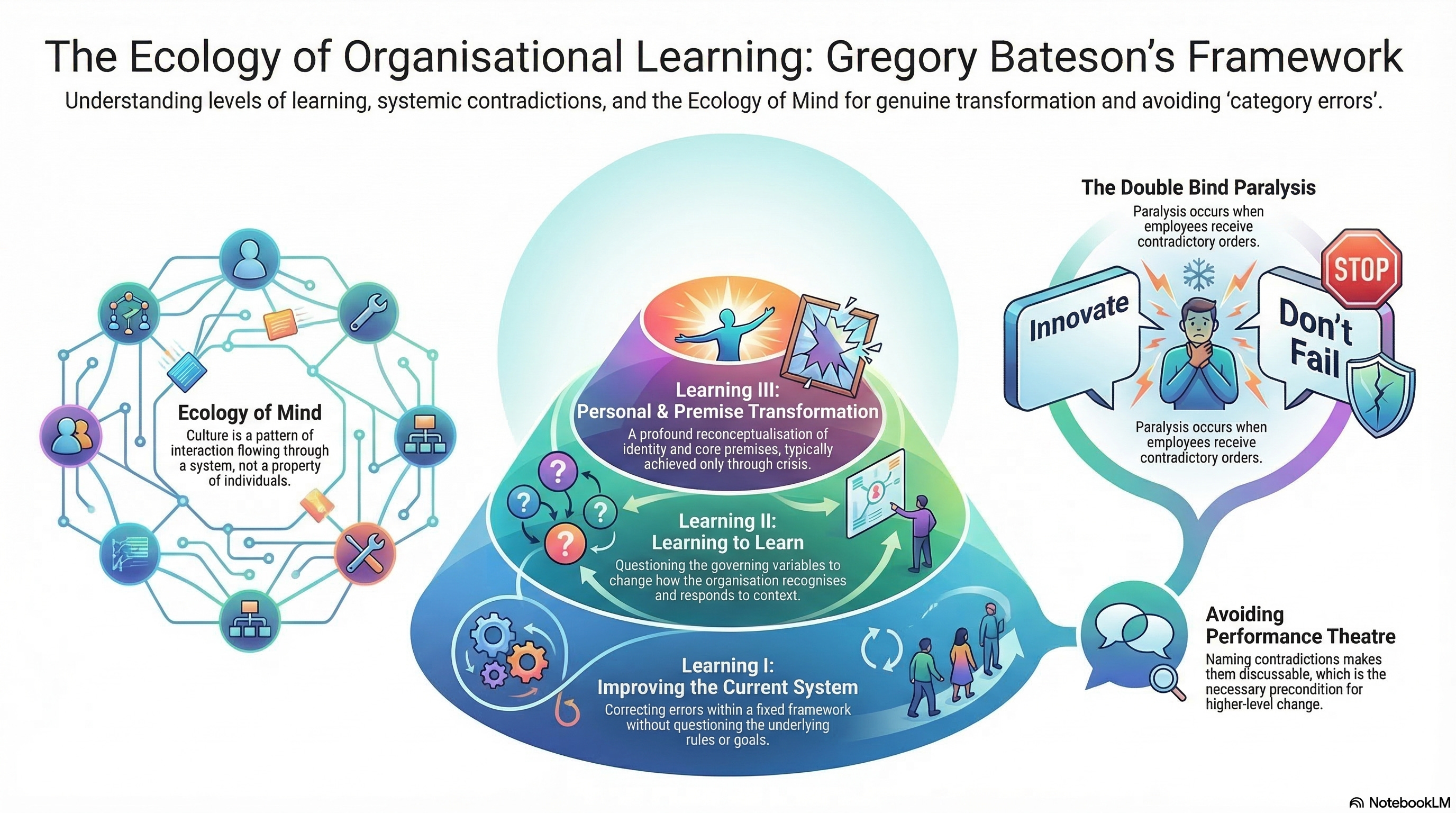
Learning I is what most people mean by the word. You correct errors within a given set of alternatives. A programmer learns a new syntax. A team learns a new deployment process. The governing framework is not questioned; behaviour within it is adjusted. This is Argyris’s single-loop learning, and it accounts for the vast majority of what organisations call training.
Learning II is where things become genuinely difficult. Bateson called it deutero-learning: learning to learn. It is not a change in behaviour within a context but a change in how the person recognises what kind of context they are in. A person operating at Learning II does not simply learn a new AI tool; they learn what category of problem calls for AI and what category does not. They do not acquire a new skill; they revise their understanding of what kind of professional they are becoming. Learning II changes character. It is Argyris’s double-loop learning: questioning the governing variables, not just the actions they produce.
Learning III is transformation of the premises that generate Learning II. Bateson described it as experiences in which the self must be reconceived. Kegan’s developmental transitions from the socialised mind to the self-authoring mind are Learning III. Heifetz’s deepest adaptive challenges require it. Almost no organisation achieves it deliberately.
The critical insight is not that these levels exist but that confusing them produces pathology. Every barrier to learning diagnosed in this series is a mechanism that keeps the organisation at Learning I when the challenge requires Learning II. Argyris’s defensive routines prevent governing assumptions from being questioned (Learning I lock). Dweck’s fixed mindset ties identity to current competence, making frame-questioning feel like identity threat (Learning I lock). Seligman’s learned helplessness is a pathological form of Learning II: the person has “learned to learn” that effort is futile (wrong Learning II). Weber’s iron cage optimises within the bureaucratic frame while making the frame itself invisible (Learning I lock). Giddens’s practical consciousness reproduces the frame through daily practice below the threshold of awareness (Learning I lock). Kahneman’s System 1 generates coherent narratives that suppress awareness of what the frame excludes (Learning I lock). Dekker’s blame culture treats systemic failures as individual errors: a Learning I correction applied to a Learning II problem (category error).
Every one of these barriers is a category error in Bateson’s sense: a Learning I intervention applied to a Learning II challenge. And every AI programme that begins with “let’s upskill everyone on prompt engineering” and ends with no discernible change in how the organisation operates has made precisely this error. It addressed a level-II challenge with a level-I intervention. The intervention was not wrong. It was at the wrong level.
2. Information: A Difference Which Makes a Difference
Bateson defined information as “a difference which makes a difference.” This sounds tautological until you grasp its implications. Information is not data. Data is what is recorded. Information is what changes something. A signal that nobody receives is not information. A report that nobody reads is not information. A strategy document that changes no behaviour is not information. It is data that has failed to become a difference that makes a difference.
This definition grounds every Information-related finding in the series. Westrum’s typology describes the cultures that determine whether differences reach the people who need them: pathological cultures suppress differences, bureaucratic cultures channel them through processes that strip context, generative cultures let differences flow to where they can make a difference. Weick’s sensemaking is the process by which raw differences become meaningful: people select cues, fit them to frames, and act on interpretations. Kahneman’s WYSIATI explains why some differences never register: the mind constructs a coherent story from available data and has no awareness of the differences it has excluded. Dekker shows what happens when the most important differences, the weak signals of drift, are filtered out by a blame culture that punishes the messenger.

The organisational implication is precise. An organisation’s capacity to learn is not determined by the quality of its people or the sophistication of its strategy. It is determined by the quality of differences its communication patterns can register and act upon. Beer’s cybernetics formalises this: variety (the number of distinctions a system can make) must match the variety of the environment the system needs to navigate. An organisation that cannot register the difference AI makes to its domain, because its channels filter unfamiliar signals, because its reward structures penalise messengers, because its categories have no place for what is emerging, is not a system with a learning problem. It is a system whose ecology of mind cannot yet accommodate the information it needs.
3. The Double Bind: Why “Innovate” and “Don’t Fail” Cannot Coexist
Bateson developed the concept of the double bind in 1956: a communicative situation in which a person receives contradictory messages at different logical levels and cannot comply with one without violating the other, cannot leave the situation, and cannot comment on the contradiction.
Consider the AI transformation double bind operating in most large enterprises. At one level: “Experiment. Be bold. Innovate with AI.” At another: “Deliver predictable outcomes. Do not disrupt existing revenue. Explain every failure.” The employee cannot comply with both. They cannot leave. And they cannot safely say “these two things you are asking me to do are incompatible,” because raising the contradiction risks being labelled as resistant.
The result is what Bateson would predict: performance theatre. People learn to perform innovation without actually innovating. They produce proofs of concept that will never reach production. They attend hackathons and build demos that demonstrate possibility without threatening any existing process. The activity satisfies the first injunction; its harmlessness satisfies the second. The double bind is not resolved but managed through theatre.

Argyris diagnosed the same phenomenon: the gap between espoused theory (”we value innovation”) and theory-in-use (”we punish failure”) produces defensive routines. Bateson explains why the routines are so resistant: they are rational adaptations to contradictory communication at different logical levels. You cannot fix a double bind by addressing either message in isolation. You can only fix it by making the contradiction visible and resolving it at the level above both messages. Edmondson’s two-by-two matrix (safety crossed with standards) is an attempt to dissolve the double bind by aligning the messages: we expect excellence and we treat difficulty as learning. The messages reinforce each other instead of contradicting each other.
Giddens’s three dimensions reveal where the double bind lives structurally. The signification says “innovate.” The domination says “within these approval chains.” The legitimation says “and be rewarded for predictable delivery.” Three dimensions, two of which contradict the first. Until all three are aligned, the double bind is structural, not communicative, and no amount of clearer messaging will resolve it.
4. Ecology of Mind: Why Culture Is Not Inside Anyone’s Head
Bateson’s most radical idea is that mind is not located in the brain. Mind is constituted by the total pattern of information flowing through a system. The unit of survival is not the organism but the organism-in-its-environment. Thought does not happen inside heads. It happens in the circuit of interactions between heads, hands, tools, institutions, and the world.
If mind is in the system, then culture is not a property of individuals. It is a property of patterns of interaction. Changing culture does not mean changing how individuals think. It means changing the patterns of communication, feedback, and response that constitute the organisation’s collective cognition.

Giddens reached a compatible conclusion through sociology: structures are reproduced in the practices of the agents they constrain. Stacey pushed further: organisations are patterns of interaction that shift only when the interactions themselves shift. Bateson provides the epistemological foundation beneath both. If information is a difference which makes a difference, and if mind is the pattern of differences circulating through a system, then an organisation’s capacity to learn is a feature of its ecology of mind: the quality of differences it can register, the levels at which it can process them, and the patterns of interaction through which they circulate.

Bourdieu’s habitus is the individual expression of this ecology: the embodied dispositions formed by participation in the patterns. The habitus is not inside the person. It is the person’s participation in the ecology, carried in the body. When the ecology changes, the habitus eventually changes too, but only through sustained practice within the new patterns. This is why Weick insists that action precedes understanding: new ecology, new practice, new habitus, new understanding. The sequence cannot be reversed.
5. What This Means: The Level Must Match the Challenge
Bateson reframes the entire learning problem this series has been exploring. The question is not “how do we get people to learn AI?” but “at what level is the learning that AI demands, and are we intervening at that level?”
If AI is a new tool for existing work, Learning I is sufficient: train people, adjust processes. But if AI changes the nature of work itself, if professional identity is bound up in capabilities that AI now performs, if the task must be defined before it can be done, then the challenge is Learning II at minimum. And Learning II cannot be achieved by Learning I methods. You cannot train your way to a transformation of character. You cannot workshop your way to a new professional identity.
Most organisations do not fail at AI transformation because they lack strategy, budget, or talent. They fail because they are addressing a Learning II problem with Learning I tools, caught in double binds they cannot name, operating within an ecology of mind that filters out the very information they need. Bateson would not have been surprised. He spent his life pointing out that the most important problems are problems of logical type, and that the most common error is trying to solve a problem at the level at which it presents itself rather than the level at which it operates.
The deepest learning happens not when people acquire new skills but when they acquire a new relationship to the process of acquiring skills. That is Learning II. And it is the difference between an organisation that has adopted AI and an organisation that has learned to learn with it.
Where this sits: Learning, the first of the four phases; Learning, Deciding, Building, Transforming. Bateson is the foundational thinker on Information in Learning, the questions about what an organisation can see, and Learning II is the clearest statement of what that work is for. Information passes to Ohno in Deciding, where the question becomes what can be seen accurately enough to design against, and From Learning to Clarity sets out where it changes.
(An Organisational Prompt is something you can do now....)
Organisational Prompt
In your next leadership meeting, ask: “Where are we sending contradictory messages about AI at different levels?” Write both messages down. Put them side by side. Ask: “If someone on the front line took both of these messages seriously, what would they actually do?”
The answer will reveal whether your organisation is creating the conditions for learning or the conditions for performance theatre. Naming the contradiction does not resolve it. But it makes the contradiction discussable, and Bateson’s entire body of work shows that making the undiscussable discussable is the precondition for change at a higher logical level. The double bind persists because it cannot be commented on. The moment you comment on it, you have begun to dissolve it.
Further Reading
Gregory Bateson, Steps to an Ecology of Mind (1972). The essential Bateson. “The Logical Categories of Learning and Communication” is the chapter most directly relevant. Dense, rewarding, and unlike anything else in the management reading list.
Gregory Bateson, Mind and Nature: A Necessary Unity (1979). Bateson’s attempt to make his ideas accessible. More structured than Steps and a better starting point for readers new to his work.
Nora Bateson, An Ecology of Mind (2010). Documentary film. Conveys the texture of Bateson’s thinking better than any summary.
Gregory Bateson, Don Jackson, Jay Haley, and John Weakland, Toward a Theory of Schizophrenia (Behavioral Science, 1956). The original double bind paper. The specific causal claim about schizophrenia is no longer accepted, but the structural insight about contradictory communication at different logical levels remains devastating. Freely accessible.
I write about the industry and its approach in general. None of the opinions or examples in my articles necessarily relate to present or past employers. I draw on conversations with many practitioners and all views are my own.