
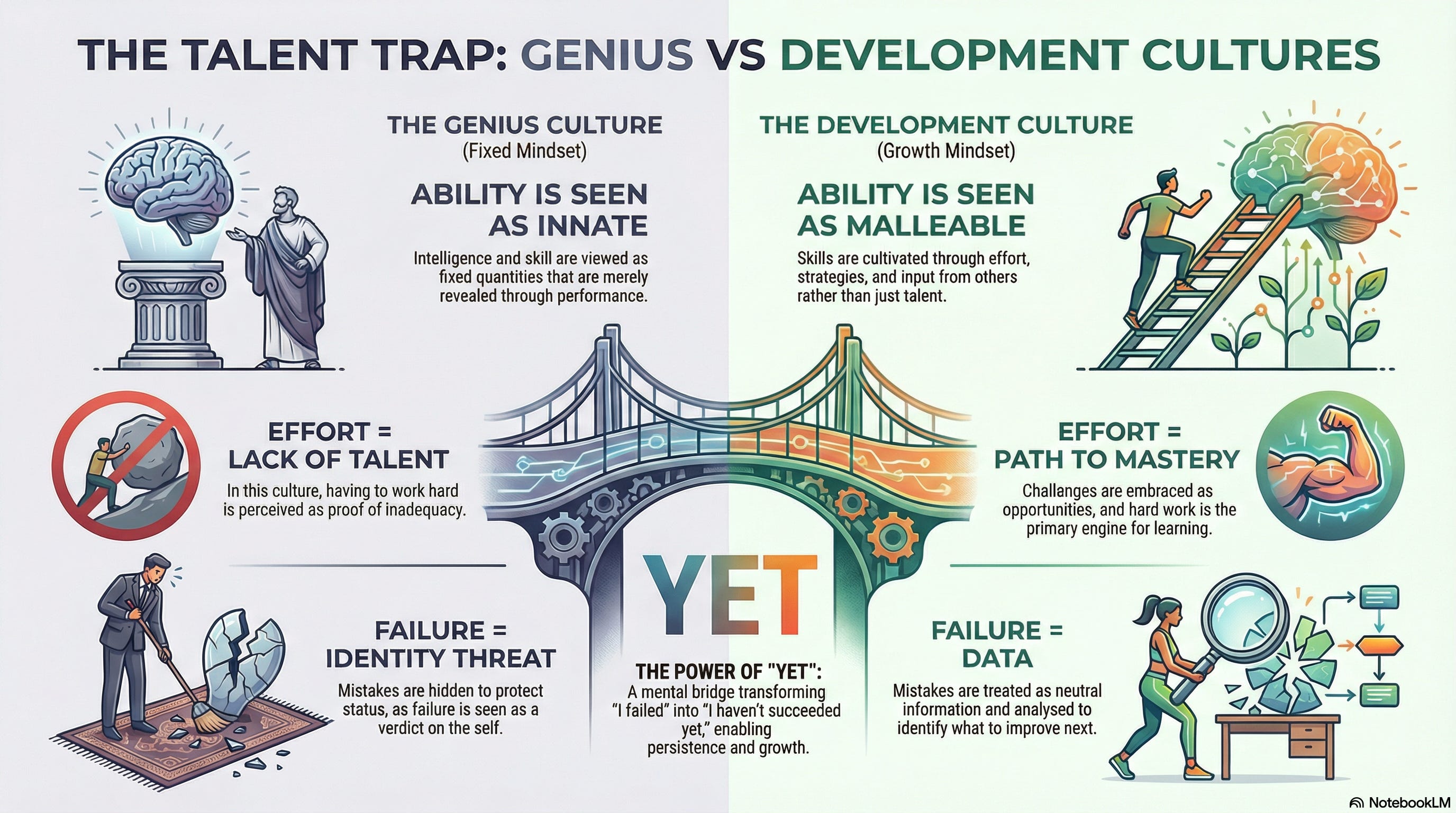
There is a psychological bedrock beneath every transformation. It sits deeper than strategy, deeper than structure, deeper than process. It determines whether any of the frameworks in this series, Argyris’s double-loop learning, Stacey’s complex responsive processes, Weick’s sensemaking, Mintzberg’s emergent strategy, can gain traction at all. That bedrock is what people believe about the nature of their own ability.
Carol Dweck, a Stanford psychologist, spent decades conducting rigorous experimental research into how these beliefs shape behaviour under challenge. Her work is often reduced to a self-help slogan, and this reduction is not helpful. What Dweck actually demonstrated is something far more precise and far more unsettling: that organisations systematically cultivate beliefs about talent that make learning structurally difficult, and they do this through mechanisms so deeply embedded in everyday language, praise, and promotion that nobody notices. The beliefs are not personality types. They are learned orientations, cultivated by environment and reinforced by culture. And they can be changed.
1. What You Believe About Ability Determines What You Do With Failure
Dweck’s research identifies two implicit theories people hold about their capabilities. A fixed mindset holds that intelligence, talent, and skill are innate and stable. Performance reveals character: success proves you are talented, failure proves you are not. Effort is suspicious; if you were truly good at this, it would not be hard. A growth mindset holds that ability is developed through effort, strategy, and learning from others. Failure is information, not identity. Effort is not evidence of inadequacy; it is the mechanism of mastery.
The distinction matters for transformation because transformation, by definition, requires moving from competence in the familiar to incompetence in the new. Every person asked to adopt a new way of working will pass through a period where they are worse at the new approach than the old one. In a fixed mindset, this temporary incompetence is an identity threat. It does not signal “I am learning.” It signals “I am not smart enough.” People resist the change not because they disagree with the strategy, but because engaging with it risks exposing a deficiency they cannot tolerate.

Bateson’s learning levels make the epistemological dimension precise. Fixed mindset locks the learner at Learning I: correcting errors within a fixed frame of “what I am good at.” The frame itself, the definition of competence, cannot be questioned because questioning it threatens the identity it supports. Growth mindset enables Learning II: questioning the frame, revising what “competence” means, expanding the model of one’s own capability. This is not just a psychological difference. It is the difference between an organisation that can question its governing assumptions and one that cannot. Argyris showed that success-oriented professionals become skilled at avoiding situations that might reveal what they do not know. Dweck explains why: in a fixed mindset, not knowing is not a temporary condition to be remedied. It is a verdict on the self.
2. The Genius Culture: When Meritocracy Kills Learning
Many organisations explicitly hire for “the best and brightest.” They celebrate natural ability, reward individual brilliance, and construct hero narratives around people who seem to achieve effortlessly. Dweck calls this a genius culture. It sounds meritocratic. It is toxic for learning.
In genius cultures, information is hoarded, because if status depends on being the cleverest person present, sharing what you know makes you less valuable. Knowledge becomes a positional good. Mistakes are hidden, because if errors signal lack of innate talent, nobody reports them. The weak signals that Weick showed are essential for high-reliability organising are suppressed instead. You cannot build what Westrum calls a generative culture if the messenger believes that bringing bad news proves they are incompetent. And collaboration collapses, because helping others is perceived as a threat to one’s own standing. The zero-sum logic of talent makes genuine collaboration irrational.

Bourdieu provides the structural explanation that Dweck’s individual psychology cannot. Fixed mindset is not merely a personal belief that individuals happen to hold. It is the psychological expression of a habitus that has been formed by organisational reward structures that treat ability as innate. The promotion criteria that reward being right over being curious. The performance review that rates “potential” on a five-point scale. The talent matrix that sorts people into boxes. The language of “high performers” and “top talent” that treats ability as a fixed quantity to be measured and ranked. These are the institutional mechanisms by which organisations reproduce fixed mindset in every cycle of hiring, reviewing, and promoting. Bourdieu would call them the logic of the field: the rules of the game that the habitus internalises and regenerates. Nobody in the organisation says “we believe that talent is innate.” The field says it for them, in every structure and every signal.
3. The Effort Paradox
Perhaps the most dangerous feature of a fixed mindset culture is its relationship with effort. The logic is unconscious but brutal: if talent is innate, then effort is evidence of its absence. The truly talented do not need to try hard. Struggle is not the path to mastery. It is the proof that mastery is beyond reach.
This creates what psychologists call strategic self-handicapping. People deliberately withhold effort or procrastinate on new initiatives, not because they are lazy, but because the incentive structure of a fixed mindset makes this rational. If you try hard and fail, you have proved you lack talent. If you do not try and fail, you retain your excuses. The second outcome is painful but survivable. The first is not. When transformation leaders observe “resistance” or “disengagement,” they are often observing people protecting their identity through strategic withholding of effort. The antidote is not motivational speeches or clearer communication. The antidote is changing what the organisation signals about the relationship between effort and worth.

Stacey places anxiety at the centre of why transformations stall. Dweck identifies one of the primary sources of that anxiety: the belief that struggle reveals inadequacy rather than growth. Giddens would locate this belief in practical consciousness: the taken-for-granted assumptions that govern behaviour without being articulated. Nobody says “we believe that effort signals lack of talent.” But the promotion criteria, the hero narratives, and the everyday language of praise all reproduce this belief continuously, in every interaction. The habitus absorbs it. The field enforces it. And the people within it experience it not as a belief that could be questioned but as the way things are.
4. Why Fixed Mindset Organisations Cannot Probe
Snowden’s Cynefin framework teaches that in the Complex domain, you must probe before you can sense. You must act under uncertainty, observe what happens, and adjust. This requires safe-to-fail experiments: probes designed so that failure is contained and informative rather than catastrophic.

Dweck’s research reveals why so many organisations cannot do this. In a fixed mindset culture, there is no such thing as “safe” failure. Every failure is a verdict on the self. Consequently, fixed mindset organisations retreat to the Complicated and Clear domains, where they can apply established methods and guarantee outcomes. They avoid the Complex domain, where genuine innovation lives, because the risk of looking inadequate is too high.
The structural consequence is predictable. The organisation creates governance frameworks, approval processes, and risk assessments that are ostensibly about managing risk but are actually about eliminating the possibility of visible failure. The architecture review that requires a complete design before any code is written is not just a process constraint. It is an institutional expression of fixed mindset: the belief that competent people should know the answer before they begin, and that the need to experiment signals a lack of expertise. Mintzberg saw this in his study of strategy formation. The Design School, with its insistence on complete analysis before action, is the strategic expression of fixed mindset. The Craft School, with its emphasis on emergent learning and intimate knowledge of the material, is the strategic expression of growth mindset. Most organisations espouse the Craft School and practise the Design School, because the Design School protects against the anxiety of not knowing.
5. Changing the Signal
Dweck’s experimental findings on praise are directly useful for leaders. A single sentence of feedback can shift behaviour.
Praising intelligence (”You are so smart,” “You are a natural at this”) triggers fixed mindset responses. The recipient becomes risk-averse. They avoid challenges that might disprove the label. They hide struggle. They choose easy tasks that confirm existing ability over difficult tasks that would develop it.
Praising process (”I noticed you tried three different approaches before finding one that worked,” “Your persistence with that specification really paid off”) triggers growth mindset responses. The recipient seeks challenges. They persist through difficulty. They treat setbacks as data rather than verdicts.
The organisational application is not about individual coaching. It is about systematically changing the signals that the culture sends about what is valued. Consider how your organisation recognised success in the last big initiative. Did it celebrate the team that “got it right the first time,” reinforcing the idea that competence means not needing to iterate? Or did it celebrate the team that ran failed experiments before finding an approach that worked, reinforcing the idea that learning is the competence? The answer tells you which mindset your organisation’s reward structures reproduce.

This connects directly to Westrum’s generative culture. In generative cultures, information flows freely, responsibilities are shared, failure leads to inquiry, and novelty is welcomed. Every one of these characteristics requires growth mindset as a precondition. You cannot build a generative culture on a foundation of fixed mindset beliefs, because fixed mindset makes every one of these behaviours irrational. The organisation that says it wants a generative culture while maintaining talent matrices and stack-ranking performance reviews is enacting the gap between espoused theory and theory-in-use that Argyris spent his career diagnosing.
6. The Structural Double Bind
Dweck’s research describes individual psychology, but Weber’s sociology explains why fixed mindset is so persistent. Bureaucratic structures systematically select for and reward fixed mindset, because fixed mindset produces the predictable, rule-following behaviour that bureaucracy requires. The performance review, the talent matrix, the promotion criteria that reward being right: these are Weber’s iron cage applied to the psychology of ability.

Giddens would call them structures of legitimation: norms that define what counts as valuable work and valuable people. Bourdieu would say they are the rules of the field that the habitus internalises and reproduces. Changing them requires not just new language but new practices. And new practices require the courage to abandon the old ones: to stop ranking talent, to stop celebrating effortless achievement, to start recognising the messy, iterative, failure-rich process by which genuine capability is built. Heifetz would name the adaptive challenge plainly: the people who must change these structures are the people whose careers were built by them. Their identity is invested in the system they are being asked to dismantle. That is a loss, and it must be named before it can be processed.
A word on placement. This is a Learning article, the first of the series' four phases, ahead of Deciding, Building and Transforming. The Learning articles ask whether an organisation can perceive its own situation, and beliefs about ability decide in advance who is allowed to see anything uncomfortable. What comes out of it is the conditions under which a person can afford to be wrong in public, and nothing later in the series works without that. From Learning to Clarity is the route into Deciding.
(An Organisational Prompt is something you can do now....)
Organisational Prompt
For the next recognition you give, whether in a meeting, a message, or a review, be specific about process. Not “great work” but “I noticed you rewrote that specification three times after the first two produced validation failures, and the third version was significantly better because of what you learned from the failures.”
Then observe what happens. Does the recipient light up, or do they look uncomfortable? Does the team treat the recognition as aspirational or as unusual? The response tells you what your organisation currently believes about the relationship between effort and ability. If praising iteration feels strange, your culture is signalling that competence means not needing to iterate. That signal is more powerful than any strategy document, because it governs what people are willing to attempt.
Further Reading
Carol Dweck, Mindset: The New Psychology of Success (updated edition, 2017). The definitive book on fixed and growth mindsets. Read it for the experimental evidence, not the self-help application. The chapters on organisational culture are the most relevant for leaders.
Carol Dweck, Self-Theories: Their Role in Motivation, Personality, and Development (1999). The academic treatment. More rigorous and more nuanced than Mindset, with the experimental detail that the popular book compresses.
Chris Argyris, Teaching Smart People How to Learn (Harvard Business Review, 1991). The essential companion. Explains why the most successful people are often the worst at learning, and why the defensive routines they develop are a direct expression of fixed mindset beliefs about competence.
Albert Bandura, Self-Efficacy: The Exercise of Control (1997). The research on why mastery experience is the most powerful source of belief in one’s own capabilities. Where Dweck explains what people believe about ability, Bandura explains how those beliefs are formed and changed.
I write about the industry and its approach in general. None of the opinions or examples in my articles necessarily relate to present or past employers. I draw on conversations with many practitioners and all views are my own.