
There is a particular kind of failure that haunts every transformation programme. It is not the failure of people who refuse to change. That failure is visible and manageable. The failure that ruins programmes is the one where everyone agrees, everyone commits, everyone is visibly willing, and nothing happens. The strategy is endorsed. The tools are deployed. The training is attended. Three months later, the organisation is doing the same things with slightly updated vocabulary.
Robert Kegan, a developmental psychologist who spent forty years at the Harvard Graduate School of Education, diagnosed why this happens. His answer is structural, uncomfortable, and directly relevant to anyone watching a transformation stall: people do not resist change. They are immune to it. And the immunity operates through a mechanism invisible to the person it controls. Kegan provides what Argyris could not: the developmental explanation for why intelligent people who agree that their governing assumptions must change consistently fail to change them. The governing assumptions are not merely undiscussed. For many people, they are undiscussable, because they operate at a level of the self that the person’s current developmental capacity cannot reflect upon.
1. Two Kinds of Learning
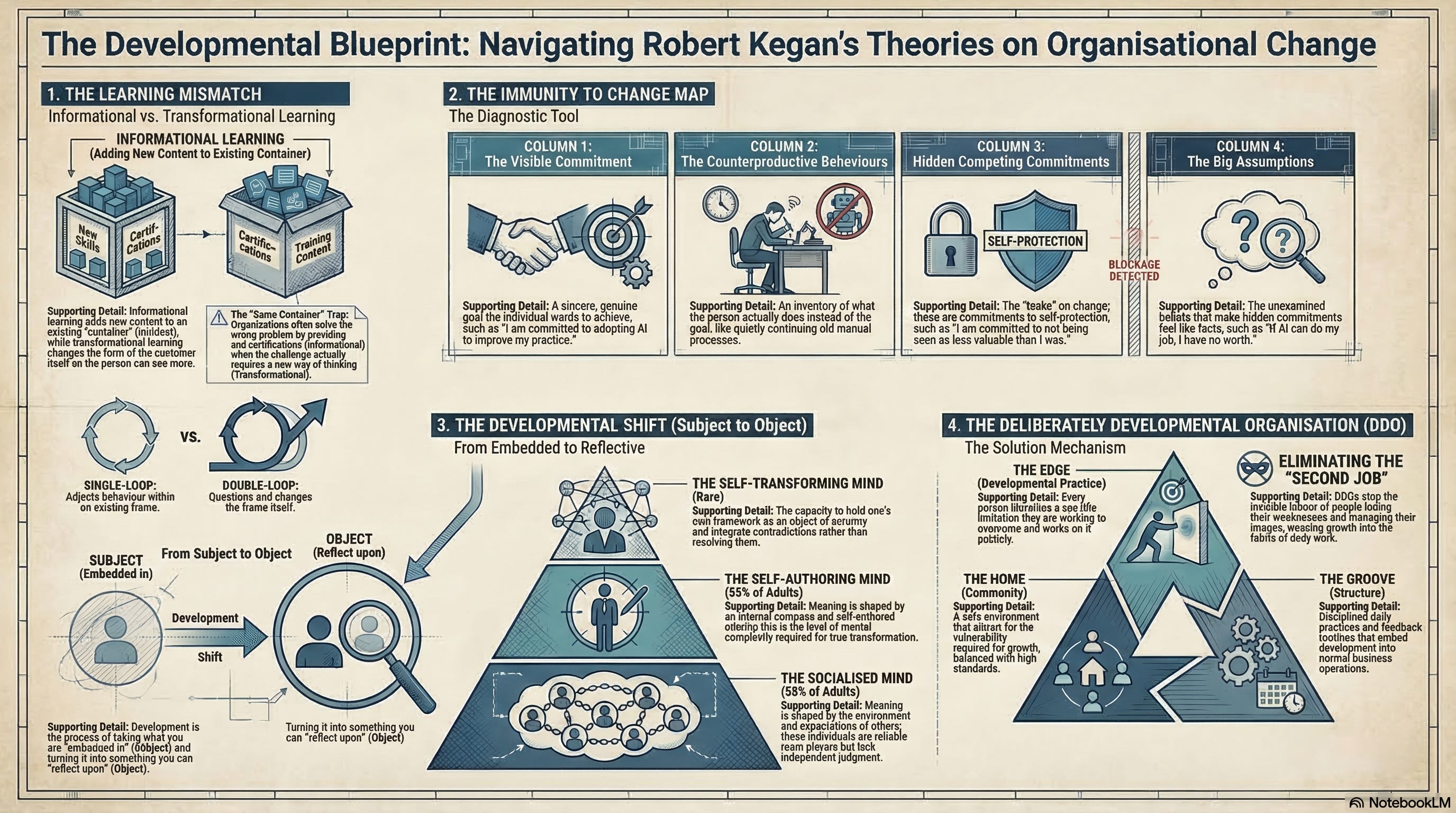
Kegan draws a distinction that cuts through most of what organisations mean by “learning.” Informational learning adds new content to an existing mindset. Transformational learning changes the form of the mindset itself.
Informational learning is what happens when a team attends a workshop on prompt engineering. The content is new; the container is unchanged. The person knows more but thinks the same way. Transformational learning is what happens when a senior architect begins to understand that AI changes what design means, and instead of defending the old definition or adopting the new one uncritically, develops the capacity to hold both, evaluate both, and construct a new understanding of their work. The person does not just know more. They can see more. What was invisible becomes visible.

Bateson mapped the same territory with greater precision. Learning I adjusts behaviour within a given frame. Learning II changes the frame. Kegan’s contribution is to explain the developmental mechanism that determines which kind of learning a person is capable of at any given moment. This mechanism is the binding constraint on every programme that assumes willingness is enough. If AI transformation requires transformational learning and the organisation invests exclusively in informational learning, it is filling a container that needs to be rebuilt.

Bourdieu’s habitus is the embodied expression of this distinction. Informational learning changes what people can say (discursive consciousness). Transformational learning changes the dispositions from which practice is generated. The movement from socialised mind to self-authoring mind, in Kegan’s framework, is a transformation of habitus: not just new knowledge but new generative principles that produce different practice automatically. The person does not merely learn to write specifications. They become someone whose habitus generates specification-writing as naturally as it once generated code.
2. The Immunity Map: Why Willing People Do Not Change
Kegan and Lisa Laskow Lahey’s most practical contribution is the immunity map: a four-column diagnostic that reveals, with uncomfortable clarity, the mechanism of stalling.
Column 1 is the genuine commitment: “I am committed to writing specifications rather than writing code.” The commitment is real.
Column 2 is what the person actually does instead: rewrites AI-generated output from scratch, finds reasons the specification approach does not work for their domain, quietly continues the old work alongside the new.
Column 3 is discovered by imagining doing the opposite of Column 2 and noticing what feels uncomfortable. This reveals hidden competing commitments: “I am also committed to not being seen as someone who cannot do the work themselves.” “I am committed to not losing my standing as the technical expert.” These are not in conflict with Column 1 by design. They are in conflict by structure. One foot on the accelerator, one on the brake.
Column 4 surfaces the big assumptions that make the hidden commitments feel necessary: “I assume that if AI can do what I do, I am no longer valuable.” “I assume my worth is defined by my ability to produce, not my ability to specify.” These assumptions do not feel like beliefs. They feel like facts. And that is precisely why they are so powerful: they are not examined because they are not experienced as things that could be examined.
Bateson would call the Column 4 assumptions a category error: the person is looking at the wrong logical level. They are trying to change their behaviour (Learning I) while the assumptions that generate the behaviour (Learning II) remain Subject, things they look through rather than at. The immunity map is a tool for making Learning II visible: it surfaces the governing assumptions that Argyris said must change but could not explain why they resist changing. The hidden competing commitments in Column 3 are information present in the system but inaccessible to the person. They are the undiscussable beneath the undiscussable.

Heifetz’s adaptive leadership connects directly. The Column 4 assumptions are the losses that Heifetz says must be named: “My worth is defined by my ability to produce” is a loss statement waiting to happen. Until the loss is named, the immunity holds, because the person is protecting something they have not yet acknowledged they are protecting.
3. Developmental Stages: Why the Organisation Asks for What Most People Cannot Yet Give
Kegan describes three plateaus of adult mental complexity relevant to professional life.
The socialised mind is shaped by the expectations of the environment: peers, bosses, professional community. The person is a reliable team player who communicates what they believe others want to hear. When the boss says AI is important, they agree. When peers say it is a fad, they agree with that too. They are not lying in either case. They are being shaped by the social field they inhabit. Roughly 58% of adults make meaning at this stage.
The self-authoring mind has an internal compass. It can step back from social pressure and evaluate competing claims against self-authored criteria: evaluate AI outputs against professional judgement, specify what needs to be done without waiting for instructions, hold a position that contradicts the consensus when the evidence supports it. Roughly 35% of adults operate here. AI transformation demands this capacity at minimum.
The self-transforming mind can hold its own framework as an object of scrutiny, see its limits, and integrate contradictions rather than resolving them. This maps to what Stacey’s skilled participation demands: leaders who tolerate paradox without collapsing it into false certainty.
The organisational learning problem is a developmental mismatch. The organisation asks for independent judgement and gets social conformity. It asks for honest evaluation and gets consensus. It asks for transformation and gets performance. Not because people are unwilling but because the developmental capacity the task requires has not yet formed.
Bourdieu deepens this. The socialised mind is a habitus perfectly adapted to the field that formed it: the dispositions were generated by the social environment and generate practice that reproduces it. Movement to self-authoring is a transformation of habitus, not merely a cognitive upgrade. It is the formation of new generative principles that can produce practice the old field did not reward. This is why the transition is so difficult and so slow: it requires sustained practice under conditions that support the new dispositions, not a training programme or a motivational speech.

Edmondson’s psychological safety is necessary but not sufficient. Safety creates the conditions in which developmental growth becomes possible. But safety alone does not produce growth. A socialised-mind professional in a safe environment will feel comfortable. They will not thereby become self-authoring.
4. The Deliberately Developmental Organisation
Kegan’s most ambitious idea is the Deliberately Developmental Organisation: a workplace that weaves development into the fabric of daily work rather than treating it as a separate activity. In most organisations, people are doing a second job nobody is paying them for: hiding weaknesses, managing impressions, covering mistakes. The DDO makes that second job unnecessary.
The DDO has three foundations. Edge: every person identifies their growing edge, the specific limitation they are working to overcome, and works on it publicly. Home: genuine safety for the vulnerability growth requires, combined with high standards that prevent safety from becoming comfort. Groove: disciplined daily practices and feedback routines that embed development into normal operations.

Senge described the learning organisation but could not fully specify what it would look like in practice. Kegan provides the specification. Westrum’s generative culture describes the conditions under which a DDO can function; pathological and bureaucratic cultures prevent the developmental exposure growth requires. Giddens’s three dimensions must all move: the DDO changes signification (what learning means), domination (who has authority over development), and legitimation (growth, not performance, is what gets recognised).
Most organisations will not become DDOs. But the immunity map alone, applied honestly, can reveal why a transformation is stuck in ways no amount of strategy review will address. The person who runs Column 4 to its conclusion and finds an assumption they did not know they held has already begun the journey from Subject to Object. That is transformational learning. It is the only kind that changes anything.
Placement: Learning, the first of four phases, ahead of Deciding, Building and Transforming. The immunity map is a Learning instrument in the strictest sense, because it makes an assumption visible without yet asking anybody to decide anything. What an organisation gets out of that work is exactly that visibility. Kegan returns in Deciding, applied to the capacity to commit under constraint, and From Learning to Clarity is the bridge between the two.
(An Organisational Prompt is something you can do now....)
Organisational Prompt
Run an immunity map on your own AI commitment. Take fifteen minutes. Write four columns. Column 1: a specific AI adoption commitment you hold and have not fulfilled. Column 2: what you actually do instead. Column 3: imagine doing the opposite of Column 2; what feels uncomfortable? Write those hidden commitments. Column 4: what assumptions make those competing commitments feel necessary?
Do not try to fix anything. Just look at what the map shows you. The assumptions in Column 4 are almost certainly things you have never articulated. They will explain something that strategy slides cannot. If you find an assumption that surprises you, you have found the thing that is governing your behaviour while remaining invisible to you. That is Subject becoming Object. That is the beginning of the only kind of learning that produces change.
Further Reading
Robert Kegan and Lisa Laskow Lahey, Immunity to Change (2009). The full immunity map diagnostic and the three developmental plateaus. The most directly useful of Kegan’s books for practitioners.
Robert Kegan and Lisa Laskow Lahey, The Real Reason People Won’t Change (Harvard Business Review, 2001). The original article introducing competing commitments and the immunity framework. Short, clear, and a better starting point than the book.
Robert Kegan and Lisa Laskow Lahey, An Everyone Culture: Becoming a Deliberately Developmental Organization (2016). The DDO concept with detailed case studies. Ambitious and demanding.
Jennifer Garvey Berger, Changing on the Job: Developing Leaders for a Complex World (2012). The most accessible practitioner-oriented account of Kegan’s developmental stages applied to leadership.
I write about the industry and its approach in general. None of the opinions or examples in my articles necessarily relate to present or past employers. I draw on conversations with many practitioners and all views are my own.