
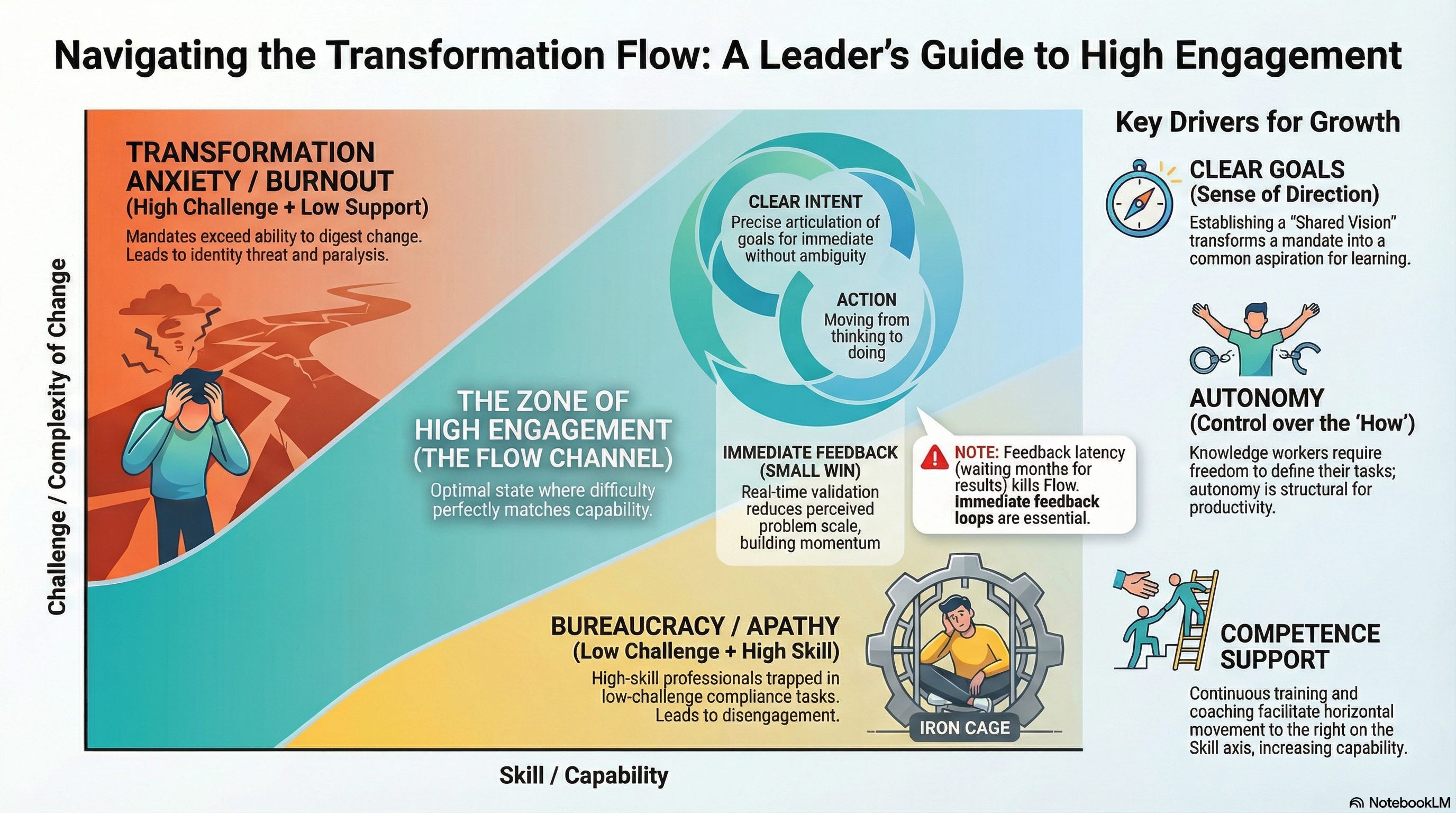
Mihaly Csikszentmihalyi, a Hungarian-American psychologist who spent four decades studying what makes experience genuinely rewarding, discovered that the most powerful motivation is not external at all. It is the state of complete absorption that occurs when the challenge of a task precisely matches the skill of the person performing it. He called this state flow. His premise is devastatingly simple for anyone managing transformation:
Optimal experience requires a specific balance between challenge and skill, and if you disrupt that balance, you do not merely get lower productivity. You get anxiety or boredom. And people will flee both, not because they are “resistant to change,” but because they are seeking psychological survival.
The relationship between flow and performance is more complex than popular accounts suggest; flow is not always beneficial (it can produce compulsive engagement and tunnel vision), and its measurement remains debated. More importantly for this series, the relationship between flow and learning is paradoxical, as we shall see.
1. The Flow Channel: Why Your Transformation Produces Anxiety, Boredom, or Both
Csikszentmihalyi defined flow as a state of complete absorption where the challenge of the task matches the skill of the performer at a high level. The model is simple but precise:
High challenge combined with low skill produces anxiety. Low challenge combined with high skill produces boredom. High challenge matched with high skill produces flow.
Between these states lies a narrow channel. Stay in it and the work is intrinsically rewarding; the person and the activity merge, self-consciousness disappears, time distorts, and the experience itself becomes the motivation. Fall out of it and you get either the paralysing uncertainty of “I cannot do this” or the deadening tedium of “this is beneath me.”
Transformation programmes, whether AI-related or not, routinely push people out of this channel in both directions simultaneously. They demand that teams adopt new, complex workflows (high challenge) without providing the scaffolding, practice, or time to develop the corresponding skill (low skill). The result is anxiety. Alternatively, they use AI to automate the interesting, challenging parts of existing work, leaving people with only the rote verification and administrative tasks. The result is boredom. Sometimes both happen to the same person in the same week: anxiety when confronting the new workflow, boredom when performing the residual tasks that remain.
Deci and Ryan’s Self-Determination Theory explains what is at stake. The competence need, the desire to feel effective in one’s interactions with the environment, is satisfied when challenge and skill are matched. When the match breaks, competence is threatened, and the person’s intrinsic motivation collapses regardless of what external incentives are on offer. Flow is the experiential expression of satisfied competence; anxiety and boredom are the experiential expression of competence under threat.

This is why Seligman’s learned helplessness can set in so quickly during transformation: repeated experiences of being outside the flow channel teach people that the new way of working is a domain where their effort does not produce mastery. The rational response is to stop trying.
Taylor’s Scientific Management, which we examined in the previous article, is the systematic destruction of flow conditions. Taylor’s separation of thinking from doing removes the clear goals that flow requires (the worker no longer decides what to do, only how fast to do it). His standardisation of method removes the autonomy that sustains engagement. His piece-rate monitoring replaces intrinsic reward with extrinsic pressure. And his deskilling of craft work ensures that the challenge level drops below what a skilled worker needs to achieve absorption. Deming understood this intuitively. His twelfth point, “remove barriers to pride of workmanship,” is a flow prescription: let people do work that challenges them, give them the authority to improve it, and stop fragmenting their attention with quotas and surveillance.
2. Immediate Feedback: The Learning Loop That Most Organisations Have Broken
One of the defining conditions of flow is immediate, unambiguous feedback. You know instantly whether you are succeeding or failing. The musician hears the note. The chess player sees the board change. The coder watches the tests pass or fail. This real-time information is what allows the person to adjust, correct, and stay in the channel.
In most large organisations, feedback is delayed by weeks or months. Annual reviews. Quarterly planning cycles. Manual QA processes that take days to return results. Governance boards that meet fortnightly. Each delay inserts a gap between action and consequence, and each gap makes flow impossible. You cannot be absorbed in a task if the information about whether your effort is working arrives long after you have moved on to something else.

Weick provides the sensemaking explanation. Action precedes understanding, but understanding requires feedback that is close enough to the action for the connection to be vivid. When feedback is delayed, the sensemaking loop breaks: the person cannot construct a coherent narrative linking their effort to its outcome, and the work becomes a series of disconnected gestures rather than an evolving conversation with the material.
Deming’s emphasis on building quality at the source, rather than inspecting it after the fact, is a feedback architecture argument. Move the information about quality as close as possible to the point of production. The Toyota production system’s andon cord, which stops the line the moment a defect is detected, is a flow-enabling device: it provides the immediate feedback that allows the worker to correct, learn, and stay engaged.
In the context of AI-augmented work, the specification-generate-validate loop is designed to restore this immediate feedback. A developer writes a specification and sees the AI generate working code within seconds. The validation runs immediately. The gap between intention and consequence collapses to near-zero. This is, in Csikszentmihalyi’s terms, a flow-enabling architecture: clear goals (the specification), immediate feedback (the generated output and validation results), and a sense of agency (the developer can revise the specification and try again). If a governance board inserts a three-day approval process between the specification and the generation, the flow is destroyed. The architecture that was designed to produce absorption now produces the same fragmented, delayed experience that the old way of working imposed.
Westrum’s typology of organisational culture explains why some organisations will build flow-enabling feedback loops and others will not. In a generative culture, information flows to where it is needed; the feedback loop is supported because it serves learning. In a bureaucratic culture, information flows through channels; the governance board exists because the process requires it, regardless of what it does to the experience of the people doing the work. In a pathological culture, information is hoarded; feedback is a weapon used for blame, not a signal used for adjustment. The same specification-generate-validate loop will produce flow in a generative culture, compliance in a bureaucratic one, and fear in a pathological one.
3. Clear Goals: The Specification as Psychological Enabler
Flow requires knowing exactly what needs to be done at any given moment. Ambiguity is the enemy of absorption. You cannot be fully immersed in a task if you are constantly wondering whether you are working on the right thing, whether the requirements have changed, or whether the person who will review your work has a different understanding of “done” than you do.
This maps directly to what Drucker identified as the defining challenge of knowledge work: the worker must define the task before they can do it. In most organisations, the task is chronically underspecified. Requirements documents are ambiguous. Acceptance criteria are vague. The knowledge worker must stop working to figure out what the work actually is, and each interruption breaks the absorption that flow requires.

The discipline of precise specification, far from being a bureaucratic overhead, is a psychological enabler of flow. When the specification is clear, the developer knows exactly what they are trying to achieve. When the validation criteria are explicit, they know exactly how to tell whether they have achieved it. The cognitive load of ambiguity, the constant background question of “am I building the right thing?”, is removed, and the freed attention can be directed entirely at the challenge of building it well.

Mintzberg’s potter at the wheel is the archetype of this condition. The potter does not consult a specification document. But the potter has absolute clarity about the material, the intention, and the emerging form. The goals are clear not because someone wrote them down but because the craftsperson’s intimate knowledge of the domain provides continuous, moment-to-moment orientation. Giddens would say the potter is operating from “practical consciousness,” the tacit knowledge that guides action without requiring conscious deliberation. Flow, in this reading, is what happens when practical consciousness is fully engaged and undisturbed.
The specification does not replace this practical consciousness. It externalises part of it, making tacit domain knowledge explicit enough for AI to act on. The flow experience shifts: from the absorption of writing code to the absorption of articulating intent with precision. Whether this new absorption is as rewarding as the old one is the question on which AI transformation will succeed or fail.
4. The Merging of Action and Awareness: Why Your Organisation Is a Distraction Factory
In flow, the person and the activity become one. There is no separate “self” watching the work; there is only the work. This requires an environment free from distraction and administrative intrusion.
Modern organisations are structurally designed to prevent this merging. Constant messaging notifications. Status meetings that fragment the day into thirty-minute blocks. Context-switching between projects. Open-plan offices that assault concentration. Each of these is a flow-killer, and collectively they produce an environment where sustained absorption is nearly impossible.

Kahneman’s dual-process framework illuminates why this matters. Flow operates in what might be described as a highly engaged form of System 1: fast, automatic, pattern-driven, but at a level of challenge that keeps the processing effortful rather than merely habitual. Every interruption forces a switch to System 2: slow, deliberate, resource-intensive reorientation. The cognitive cost of this switching is not merely the time lost to the interruption. It is the time required to rebuild the mental context that flow depends on. Research on task-switching suggests this recovery can take fifteen to twenty minutes, which means a single interruption in a two-hour block does not cost five minutes. It costs the entire block.
If your transformation programme adds more meetings and more reporting to “track progress,” you are actively destroying the capability you are trying to build. You cannot mandate high performance while simultaneously fragmenting the time required to achieve it. Tom Peters saw this clearly: bureaucratic overhead kills the human energy that is the actual source of organisational performance. His liberation management, the relentless stripping away of administrative burden to free people for the work that matters, is a flow programme, whether or not he used the term.

Weber’s iron cage is the structural explanation. Bureaucratic rationality demands documentation, reporting, and procedural compliance because these are the mechanisms through which the organisation achieves predictability and control. But predictability and control are the enemies of absorption. The person filling in the status report is not in flow. They are performing an accountability ritual that serves the organisation’s need for legibility at the expense of the individual’s capacity for deep work. The tragedy Weber diagnosed, that the mechanisms designed to serve rational purposes become cages that prevent those purposes from being achieved, is precisely what happens when governance frameworks designed to support AI adoption become the primary obstacle to the absorption that AI adoption requires.
5. The Paradox: Flow Is Not Learning
Here is the finding that most popular accounts of flow omit, and that matters most for transformation.
Flow is what sustains engagement. But flow is not what produces improvement. Performing at your current level in a state of absorption does not make you better. It makes you faster and more automatic at your current level. Ericsson’s research on deliberate practice describes the opposite experience. Deliberate practice requires full concentration on the aspects of performance where you are weakest. It involves repeated failure at tasks designed to exceed your current capability. It is effortful, frustrating, and cognitively draining. Elite violinists rated deliberate practice as the least enjoyable of their musical activities, even as they rated it the most important for their development.
The paradox is sharp. Flow occupies one psychological territory; deliberate practice occupies another.
Flow is intrinsically rewarding and self-sustaining. Deliberate practice is inherently uncomfortable and requires external structure to sustain. Flow happens when challenge matches skill. Deliberate practice happens when challenge slightly exceeds skill, at the uncomfortable edge where the person is most likely to fail.
This paradox explains a pattern visible in every AI adoption programme. The developers who use AI most enthusiastically are often the ones who learn least. They have found a way to use AI that produces flow: generating code quickly for problems they already understand, achieving the satisfying feeling of rapid output. But they are not developing the specification-writing expertise that would allow them to tackle genuinely difficult problems. They are in the flow channel, which feels like mastery but is actually what Ericsson calls the automaticity trap: fluent performance at a fixed level, mistaken for growth.

Argyris diagnosed this same pattern in organisational behaviour. His “skilled incompetence,” the highly developed ability of smart professionals to avoid learning, is the professional equivalent of Ericsson’s automaticity. The senior architect who “just knows” the right technical approach is not exercising expert judgment. They are exercising automatic pattern-matching calibrated for a world that no longer exists. They are in flow, and the flow feels like expertise. But flow within an obsolete paradigm is not competence; it is comfortable irrelevance.
Meanwhile, the developers who find AI frustrating, whose specifications fail, who struggle to articulate implicit knowledge, are the ones most likely to be developing genuine expertise, if the frustration is accompanied by specific feedback and progressive structure. Without that support, the frustration produces not learning but learned helplessness: the conclusion that specification writing is something they cannot do. Dweck’s growth mindset is the cultural precondition for staying in the uncomfortable zone long enough for the learning to take hold. In a fixed mindset culture, the frustration is interpreted as evidence of inadequacy, and the person retreats to the flow of familiar work. In a growth mindset culture, the same frustration is interpreted as evidence of learning, and the person persists.

Bandura’s self-efficacy research provides the mechanism by which this persistence is sustained or destroyed. The person must believe that their effort will produce improvement. Mastery experience, the felt sense of “I did that and it worked,” is the most powerful source of this belief. But the mastery experience must be genuine: calibrated to be achievable with effort but not so easy that success feels trivial. Csikszentmihalyi’s flow channel provides the design principle for the mastery experience. Bandura provides the psychological theory of why it works. And Ericsson provides the warning that the experience must be progressive, pushing the person to the edge of their capability rather than allowing them to settle into comfortable automaticity.
The practical implication for transformation design is this: you need both. You need flow to sustain engagement and prevent people from disengaging entirely. And you need deliberate practice to produce the actual capability development that transformation requires. The art is in the sequencing. Early in the transformation, provide flow experiences: small specifications for real problems, with immediate feedback and visible success. These build Bandura’s self-efficacy and Deci and Ryan’s sense of competence. Then, progressively, increase the challenge: more complex specifications, harder domain problems, more rigorous validation criteria. The person moves from flow into productive discomfort and back again, building capability through each cycle.
Stacey would caution that this sequence cannot be centrally designed. The patterns of interaction that produce learning are emergent; what works for one team will not work for another.

Heifetz would add that the leader’s role is to regulate the distress: keep people in the productive zone of disequilibrium where learning happens, without pushing them so far that they retreat into defensive routines or learned helplessness. Too much comfort and you get flow without growth. Too much distress and you get anxiety without learning. The leader’s job is not to design the experience but to hold the space in which the right balance can emerge.
6. Flow as the Litmus Test for Transformation Design
Csikszentmihalyi argued that flow is autotelic: it is an end in itself. People seek activities that produce flow because the experience is inherently rewarding. This is the final and most important implication for transformation.
Does the new way of working feel better than the old way? Not “is it more efficient?” Not “does it meet the strategy objectives?” Does it feel better to the people doing it?
If developers experienced flow while coding, the immediate feedback of compilation, the clear goals of passing tests, the progressive challenge of increasingly complex problems, and your new “AI-assisted” process replaces that experience with administrative overhead, approval workflows, and the disorienting sense of working at someone else’s direction, they will resist it. Not because they are change-averse. Because they are flow-seeking. And flow-seeking is not a weakness to be overcome. It is the most powerful motivational force available to you.
Tom Peters intuited this decades before the experimental evidence was clear. His insistence that excellence requires passion, that procedure kills intrinsic motivation and replaces it with compliance, is the managerial expression of flow theory. Normann provides the strategic frame: the specification-generate-validate loop is not merely a technical workflow. It is a new offering, a reconfiguration of the relationship between human expertise and machine capability that must be designed to enable the people within it to experience value, not just to produce it.
To succeed, the new workflow must offer its own intrinsic rewards: a new kind of flow found in the rapid iteration of high-level logic rather than the manual production of syntax. The absorption of articulating precisely what you mean. The immediate feedback of watching AI generate something from your specification. The progressive challenge of tackling more complex domain problems as your specification skill develops. If the transformation can produce this experience, adoption will not need to be mandated. If it cannot, no amount of mandating will produce genuine adoption.
A note on placement. This sits in Learning, the first of the series' four phases; Learning, Deciding, Building, Transforming. The Learning articles ask whether people can engage closely enough with the work to perceive anything true about it, and flow is the state in which that engagement sustains itself. What comes out of it is attention rather than output. In Deciding the question becomes what can be designed from what the attention found, and From Learning to Clarity sets out the route.
(An Organisational Prompt is something you can do now...)
Organisational Prompt
Go to a team that is working with AI. Do not look at their dashboards, their velocity metrics, or their adoption scores. Sit with them. Map what you hear onto Csikszentmihalyi’s channel. Then ask yourself: what would it take to move the team’s daily experience closer to flow?
Further Reading
Mihaly Csikszentmihalyi: Flow: The Psychology of Optimal Experience - The seminal book. Read it for the theory of the flow channel, the conditions for optimal experience, and the argument that the quality of experience, not external reward, is the true measure of a good life. The organisational implications are not fully developed here but are impossible to miss.
Mihaly Csikszentmihalyi: Good Business: Leadership, Flow, and the Making of Meaning - The application of flow theory to leadership and organisational design. Read it for the argument that leaders create the conditions for flow and that organisations designed around flow outperform those designed around control.
K. Anders Ericsson, Robert Pool: Peak: Secrets from the New Science of Expertise - The essential companion and corrective. If Csikszentmihalyi explains why people sustain engagement, Ericsson explains how they actually improve. The tension between flow and deliberate practice is the central design challenge for any transformation that needs both motivation and capability development.
Daniel Pink: Drive: The Surprising Truth About What Motivates Us - The popular synthesis of Deci and Ryan’s Self-Determination Theory, with flow as a central theme. Pink’s three pillars of autonomy, mastery, and purpose are the motivational framework within which flow operates.
Disclaimer
I write about the industry and its approach in general. None of the opinions or examples in my articles necessarily relate to present or past employers. I draw on conversations with many practitioners and all views are my own.