
Writing in 1959, Peter Drucker coined the term “knowledge worker” and spent the next five decades arguing that making knowledge work productive would be the defining management challenge of the twenty-first century. He was right. And AI has arrived to prove it.
Most organisations approach AI adoption as a technology problem: select the tools, build the infrastructure, train the staff. Drucker would have recognised this immediately as the wrong framing. The technology is not the constraint. The constraint is the same one he identified decades ago: we still do not know how to make knowledge workers productive, and AI has made the cost of that failure impossible to ignore. When the machine can generate code, draft documents, and synthesise research, the question that remains is the question Drucker placed at the centre of everything: what should the knowledge worker actually be doing?
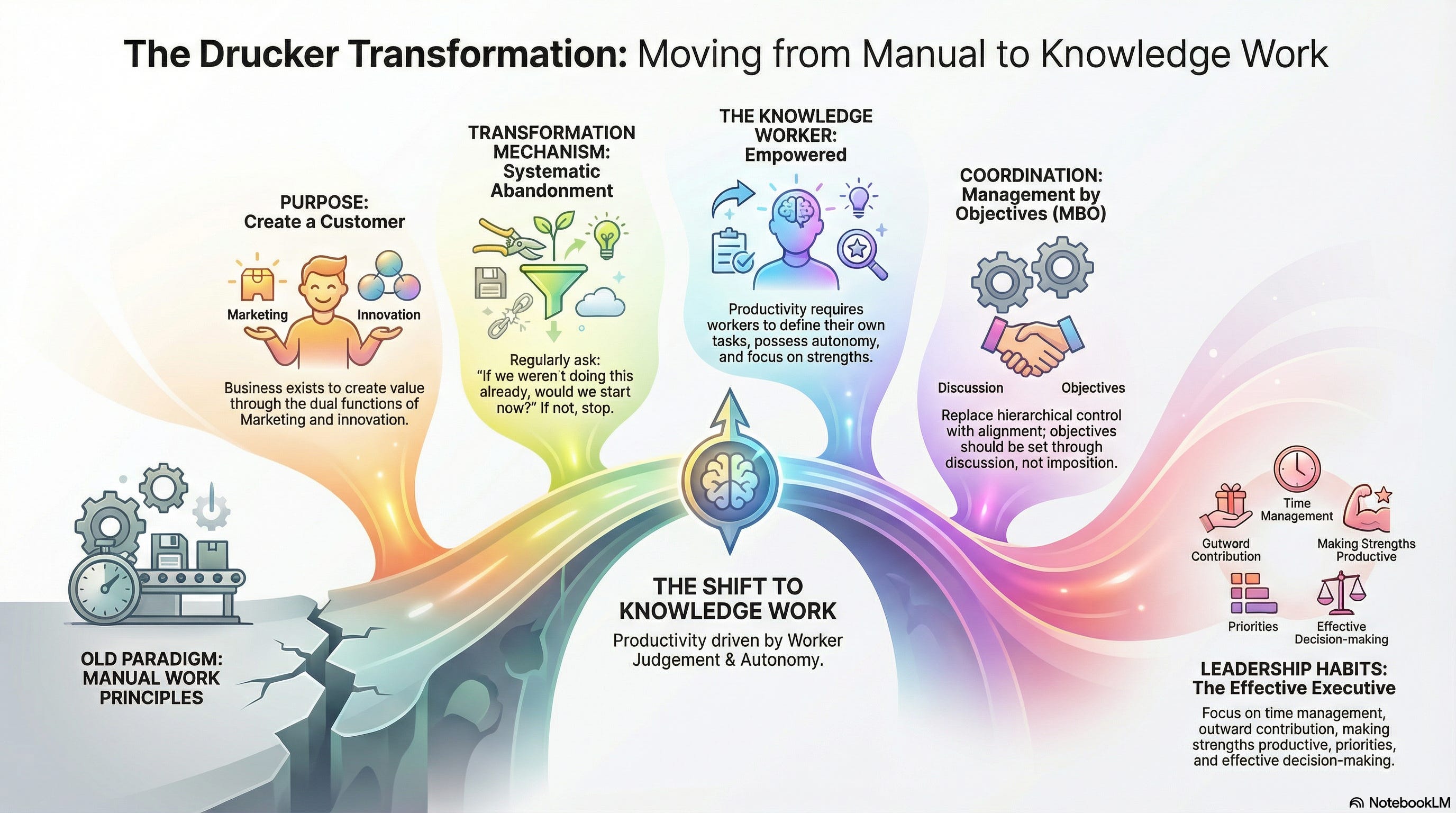
1. Create a Customer, Not a Profit
Drucker’s most radical claim is deceptively simple: the purpose of a business is not to make profit. It is to create a customer. Profit is a necessary condition for survival, but it is not the purpose. The purpose is to create something that someone values enough to pay for.
This reframes what “success” means for AI adoption. If the purpose is profit, AI is justified by cost reduction: fewer developers, faster delivery, cheaper operations. If the purpose is to create a customer, AI is justified by something different: the ability to build things customers actually want, faster and more precisely than before. The distinction determines what you measure, what you invest in, and what you ask people to learn. Normann deepened this by dissolving the boundary between firm and customer entirely. In the value constellation, the customer is not a passive recipient but an active co-producer. Drucker’s “create a customer” anticipates this: the purpose is not to serve the customer but to create the conditions in which the customer can participate in value creation.
2. The Knowledge Worker Owns the Means of Production
Drucker’s knowledge worker concept is the foundation stone. A knowledge worker owns their means of production: their knowledge. Unlike a manual worker, the knowledge worker must define the task before they can do it. Their output is quality, not quantity. They cannot be supervised in the Taylorist sense because the work is invisible until it produces results. Autonomy is not a perk. It is a structural requirement.
This has a devastating implication. AI does not replace the knowledge worker. It depends on them. The quality of the AI output is entirely determined by the quality of the specification the knowledge worker provides. An imprecise specification produces useless code, regardless of how powerful the model. This is the specification problem. It is not a technology problem. It is a knowledge worker productivity problem. Drucker told us decades ago that solving it requires removing obstacles and enabling autonomy, not imposing controls and measuring outputs.

Taylor is the figure Drucker argued against. Taylor separated thinking from doing: the manager thinks, the worker executes. Drucker reunited them: in knowledge work, thinking is the doing. The specification writer cannot be separated from the specification. To impose Taylorist supervision on this process, to measure it by volume of specifications produced, is to destroy the very productivity you are trying to create.
Bateson’s levels framework reveals the epistemological depth. Drucker’s knowledge worker operates at Learning II: they must define the task, which means questioning the frame within which the task has been understood, not merely executing within it. Taylor’s worker operates at Learning I: they correct errors within a frame defined by management. AI transformation demands Learning II, because the task itself must be defined before the machine can act on it. The organisation that treats specification as a Learning I activity, a template to be filled in, a form to be completed, has misunderstood both Drucker and Bateson. The specification is not a form. It is the act of defining the task, and defining the task is the knowledge work.

Deci and Ryan provide the psychological evidence for Drucker’s structural argument. Knowledge work productivity requires autonomy, competence, and relatedness. When organisations respond to AI by imposing governance that dictates how AI may be used, by measuring compliance rather than quality, and by restructuring teams in ways that break relationships, they thwart all three needs. The predictable result is disengagement, interpreted as resistance, triggering further control, deepening disengagement. The cycle is vicious and self-reinforcing.
3. Management by Objectives: The Corrupted Ideal
Drucker invented Management by Objectives with a specific intent: to enable decentralisation and autonomy. If people understood the objectives clearly, they could determine for themselves how to achieve them. MBO was designed to replace command-and-control with trust-and-clarity.
What happened was the opposite. MBO was corrupted into top-down quotas, cascaded KPIs, and surveillance. The objectives were imposed, not negotiated. The “how” was specified along with the “what.” Drucker acknowledged the corruption: “MBO works if you know the objectives. Ninety percent of the time you don’t.”
The parallel to specification-driven development is exact. A specification, properly understood, defines what and why but leaves how to the AI and the team. This is MBO applied to software production. But if specifications become rigid instruction sets imposed by a planning function, if they become the AI equivalent of cascaded KPIs, the corruption is identical. The specification should liberate, not control. Deming went further: his eleventh point, “eliminate management by objective,” rejected what MBO had become. Deming argued that quotas address numbers, not quality, and that MBO without method is management by fear. The corruption Drucker lamented, Deming diagnosed as inherent to any system that specifies outcomes without providing the means to achieve them.

Weick would add that the objective’s value lies partly in the sensemaking process that produces it, not just in the document that results. The conversation about what the specification should say is where the real learning happens. The specification itself is a by-product.
4. Systematic Abandonment: The Discipline Nobody Practises
Of all Drucker’s ideas, systematic abandonment is the most underused and the most needed. The discipline is simple: regularly ask, “If we were not already doing this, would we start now?” If the answer is no, stop.
Every organisation has processes that exist because they were once necessary. The architecture review board that was essential when systems were handcrafted may be harmful when systems are generated from specifications and validated automatically. The separate testing phase that was necessary when code was written by humans may be redundant when validation is continuous. Yet nobody stops them, because stopping threatens the people whose roles depend on them. This is where Drucker meets Dekker. The resistance to abandoning outdated processes is locally rational: the people running them are protecting their livelihoods, their status, and their sense of contribution.

Giddens explains why abandonment is structurally difficult. The processes are not merely procedures. They are structures reproduced through daily practice: relationships, sources of status, patterns of meetings, ways of knowing where power sits. Bourdieu adds the embodied dimension: the dispositions acquired in the old world persist long after the conditions that produced them have changed. Heifetz would name the adaptive challenge: the people who must abandon the old processes are the people whose identity was built through them. That is a loss, and it must be named before it can be processed.
Weber provides the biggest framing. The processes that resist abandonment are the local expression of rationalisation: the deep commitment to making the world calculable and controllable through formal rules. Weber would predict that the organisation’s response to systematic abandonment will be to create a new process for deciding which processes to abandon, adding bureaucratic weight in the act of trying to remove it.
Drucker’s systematic abandonment is the refactoring discipline for organisational design. For every new AI governance requirement, ask: what existing requirement does this replace? If the answer is “none, it is additional,” you are adding weight, not enabling transformation.
5. The Effective Executive and the Transformation Leader
Drucker’s five practices of the effective executive translate directly to transformation leadership. Know where your time goes: Mintzberg studied what managers actually do and found it bears little resemblance to what they say they do. Focus on contribution: Heifetz would recognise this as distinguishing technical work from adaptive work. Make strengths productive: the domain expert who understands the business deeply is not deficient because they cannot code; they are the ideal specification writer. Dweck would add that this requires treating “strength” as developable, not static. First things first: the organisation that launches twelve AI pilots simultaneously will complete none. And make effective decisions: Drucker insisted decisions require disagreement, the deliberate cultivation of opposing views. If everyone agrees with the AI strategy, something important is being suppressed. Argyris would call this making the undiscussable discussable.
Where this sits: Learning, the first of the series' four phases; Learning, Deciding, Building, Transforming. Drucker belongs here because knowledge work can only be made productive by somebody who can see what the work actually is, which is the whole business of the first phase. He returns twice, in Deciding on the logic of the well-made wrong answer and in Transforming on management as a liberal art. From Learning to Clarity is where the question changes.
(An Organisational Prompt is something you can do now....)
Organisational Prompt
Take one governance process that every initiative must pass through. Ask the people who run it: “If this process did not exist, would we create it today, knowing what we know about AI-generated code and automated validation?”
If the answer is no, or if it is a long pause followed by a qualified yes, you have found process debt. Organisations accumulate process debt the same way they accumulate technical debt. The constraint is rarely that you need to add something new. It is that you need to stop doing something old. The freed capacity is the space in which learning becomes possible.
Further Reading
Peter Drucker, The Effective Executive (1967). Still the most practical book on management ever written. Short, clear, ruthlessly focused on what actually makes leaders productive.
Peter Drucker, Management Challenges for the 21st Century (1999). Where Drucker directly addresses knowledge worker productivity as the defining challenge. The argument that knowledge workers must manage themselves.
Peter Drucker, Innovation and Entrepreneurship (1985). The seven sources of innovation, including “the unexpected success” that organisations systematically ignore because it does not fit their plan.
W. Edwards Deming, Out of the Crisis (1986). Read alongside Drucker for the critique of what MBO became. Together they define the challenge: clarity of purpose without the surveillance apparatus that destroys the autonomy the purpose was supposed to enable.
I write about the industry and its approach in general. None of the opinions or examples in my articles necessarily relate to present or past employers. I draw on conversations with many practitioners and all views are my own.