
The people who are supposed to adopt a new way of working often do not adopt it. Not because they disagree with the strategy. Not because they lack access to the tools. Not because they have not been trained. Because they do not believe they can do it.
Albert Bandura identified this as the single most powerful predictor of human behaviour: not what people can do, but what they believe they can do. He called it self-efficacy, the domain-specific belief in one’s capability to perform a particular task, and demonstrated across hundreds of studies that it predicts performance more reliably than actual skill, past experience, or incentive structures. People who believe they can do something attempt it, persist through difficulty, and recover from failure. People who do not believe they can do it avoid it, give up early, and interpret setbacks as confirmation of their inadequacy. The belief precedes the behaviour. And in AI transformation, the belief is almost always missing, because the capability being asked for is genuinely new and nobody has yet experienced themselves succeeding at it.
1. Self-Efficacy Is Not Self-Esteem
Self-efficacy is precise, specific, and domain-bound. It is not self-esteem, not general confidence, not optimism. It is the answer to: “Can I do this particular thing, in this particular situation, right now?”
A senior developer can have high self-esteem and zero self-efficacy for writing AI specifications. The general positive feelings do not transfer. They know, with the clarity that comes from decades of practice, that they are excellent at writing code. They have no basis for believing they can write a specification precise enough for AI to generate working software. They have never done it. They have never seen anyone like them do it. And their body, when they contemplate attempting it in front of colleagues, produces the unmistakable sensations of anxiety rather than readiness.

Bourdieu would recognise the mechanism. The developer’s habitus was formed through years of practice in a field that rewarded code-writing expertise. The dispositions that generate their sense of professional competence are calibrated to that field. AI transformation shifts the field: the new capability (specification writing) has no purchase in the existing habitus. The developer does not merely lack the skill. They lack the embodied basis for believing the skill is theirs to acquire. Their habitus tells them who they are, and who they are is not someone who writes specifications. The belief deficit is not cognitive. It is dispositional.
2. The Four Sources: A Hierarchy That Transformation Programmes Invert
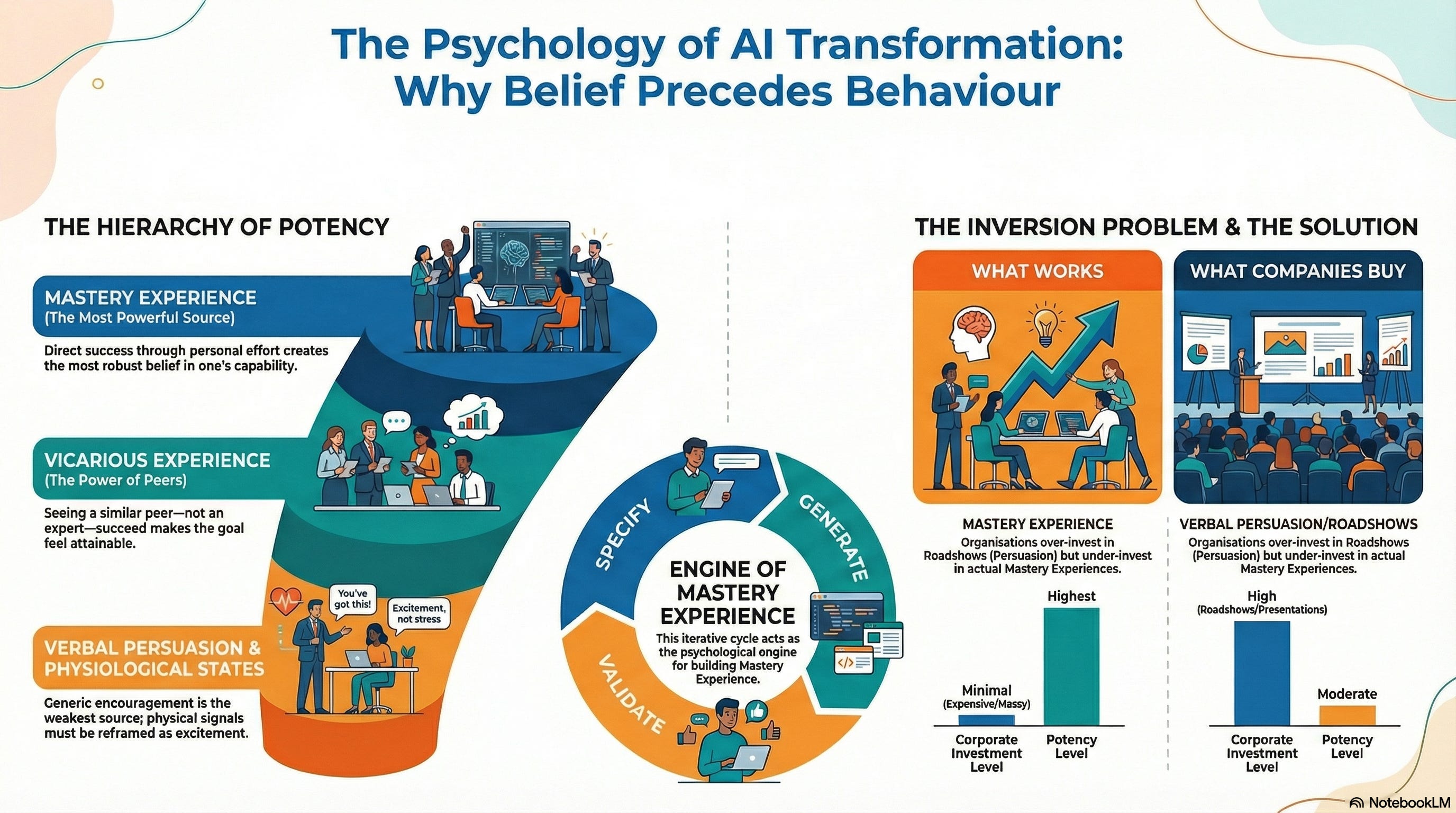
Bandura identified four sources of self-efficacy, ordered by potency. Understanding this hierarchy is essential because most transformation programmes invest everything in the weakest sources and almost nothing in the strongest.
Mastery experience, actually doing the thing and succeeding, is the most powerful source by a significant margin. Direct personal experience of success builds robust belief that transfers to related challenges and persists through setbacks. But the attribution matters: the person must believe the success resulted from their own effort, not from luck, excessive help, or an artificially easy task.
Vicarious experience, watching someone similar succeed, is the second most powerful. The key word is similar. Watching an AI expert effortlessly generate code does almost nothing for the self-efficacy of a domain expert who has never written a specification, because the observer cannot identify with the model’s starting point. But watching a peer struggle, iterate, and eventually produce something that works is profoundly influential. The struggle is the mechanism. Edmondson’s psychological safety determines whether the struggle can be visible: nobody will model the learning process if modelling it carries social risk. Dweck’s growth mindset determines whether the struggle is interpreted as learning (valued) or incompetence (stigmatised).
Verbal persuasion, being told you can do it by someone credible, is weak but not negligible. Effective persuasion is specific: “Your ability to decompose complex business processes into clear rules is exactly the skill that specification writing requires.” This bridges existing self-efficacy to the new domain. Generic persuasion (”I believe in you”) connects to nothing.
Physiological and emotional states, how you interpret your body’s signals, operate automatically. The same elevated heart rate can be read as excitement or as anxiety. The interpretation feeds directly into self-efficacy.
Now consider how transformation programmes allocate resources. They invest heavily in verbal persuasion: executive announcements, strategy presentations, training. They invest moderately in vicarious experience but typically the wrong kind: vendor demonstrations by experts rather than peer learning by similar others. They invest minimally in managing physiological states. And they invest almost nothing in mastery experience, the most powerful source, because mastery experience requires giving people real problems, real tools, and real time, which is expensive, messy, and does not fit a twelve-week change plan. The hierarchy is inverted. The organisation spends the most on what works least.
3. Mastery Experience and the Learning Loop
Bandura’s theory explains why demonstrations and early experiments are not marketing exercises. They are the primary mechanism by which organisations develop the psychological capability for change. When a team writes a specification and watches AI generate working code from it, something happens that no presentation can produce: the felt experience of “I did that, and it worked.” That is a mastery experience, and it builds self-efficacy in a way that is qualitatively different from any other intervention.

The design matters enormously. The first experience must succeed, not artificially, but the difficulty must be calibrated so that genuine effort produces a visible result. Csikszentmihalyi’s flow research provides the design principle: challenge matched to current skill. Too hard produces anxiety that reduces self-efficacy. Too easy produces dismissal. Success must be attributed to effort and strategy, not luck or help. And difficulty must increase progressively, which is where Ericsson’s deliberate practice connects: each step stretches capability without breaking confidence.

Bateson’s levels illuminate what is happening beneath the surface. The first mastery experience is Learning I: the person succeeds within a bounded frame. But the accumulation of mastery experiences, with progressive challenge, produces Learning II: the person’s model of their own capability expands. They are not just learning to write specifications. They are learning that they are the kind of person who can learn to write specifications. The identity shift, from “I am someone who writes code” to “I am someone who can articulate intent precisely enough for machines to act on it,” is the Learning II outcome that transforms the habitus. Each mastery experience is a small intervention in the field that Bourdieu describes, gradually forming new dispositions that generate new practice.

Deci and Ryan’s competence need connects here directly. Self-efficacy is the cognitive mechanism through which competence is experienced. When the specification-generate-validate loop works, the person is simultaneously building self-efficacy (Bandura) and satisfying their competence need (Deci and Ryan). The loop is a psychological engine, not merely a technical process.
4. The Verbal Persuasion Trap
Most organisations invest disproportionately in verbal persuasion because it is scalable and least disruptive. Training programmes, presentations, e-learning modules are all forms of verbal persuasion in Bandura’s framework. They tell people they can do something. They produce minimal self-efficacy change, because telling someone they can do something is fundamentally different from them experiencing it themselves.
Verbal persuasion works when three conditions are met: the persuader is credible and trusted, the message is specific (connecting the new challenge to existing capabilities), and the persuasion is immediately followed by an opportunity for mastery experience. Most training programmes meet none of these conditions. The trainer is external. The message is generic. And the training ends before any mastery experience is attempted. Participants return to their desks, discover the training did not prepare them for real complexity, and conclude they lack the ability.

Argyris identified this pattern. The espoused theory: “This training will equip you.” The theory-in-use: “This training will provide information that is necessary but insufficient, and the gap will be closed through practice, failure, and repetition that the programme neither provides nor acknowledges.” The gap is undiscussable because acknowledging it would undermine the business case for training.
The alternative is embedded learning through guided practice. Not training followed by application, but application guided by coaching in real time, on real problems, with real feedback loops. The specification-generate-validate loop is a self-efficacy building cycle when properly supported: the specification is the attempt, the generated output is the feedback, and the iteration is the mastery experience. But it requires someone alongside during the critical early attempts when self-efficacy is most fragile.
5. From Individual Belief to Collective Capability
Bandura’s later work extended self-efficacy to the group level: collective efficacy, the shared belief in a group’s capability to achieve a desired outcome. This matters for AI transformation because the capability required is not individual but collective. Writing a good specification requires domain expertise, technical understanding, and validation design, rarely possessed by a single person. The relevant belief is not “Can I write a specification?” but “Can we, this team, produce specifications that generate useful results?”
Collective efficacy is built through the same four sources at the team level: shared mastery experiences, watching a similar team succeed, credible affirmation from a trusted leader, and shared emotional states. Giddens would locate collective efficacy in practical consciousness: the taken-for-granted assumption that governs group behaviour. A team that believes “we can figure this out” does not articulate this in every meeting. It operates as a background assumption shaping what the team attempts and whether they persist. Moving a team from “we have been through this before and it never works” to “we can figure this out” requires precisely the mastery experiences Bandura describes. The assumption cannot be installed through communication. It must be built through experience, which is why Weick’s insistence that action precedes understanding applies as much to collective belief as to individual sensemaking.
Stacey would add that collective efficacy is not a property the leader can design into a team. It emerges from the quality of interaction between the people in the team. The leader’s role is to create the conditions: the right problem, the right support, the right level of challenge, the safety to fail visibly. What emerges from those conditions is the team’s to produce.
This is a Learning article; the series runs Learning, Deciding, Building and Transforming, in that order. The first of those asks whether an organisation can perceive and act on its own situation, and self-efficacy is the condition under which anybody bothers to try. What an organisation gets out of that work is the belief that effort connects to outcome, without which nothing later is attempted at all. From Learning to Clarity is where the question changes from Learning to Deciding.
(An Organisational Prompt is something you can do now....)
Organisational Prompt
Identify the next AI learning activity your organisation has planned. Now redesign it using Bandura’s hierarchy. Ensure that every participant does the thing, not just hears about it, before the session ends. Make the problem real but calibrate the difficulty so that success is achievable with genuine effort. If the session does not end with every participant having experienced “I did that and it worked,” the session has failed, regardless of how much content was covered.
For vicarious experience: do not use an expert demonstrator. Find a peer who learned recently and is willing to share honestly, including the confusion, the struggle, and what they would do differently. The struggle is the mechanism, not a flaw in the presentation.
Further Reading
Albert Bandura, Self-Efficacy: The Exercise of Control (1997). The definitive academic treatment. The four sources of self-efficacy and the experimental evidence that belief in capability predicts performance across virtually all domains studied.
Albert Bandura, Social Foundations of Thought and Action: A Social Cognitive Theory (1986). The broader framework: observational learning, reciprocal determinism, and the mechanisms by which people, behaviour, and environment continuously shape each other.
Albert Bandura, Self-Efficacy: Toward a Unifying Theory of Behavioral Change (Psychological Review, 1977). The foundational paper introducing the four sources. Freely available.
K. Anders Ericsson and Robert Pool, Peak: Secrets from the New Science of Expertise (2016). The essential companion: self-efficacy explains why people persist or give up; deliberate practice explains how expertise develops when they persist. Together they provide the design principles for learning pathways that build both belief and capability.
I write about the industry and its approach in general. None of the opinions or examples in my articles necessarily relate to present or past employers. I draw on conversations with many practitioners and all views are my own.