
The data platform was approved in under an hour. The business case was clean, the vendor credible, the numbers held, and everybody agreed. Eighteen months later it was technically sound and strategically useless — built to answer questions the company had stopped asking. No one in that room chose badly. They optimised an answer to a question nobody had pinned down.
Most decision post-mortems look for the bad choice. They rarely find one. What they find instead is a decision taken without anyone having established two things: whether the organisation knew what it was deciding, and whether it had picked a sound way to decide it. A decision has two failure modes, and the visible one — the wrong call — is the rarer of them. The dangerous one is structural and almost invisible: a sound-looking choice produced by a process that was never fit for the decision in front of it.
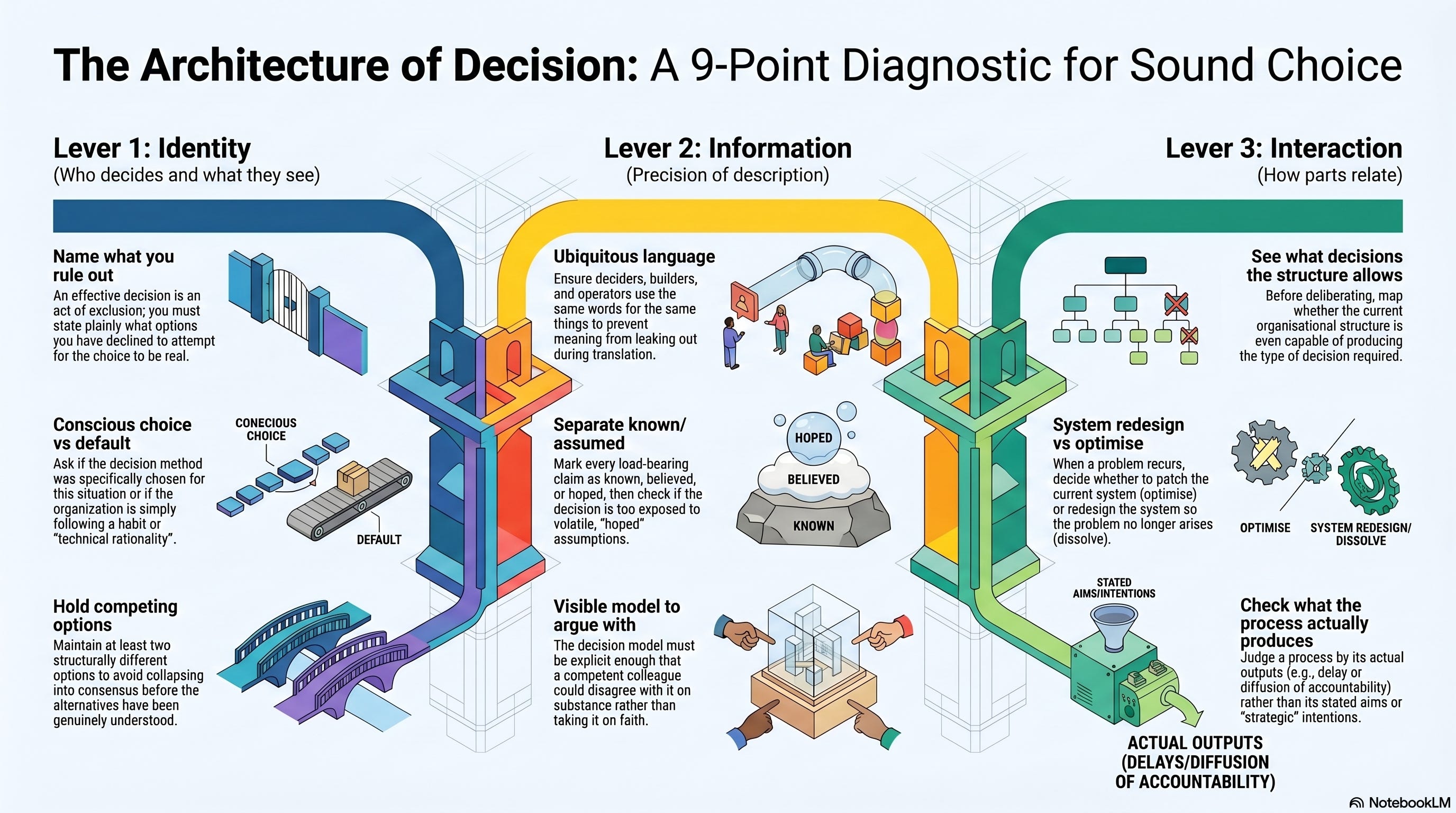
This is the closing instalment on deciding, and its job is consolidation. These articles have moved through bounded rationality and satisficing, ubiquitous language and the discipline of going to see, viable systems and the purpose revealed by behaviour, heuristics and recognition and reflective practice, dissolution and incrementalism and orientation. Behind that variety is a single claim, the Deciding hypothesis: decisions are design challenges, and design is a sequence of decisions under constraint. If that is true, then a decision can be examined the way a design can be examined — not by whether you like the result, but by whether the process that produced it was sound. This article turns the phase into nine methods. Each one is a diagnostic, something you can observe, and a method, something you can do. They fall into three groups, the three levers that run through every phase of this series: Identity, Information, and Interaction. Used together, they answer the two questions a decision actually turns on. Do you know what you are deciding? And have you chosen a sound way to decide it?
The three levers are not a sequence. A decision is exposed to all three at once. Identity concerns who decides and what they are able to see; that is Simon’s territory. Information concerns how precisely the thing being decided can be described; that is Ohno’s. Interaction concerns how the parts of the organisation relate at the moment the decision is made; that is Beer’s. The nine methods are three to a lever. What follows is each of them, and then the consolidated diagnostic a practitioner can use.
Identity: Who Decides, and What They Can See
The Identity questions are about what constrains the decision-maker before the decision begins. Simon is its foundational thinker. Bounded rationality is not a flaw to be corrected by better training or more data; it is the permanent condition of every decider, human or organisational. No one sees the whole problem. The Identity methods do not remove the constraint. They make it visible, so that whatever is excluded is excluded on purpose rather than by accident.

1. Name what you will not do. Can the organisation state, for this decision, what it has ruled out? Simon’s satisficing carries an implication that is easy to miss: a decision is an act of exclusion. To decide is to close options, and if you cannot say which options you are closing, you have not decided. You have added a commitment alongside all the others and called it a choice. Drucker said the same thing in the language of boundary conditions — an effective decision specifies what it must accomplish, and by implication what it declines to attempt. Rumelt’s account of bad strategy is the diagnostic in negative form: bad strategy is the strategy that excludes nothing, the list of good things, the dog’s dinner of goals that reads as ambition and functions as evasion. The method is blunt. Require every proposal to carry an explicit statement of what it rules out. That statement is the decision. Everything else in the document is justification. And exclusion only counts as a decision if the thing excluded was genuinely on the table, which raises the next question: whether the decision was made at all, or merely inherited.

2. Tell choosing from defaulting. When was this decision last consciously taken? Bounded rationality has a second consequence. Most of what an organisation appears to decide, it does not decide. It defaults. The decision premise was set years ago, by someone who has since left, for conditions that have since changed, and it now runs unexamined because nothing has forced it back into view. March named the pattern: getting better at the wrong thing, the competency trap, in which the organisation refines an inherited answer with real discipline and never asks whether the answer still fits the question. Christensen’s incumbents did not choose to miss the disruption; they defaulted into the decision their existing customers and their existing margins had already made on their behalf. The default extends past answers to methods. An organisation inherits not only what it decides but how it decides — the committee, the business case, the steering group, applied to every decision regardless of type because they are simply what the structure produces. Schön named the underlying error, technical rationality: the assumption that every problem is a well-formed problem, to be solved by applying the standard procedure. Most real decisions are not in the textbook. They are in what he called the swampy lowland. The method: for any significant decision, ask when it was last consciously taken, and whether the method now being used was chosen for this decision or simply supplied by habit. If neither has an answer, you are not deciding. You are maintaining.
3. Hold competing designs without closing too early. Are there at least two structurally different options genuinely in play — and do they decide the question in different ways? Boyd’s OODA loop locates the advantage with whoever can hold a situation open longer and re-orient inside it faster, not with whoever commits first. Kegan’s self-transforming mind describes the developmental capacity this requires: the ability to hold a position and its opposite without needing the discomfort resolved before it has been understood. An organisation that collapses to consensus before its alternatives have been genuinely inhabited has not chosen between options. It has ratified the first one and staffed the rest. This is also the method where the way of deciding gets chosen. Two options that differ only in detail can be decided by the same procedure. Two options that are structurally different — build it versus dissolve the need for it, optimise the current system versus redesign it — cannot, and the gap between them forces the organisation to ask which way of deciding actually fits. Gigerenzer’s work belongs here: there is no single best method, only a method matched to its environment, and a fast heuristic will outperform an elaborate analysis in an uncertain world while the reverse holds in a stable one. Klein showed that experts under time pressure do not compare options at all; they recognise a workable one and simulate it forward. Kahneman completes the set with the necessary caution: know when the situation is benign enough to trust the fast judgement, and when it will punish you for trusting it. The method: require at least two structurally different options before any commitment, and make each option name the method by which it would be decided. Where the methods differ, you have found the real decision — which is not which option to take, but how to choose. Holding genuine alternatives, though, depends on being able to describe them precisely enough to tell them apart, and that is the work of the second lever.
Information: How Precisely You Can Describe What You Are Deciding
The Information questions are about whether the organisation can describe the thing it is deciding about with enough precision to decide within it. Ohno is its foundational thinker. Evans, whose ubiquitous language and bounded contexts run through the phase, is the software instantiation of an older and more general discipline, and that discipline is Ohno’s. Gemba is the instruction to go and see the actual place where the work happens, because the description that reaches the decision-maker has been smoothed, summarised, and quietly flattered at every level it climbed. Standard work is the current best description of how a thing is done, written down — not so that it can be obeyed, but so that it becomes the explicit hypothesis the next observation can falsify. The Information methods are the discipline of seeing precisely enough to decide.

4. Use one language for the domain. Do the people deciding, the people building, and the people operating use the same words for the same things? This is Evans’s ubiquitous language. Where a domain expert says one thing, a strategy deck says another, and the running system encodes a third, the organisation does not have a model of its domain. It has three, and the translation between them is exactly where meaning leaks out. Ohno would say the description has drifted from the gemba — that the account on the slide no longer matches the work on the floor. The test is auditory. Listen for translation. Where a meeting needs someone to explain what a term really means, the model is split, and every decision taken on top of it inherits the split without knowing it has. The method is not to mandate a glossary, which produces a document nobody consults. It is to put the people who decide, build, and operate in the same room using the same words until the words mean one thing.
5. Separate what you know from what you assume. For each claim the decision rests on, is it marked as known, believed, or hoped? This is the method that most directly tells you what kind of decision you are in, and therefore how it should be decided. A decision rests on claims, and the claims are not all the same. Some are known. Some are believed on reasonable evidence. Some are hoped, and dressed as believed. Taleb’s distinction is the sharp edge here: a decision in a domain of thin, well-behaved uncertainty can be optimised, and a decision exposed to fat-tailed, consequential uncertainty cannot. In the second domain the only sound methods are the ones that cap the downside, preserve optionality, and proceed by via negativa — removing the fragilising error rather than predicting the unpredictable. An organisation that has not established which kind of uncertainty it faces will choose the wrong method with complete confidence. Parnas gives the constructive form of the same instruction from software: a design should hide the decisions most likely to change, and to hide them you must first know which they are — which assumptions the design rests on and which are likely to change, and which are safe to build on. The method: mark every key assertion in a strategy or design as known, believed, or hoped, then check whether the volatile, consequential assumptions are the ones the decision is most exposed to. If they are, the method must change. Stop optimising and start limiting downside.
6. Make the model visible enough to be argued with. Is the model behind the decision explicit enough that a competent colleague could disagree with it on the substance? Evans treated the domain model as a designed artefact, not a diagram drawn after the fact to decorate a decision already taken. Ohno’s standard work is a hypothesis precisely because writing the current method down makes it challengeable — a thing the next observation at the gemba can prove wrong. Argyris named the failure mode with more force than anyone else here: the model that cannot be challenged is the one held as a theory-in-use, never surfaced, never tested, and defended most strongly by the people who deny holding it at all. Senge’s mental models and Nonaka’s movement from tacit knowledge to explicit are the same instruction approached from different sides. A decision model that lives only inside someone’s head cannot be improved, because it cannot be attacked. The method: make every decision model explicit enough that someone could disagree with it specifically. If no one can locate the thing to disagree with, the model is not visible, and the decision is being taken on faith. A precise description, though, is always taken inside a structure, and the structure has already shaped what the decision is allowed to be. That is the third lever.
Interaction: How the Parts Relate When the Decision Is Made
The Interaction questions are about how the parts of the organisation relate at the moment a decision is made. Beer is its foundational thinker. His POSIWID — the purpose of a system is what it does — is the most unforgiving diagnostic in the series, because it refuses to let an organisation describe itself by its intentions. Ackoff supplies the constructive move: the distinction between solving a problem inside the existing system and dissolving it by redesigning the system so the problem no longer arises. Conway supplies the structural fact the whole lever rests on: an organisation’s communication structure is reproduced in everything it designs, and that includes its decisions.
7. See the decision the structure will allow. Before asking what we should decide, have we asked what decisions this structure can produce? Conway’s law, generalised from software to decisions, says that a structure built around three divisions will produce three-division decisions, and a structure with no forum where two functions meet cannot produce a decision that requires those functions to agree. Alexander made the same observation in architecture: form is shaped by the structure of the context that produces it, and a form imposed against that structure will not hold for long. The decision an organisation reaches is bounded by the conversations its structure permits before anybody sits down. The method: before deliberating, map which decisions the current structure can and cannot produce. If the decision you need is not one the structure can produce, then the first decision is a structural one, and deliberating before you have made it is theatre.

8. Decide whether to redesign the system or optimise within it. When a problem recurs, is it being solved, or is the system that keeps generating it being redesigned? Ackoff distinguished resolving a problem, solving it, and dissolving it, and argued the highest move is dissolution — redesigning the system so the problem stops arising. Lindblom is the honest counterweight, and both are needed. Most organisations cannot redesign their systems at will, and should not pretend they can; they muddle through by small comparative steps, and incrementalism is a genuine method with real strengths in a world too complex to redesign with confidence. The point is not that redesign beats incrementalism. It is that they are different methods, and an organisation should know which one it is using and why it has chosen it. A recurring problem patched the same way every time is the signature of incrementalism applied where dissolution was needed — and applied not as a choice but as a reflex. The method: when a problem recurs, ask explicitly whether the problem lies in the decision or in the system that keeps generating the decision, and choose the method to match. Patch by intent, not by habit.
9. Check what the decision process actually produces. Does the way this organisation decides produce what it claims to produce? This is Beer’s POSIWID turned on the decision process itself. A process that reliably produces delay, or the diffusion of accountability until no one owns the outcome, or the protection of the largest existing budget, has those as its purpose, whatever its stated aim. The gap between what the process claims and what it does is the real strategy of the organisation, and it is observable, which is the standard this series sets for every probe. The military tradition examined earlier in the series supplies the constructive form: a decision is not complete until accountability for it is unambiguous and the process that produced it can be examined honestly after the fact. The method: take the last several significant decisions, compare what the process actually produced with what it claimed it would produce, and decide on the basis of the gap rather than the claim.
Choosing How to Decide
The nine methods do two distinct jobs, and it is worth separating them. Methods four, six, and seven test whether the organisation knows what it is deciding — whether the thing on the table has been described in one language, modelled visibly enough to be argued with, and bounded by a structure the organisation has actually examined. Methods one, two, three, five, and eight test whether it has chosen a sound way to decide — whether it has excluded on purpose, chosen rather than defaulted, held genuine alternatives, typed its uncertainty correctly, and matched redesign or incrementalism deliberately to the problem. Method nine tests both at once, after the fact, by looking at what the process produces over time.
These articles have, in effect, been assembling a small library of deciding methods, and the consolidation worth stating plainly is that there is no best one. Optimisation suits a described, stable, thin-uncertainty decision. Satisficing suits a bounded decision where optimisation is not available at any reasonable cost. Recognition-primed judgement suits a time-pressed domain in the hands of a genuine expert. Heuristics suit an uncertain world. Dissolution suits a recurring structural problem. Incrementalism suits a world too complex to redesign with confidence. Via negativa suits a decision exposed to consequential tails. The error diagnosed here, in one thinker after another, is almost never the wrong option. It is the organisation’s habitual method applied to a decision of a type that method cannot handle — and the misapplication going unnoticed, because the method itself was never chosen, only inherited.
AI sharpens this rather than changing it. As generation becomes cheap, the bottleneck in deciding moves decisively away from producing options and analysis and towards choosing well among them. A model will generate a credible business case, a plausible architecture, and a confident recommendation in the time it once took to schedule the meeting. None of that touches the two questions that actually matter. The organisation that treats AI as a way to produce more decisions faster will accelerate its existing pathologies. The organisation that treats it as a reason to get deliberate about what it is deciding, and how, will have used the tool for the one thing it cannot do itself.
The Consolidated Diagnostic
Nine questions. They are not a scoring rubric. They are the checks a practitioner runs before committing, and again afterwards, and the value is in the questions the organisation cannot answer, because each unanswerable question names a method it does not yet have.
Identity — who decides, and what they can see:
Can we state plainly what this decision rules out?
When was this decision last consciously taken, and was the method being used chosen for it or simply inherited?
Are there at least two structurally different options in play, and do they decide the question in different ways?
Information — how precisely the decision is described:
Do the people who decide, build, and operate use one language for the domain, with nobody translating between them?
Is each claim the decision rests on marked as known, believed, or hoped, and is the consequential uncertainty correctly typed?
Is the model behind the decision explicit enough that a competent colleague could disagree with it on the substance?
Interaction — how the parts relate when deciding:
Have we asked what decisions this structure is capable of producing before asking what we should decide?
When this problem recurs, are we solving it or redesigning the system that generates it — and is that a deliberate choice?
Does the decision process produce what it claims to produce, judged on the last several decisions rather than its stated aim?
If the organisation can answer the first six honestly, it knows what it is deciding and has chosen how. If it can answer the last three, the structure it decides inside is one it understands. If it cannot answer some of them, those are not gaps in the decision. They are gaps in the organisation’s capacity to decide at all, and they will recur under every future decision until they are closed.
Placement: Deciding, the second of four phases; Learning, Deciding, Building, Transforming. These nine methods belong to Deciding because every one of them interrogates a description before anything gets built. The three levers they cluster under, Identity, Information and Interaction, run through every phase and change only which thinker holds each one. Why Your Organisation Can't Decide is the synthesis that follows, and From Deciding to Building the bridge out.
I write about the industry and its approach in general. None of the opinions or examples in my articles necessarily relate to present or past employers. I draw on conversations with many practitioners and all views are my own.