
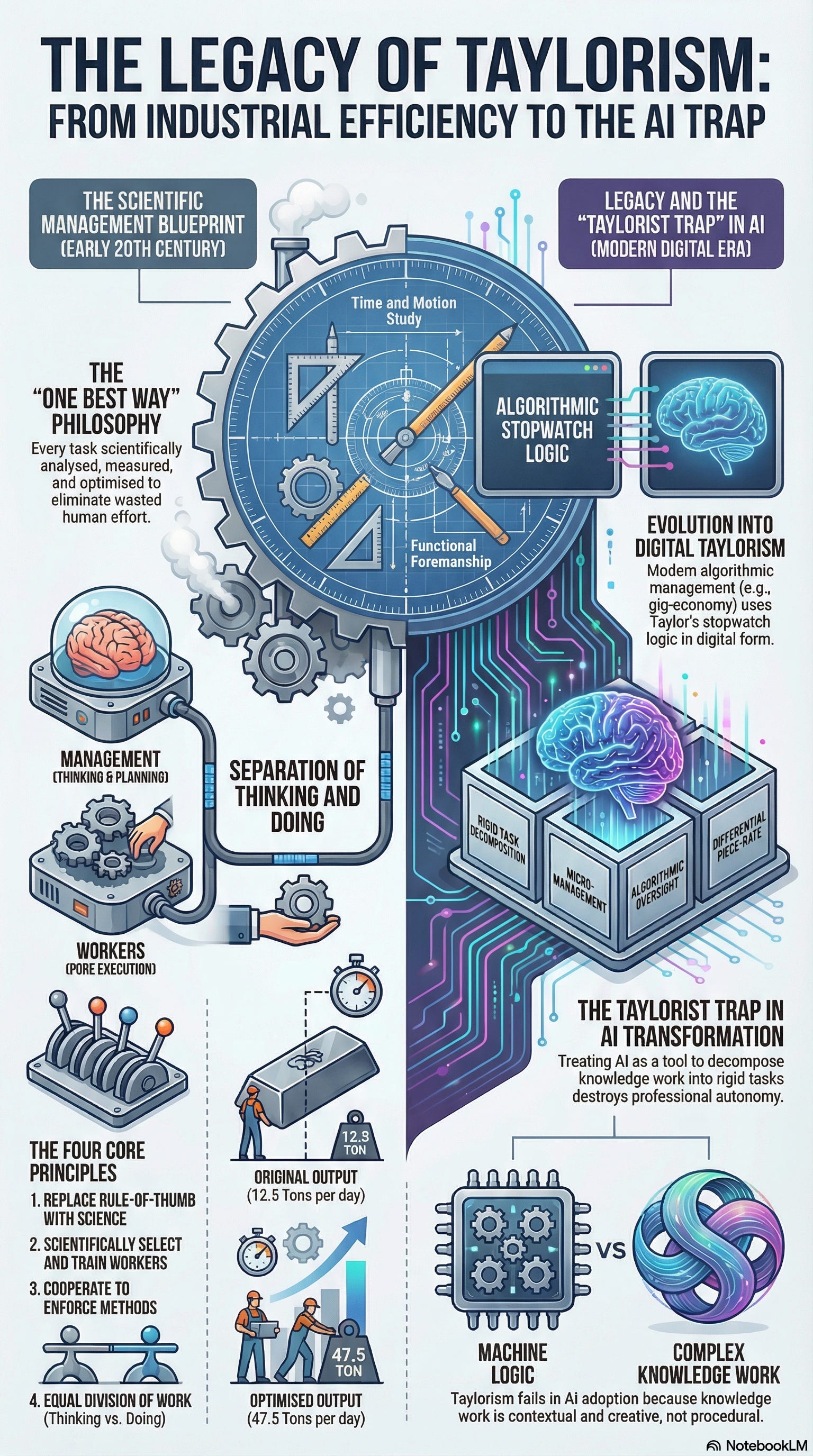
Modern leadership theory is an open rebellion against Frederick Winslow Taylor. So why does he still run your company? Walk into a boardroom and you will hear the language of the future: learning organisations, psychological safety, self-organising teams. Watch what the leaders actually do, how they budget, plan, restructure and measure, and you will see the ghost of a man who died in 1915.
Almost every modern theory of transformation attacks the scientific management Taylor established. Taylorism runs most large enterprises anyway, because it offers what the modern theories refuse to give, which is the feeling of control. Taylor deserves his context. He was an engineer solving problems on a factory floor, not designing knowledge work, his methods genuinely improved conditions for some workers, and his insistence that managers study their own work systematically was revolutionary. His principles have outlived the floor they were built for. Those principles are now the single greatest structural barrier to the learning this series describes.
1. The Separation of Thinking from Doing
Taylor split the organisation into two castes. Managers hold the knowledge and decide the one best way. Workers follow it without deviation.
That split survives in the belief that a strategy team can design a transformation and roll it out to everybody else. It survives in the assumption that the people closest to the work lack the tools to judge how the work should change. It survives most quietly in every governance framework that specifies the method rather than the outcome.

Drucker spent his career arguing against the split. Knowledge workers must define the task before they can do it, which repudiates Taylor’s core principle directly. Separate thinking from doing in knowledge work and you get specifications written by people who do not know the domain, built by people nobody asked what the real problem was. Mintzberg’s potter at the wheel is the anti-Taylor. Formulation and implementation are one act for her, because shaping the clay is what tells her what the pot will be.

Bateson shows the damage this does to knowing itself. Taylor’s framework can only produce Learning I, which corrects errors inside a frame that management has already fixed. Learning II questions the frame, and it is structurally impossible here, because the workers may not question and the managers stand too far from the material to know which questions matter. The split does more than slow the work down. It removes the capacity to question the frame, which is the capacity transformation runs on. Deming saw it plainly. His twelfth point, remove barriers to pride of workmanship, instructs you to undo Taylor’s division. People want to do good work. Systems that specify, monitor and restrict stop them.
2. The Machine Metaphor: Parts and Wholes
Taylor saw the organisation as a machine of independent parts. Tune each part, the worker and the department, and the whole runs better. Idle time is waste. Keep everybody busy.
That logic survives wherever resource efficiency is measured: every developer fully allocated, every department hitting its own targets, every sprint packed. Deming demolished the assumption. Tuning the parts damages the whole. Collaboration requires departments to give up their own efficiency for the good of the system, and his ninth point, break down barriers between departments, is the systems insight that follows. Tune one function and you create the queues, handoffs and rework that slow every other function down. An engineering organisation where every engineer is fully allocated is almost certainly drowning in context-switching and lead time.

Stacey takes this past the mechanical. Organisations are not machines with parts. An organisation is a pattern of interaction between people, and you cannot tune a conversation. You can create conditions in which better conversations happen more often. Specify and control the interactions instead, which is what governance frameworks and responsibility matrices do, and you get the appearance of coordination while destroying the informal adjustment that actually makes the place work. Peters said the same about rational-analytic management. The obsession with measurement and procedure kills the human energy that produces the performance.
The machine metaphor decides how the parts relate to each other. It makes them mechanical linkages to be tuned rather than living connections from which capability emerges. Every structure in this series that obstructs learning is a Taylorist structure, from the governance framework that prevents an experiment to the reporting line that filters what travels upward. Each was designed to control an interaction rather than enable one.
3. The Illusion of Predictability
Taylor believed that enough data would let you predict and control the future. Management is a science of cause and effect. Make a plan. Execute the plan. If the plan fails, the workers failed to follow instructions.
This drives the addiction to three-year roadmaps and milestone governance in environments nobody can forecast. Weick showed that action comes before understanding. We do not plan and then act. We act, and then we make sense of what happened. The roadmap is not wrong because its dates are wrong. It is wrong because it assumes a foreknowledge that complex domains do not contain.

Heifetz separates technical problems, where somebody already knows the answer and only has to apply it, from adaptive challenges, where the problem is unclear and the people who have it must do the learning. Taylor assumed every problem was technical. AI transformation is adaptive. Designing the solution and rolling it out is the commonest and most expensive error in enterprise AI adoption. Kahneman explains why the illusion holds. System 1 reaches for the feeling of control before System 2 gets the chance to say the control is not real.
4. The Motivation Myth
Taylor believed money moved workers, and that workers restricted their own output, which he called soldiering. Strict monitoring and piece-rate pay were his answer. The assumption survives in performance tracking, adoption dashboards and the whole apparatus of management by objectives. It surfaces every time a leader asks how to incentivise AI adoption, as though adoption were a behaviour you could buy.
Deci and Ryan rebut this most directly. External incentives of the kind Taylor prescribed do not merely fail to create motivation. They destroy the motivation already there. People need autonomy, competence and relatedness, and Taylorist management attacks all three. It removes autonomy by specifying the method, it removes competence by deskilling the work, and it removes relatedness by reducing workers to interchangeable units measured one by one.

Seligman explains what that produces over years. The passivity Taylor called soldiering, and that modern managers call change fatigue, is often learned helplessness: a rational decision to conserve effort in a system that has repeatedly shown effort does not matter. Dweck connects it to what people believe about ability. In the fixed mindset culture that ranking and rating create, people protect their reputation for competence rather than take a risk. You get exactly the soldiering Taylor diagnosed, from the opposite cause. People are not holding back out of laziness. They are holding back because the measurement system taught them that visible failure is punished and safe mediocrity is not.
5. Why We Cannot Escape
If everyone attacks Taylorism, why does it persist? Stacey answers with anxiety. Taylorism offers leaders safety: measure enough, plan enough, control enough, and you are safe. It turns a complex world, where you genuinely do not know what will happen, into a merely complicated one where you need experts and a roadmap.

Bourdieu explains how the persistence works. Taylorist assumptions are not conscious beliefs a manager could drop on better evidence. They are habitus, laid down in the body over decades of working that way, and a manager cannot simply decide to stop having them. Managers who were themselves managed by measurement and control reach for measurement and control when anxious. They did not choose Taylorism. Their hands produce it. Organisations that formally reject Taylor reproduce his logic anyway, because their managers were formed in his conditions.
Weber would say Taylor expressed a civilisational process rather than departing from one. The iron cage of bureaucratic rationality and the efficiency obsession of scientific management are two faces of one force, which is the steady displacement of asking whether a goal is right by asking whether we are hitting the goal efficiently. Moving past Taylor takes more than better management practice. It means resisting the dominant logic of modernity.
To move past Taylorism a leader must accept a proposition Taylor would have found incomprehensible. You are not the designer of the machine. You are a participant in a system you do not fully control, whose outcomes you cannot predict, and whose people are not resources to be allocated but agents whose knowledge, motivation and creativity are the only materials transformation can be built from.
Placement: this is a Learning article, and Learning is the first of the four phases the series runs; Learning, Deciding, Building, Transforming. These articles ask whether an organisation can see its own situation, and Taylorism is the theory that makes seeing unnecessary because somebody senior has already worked it out. What an organisation gets out of Learning is the admission that the design is not yours alone to make. From Learning to Clarity is the route into Deciding, which asks what can be designed once that admission has landed.
(An Organisational Prompt is something you can do now....)
Organisational Prompt
Pick one process in your transformation programme: the approval workflow, the governance review, the training curriculum, the adoption dashboard. Ask one question. Does this process specify the outcome you need, or the method people must follow?
Taylor specified the method. Drucker argued that knowledge workers must define the task themselves. If your process prescribes the method, you are managing hands rather than heads. A specification should say what is needed and why. How the work gets done belongs to the people doing it. The distance between that sentence and your actual governance framework measures how much Taylor still runs your organisation.
Further Reading
Frederick Winslow Taylor, The Principles of Scientific Management (1911). The original text. Read it to understand what every subsequent management thinker has been arguing against. Short, clearly written, and more reasonable than its reputation suggests, which makes its persistence both more understandable and more dangerous.
Harry Braverman, Labor and Monopoly Capital: The Degradation of Work in the Twentieth Century (1974). The most influential critique of Taylorism as a system of labour control, and essential for seeing why algorithmic management of knowledge work carries political consequences as well as inefficiency.
W. Edwards Deming, Out of the Crisis (1986). Deming’s fourteen points dismantle Taylorist assumptions one at a time. He replaces measurement with understanding, inspection with quality at source, and numerical targets with systems thinking.
I write about the industry and its approach in general. None of the opinions or examples in my articles necessarily relate to present or past employers. I draw on conversations with many practitioners and all views are my own.