
Every organisation claims to value transparency. Every leader says their door is open. And in almost every organisation, the people closest to the work know things that the people making decisions do not, and have learned that saying so carries a cost.
Ron Westrum, a sociologist at Eastern Michigan University, spent decades studying what happens when organisations encounter information they did not expect. His career began not with management but with the sociology of science, examining how communities respond to anomalous observations. Biologists refused to believe the platypus existed. Physicians denied that child abuse was systematic. The pattern was consistent: the community’s prior beliefs determined which observations could be reported, not the observations themselves. From anomalous science, Westrum moved to aviation safety, then healthcare, then to a general theory of organisational culture that would, decades later, become one of the most empirically validated predictors of software delivery performance in the world. The thread connecting all of it is a single proposition: the way an organisation processes information, particularly information about problems, is the defining characteristic of its culture and the primary determinant of its performance.
1. The Typology: Information Flow as Culture
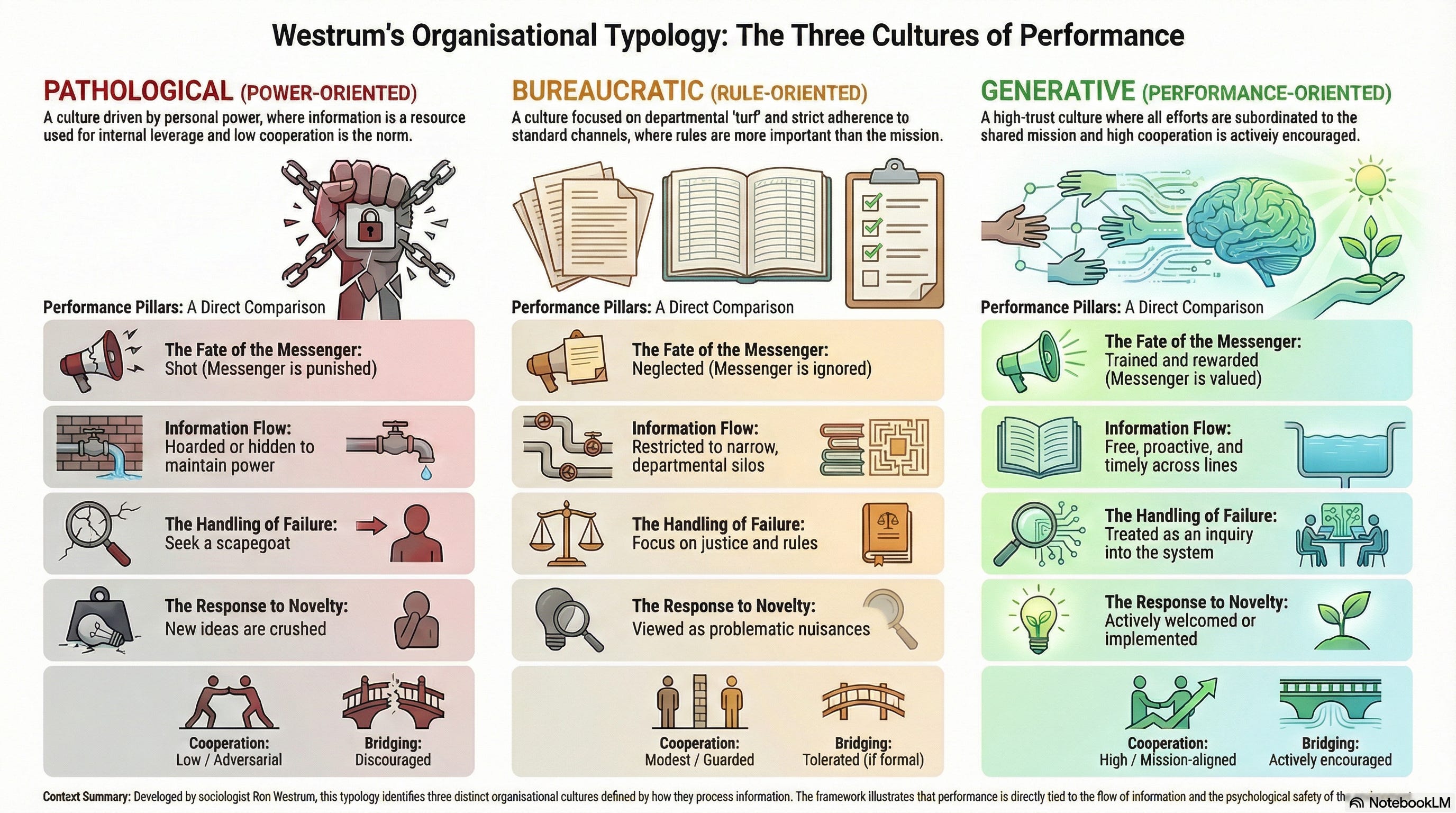
Westrum’s central insight is deceptively simple: you can classify an organisation’s culture by observing how it handles information about problems, anomalies, and failures.
In pathological cultures, information is a weapon. The leader’s preoccupation is personal power and status. Messengers of bad news are punished. Failure is concealed. New ideas are crushed. Information is a positional good: sharing it makes you less powerful.
In bureaucratic cultures, information is channelled. The leader’s preoccupation is departmental turf and procedural compliance. Messengers are tolerated but frequently unheard, because they did not use the correct form or the correct channel. Failure leads to new process, not inquiry.
In generative cultures, information flows to where it is needed, regardless of hierarchy. The leader’s preoccupation is the mission. Messengers are trained and rewarded. Failure leads to inquiry. Bridging across departments is encouraged because the mission takes precedence over the org chart.
The culture type is determined by what the leader prioritises. Westrum is explicit: the culture is not a mysterious emergent property. It is a direct reflection of what leadership actually rewards, punishes, and ignores.

Bateson provides the theoretical foundation that Westrum’s typology operationalises. Information, for Bateson, is “a difference which makes a difference.” The question is whether differences reach the people who need them. In a pathological culture, differences are suppressed. In a bureaucratic culture, differences are channelled through processes that strip them of context and timeliness. In a generative culture, differences flow to where they can make a difference. Westrum is the bridge between Bateson’s epistemology and the observable behaviour of organisations. He takes Bateson’s abstract definition and gives it a diagnostic you can use on Monday morning.

Giddens would recognise this as structuration: the leader’s preoccupation creates structures that shape behaviour, and that behaviour reproduces the structures in daily interaction. A pathological culture does not feel pathological to those inside it. It feels like “the way things work here.” This is why culture change is so difficult: the structure that needs to change is the same structure shaping the behaviour of the people who would need to change it.
2. Hidden Events and the Undiscussable
Westrum’s early research on hidden events gives the typology its depth. Many phenomena exist in organisations that are systematically denied, ignored, or misclassified because they conflict with prevailing beliefs. Every organisation has hidden events: problems, risks, failures, and innovations that exist in the experience of the workforce but do not appear in management’s picture of reality. The culture type determines whether these events surface or remain buried.
This is where Westrum connects to Argyris with precision. Argyris identified “undiscussables”: topics everyone knows about but nobody raises because raising them would violate the governing norms. Westrum provides the cultural mechanism that produces undiscussables. In a pathological culture, problems are undiscussable because raising them is dangerous. In a bureaucratic culture, problems are undiscussable because raising them is procedurally difficult; the information system that was created to serve the organisation has become a structure the organisation must serve. Only in a generative culture does the cost of raising a problem fall below the cost of concealing it.

Dweck’s mindset research illuminates the individual psychology. In a fixed mindset culture, reporting a problem risks being seen as the person who caused it, or as someone who lacks the competence to solve it quietly. The messenger’s identity is threatened by the message. Bourdieu would add the structural dimension: the habitus formed in a pathological or bureaucratic culture generates information behaviours, concealment, hedging, impression management, that operate below conscious awareness. The person is not choosing to withhold information. Their professional dispositions, formed through years of experience in an environment that punished candour, are producing the only response they know.

For AI transformation, hidden events are everywhere. Teams that have discovered AI-generated code requires extensive reworking do not report this if the organisational narrative is “AI makes us faster.” Engineers who have found that AI tools work well for some tasks and poorly for others stay silent if the governance framework treats AI as a uniform capability. The gap between the official story and the lived experience is a hidden event, and its size is determined by the culture type.
3. Training the Messenger
Westrum introduced the phrase “training the messenger” to describe what generative cultures do differently. In most organisations, “shooting the messenger” is recognised as bad practice, but the alternative is assumed to be merely tolerating them. Westrum argues that tolerance is insufficient; it is the response of a bureaucratic culture. Generative cultures actively train and reward the messenger, because early, accurate information about problems is the organisation’s most valuable resource.
The practical test is vivid. Someone stands up and says, “This AI transformation strategy is not working for my team.” In a pathological culture: “You are not a team player.” The messenger is marginalised. In a bureaucratic culture: “Please submit that through the feedback process.” The messenger is redirected to a channel designed to slow information. In a generative culture: “Thank you for telling us. What are we missing?” The messenger is rewarded with attention and the information is acted upon.
Heifetz calls this “protecting voices from below.” Adaptive leadership requires that people experiencing the adaptive challenge can surface their experience without being punished for disrupting the official narrative. Heifetz provides the leadership practice; Westrum provides the cultural precondition. You cannot protect voices from below in a pathological culture, because the power dynamics make protection impossible. You cannot protect them reliably in a bureaucratic culture, because the channels designed to process feedback are also channels designed to filter it. Dekker’s just culture is the mechanism that makes the shift possible: distinguishing systemic failures from individual negligence, and responding to each accurately rather than punitively.
4. Bridging: Why Transformation Happens Between Silos
Westrum observed that in crises, standard communication channels consistently fail. The information needed to resolve the problem exists in the organisation, but it is distributed across departments that do not normally talk to each other. In generative cultures, people reach across departmental lines without waiting for permission. Westrum calls this bridging, and it is the cultural foundation for any transformation that crosses organisational boundaries.
AI adoption inherently crosses those boundaries. The specification-driven approach that this series describes, where domain experts specify intent and AI generates implementation, is a bridging activity. It requires business analysts, engineers, and domain experts to work together in ways that most organisational structures actively discourage. If the culture punishes bridging, the approach fails regardless of the quality of the tooling.
5. From “Soft” to Statistical
For years, Westrum’s typology was dismissed as “soft.” The DORA research, synthesised in Forsgren, Humble, and Kim’s Accelerate (2018), changed this decisively. Using Westrum’s model as a measurement instrument, the research demonstrated that generative culture, measured through simple survey items about information seeking, shared responsibility, and inquiry-driven failure response, is predictive of higher software delivery performance, higher organisational performance, and lower burnout.
The DORA research also confirmed a finding Deming had insisted on for decades: speed and stability are not trade-offs. The organisations that move fastest are also the most stable, and the cultural precondition for both is generative information flow. This is the empirical validation that connects Westrum to every thinker in this series. Argyris’s double-loop learning requires an environment where governing assumptions can be questioned: generative culture provides it. Weick’s high reliability organisations exhibit generative characteristics by definition. Stacey’s emphasis on the quality of conversational interaction presupposes an environment where honest conversation is possible. Westrum provides the measurable, predictive variable that underlies all of their frameworks.
6. Westrum and His Limits
Westrum must be read with his limitations visible. His typology tells you what generative culture looks like but is less precise about the mechanisms that produce it. Giddens would note that culture is produced and reproduced through structural conditions: incentive systems, reporting lines, budget allocation. A leader who wants generative culture but operates within incentive structures that reward departmental optimisation will find the structure overwhelms the intention.

Heifetz would add that shifting from bureaucratic to generative is an adaptive challenge. The bureaucratic leader’s power depends on being the gatekeeper of information; generative culture dissolves that gatekeeping function. The adaptive loss is real, and Westrum’s framework does not adequately address it. Stacey would observe that “creating a generative culture” is a paradoxical instruction: a bureaucratic command to become non-bureaucratic. The paradox does not make the aspiration worthless. It makes the path more complex than the typology suggests.
Despite these limits, Westrum provides something rare: a framework simultaneously grounded in decades of research, simple enough to be immediately diagnostic, and empirically validated as a predictor of outcomes that leaders actually care about. That combination is why his typology has travelled further than most academic frameworks, from sociology to aviation to healthcare to software engineering to the broader question of how organisations learn.
Where this falls: Learning, the first of the series' four phases, followed by Deciding, Building and Transforming. The Learning articles ask whether information reaches the people who need it, and Westrum's typology is the cleanest available test of whether it does. What comes out of it is flow, not decisions. Deciding is where flow becomes a description an organisation can design against, and From Learning to Clarity is the route between them.
(An Organisational Prompt is something you can do now....)
Organisational Prompt
In your next team meeting, ask this question: “What is one thing about our AI adoption that we all know is not working but nobody has said out loud?” Then be silent. Wait. The silence will be uncomfortable. That discomfort is the sound of the culture being tested.
If someone speaks, respond with curiosity, not solution. Ask: “What do you see that we are missing?” Do not defend. Do not explain. Do not redirect to a feedback portal. The act of asking, listening, and visibly valuing the response is the smallest unit of generative culture. If nobody speaks, that silence is also data. It tells you where you are on Westrum’s typology more accurately than any survey.
Further Reading
Ron Westrum, A Typology of Organisational Cultures (BMJ Quality & Safety, 2004). The foundational paper. Read it for the typology and for the insight that information flow is both influential and indicative of culture. Freely accessible.
Ron Westrum, The Study of Information Flow: A Personal Journey (Safety Science, 2014). Westrum’s own account of how his intellectual journey from anomalous science to organisational culture came together. The deeper context behind the typology.
Nicole Forsgren, Jez Humble, and Gene Kim, Accelerate: The Science of Lean Software and DevOps (2018). The empirical validation of Westrum’s model. The statistical evidence that generative culture predicts both speed and stability.
Ron Westrum, Social Intelligence about Hidden Events (Knowledge: Creation, Diffusion, Utilization, 1982). The original paper on how communities suppress anomalous observations. The intellectual foundation for everything that followed.
I write about the industry and its approach in general. None of the opinions or examples in my articles necessarily relate to present or past employers. I draw on conversations with many practitioners and all views are my own.