Problems with the Traditional Change Theory We All Inherited
Why John Kotter’s 8-Step Model Is the Most Widely Used Change Framework in the World, and Why Every Thinker in This Series Explains What It Gets Wrong
We have been talking around him for weeks now. Every time this series has critiqued linear change management, top-down planning, or the assumption that transformation can be designed and controlled from above, it has been describing the world that John Kotter codified. It is time to address him directly.
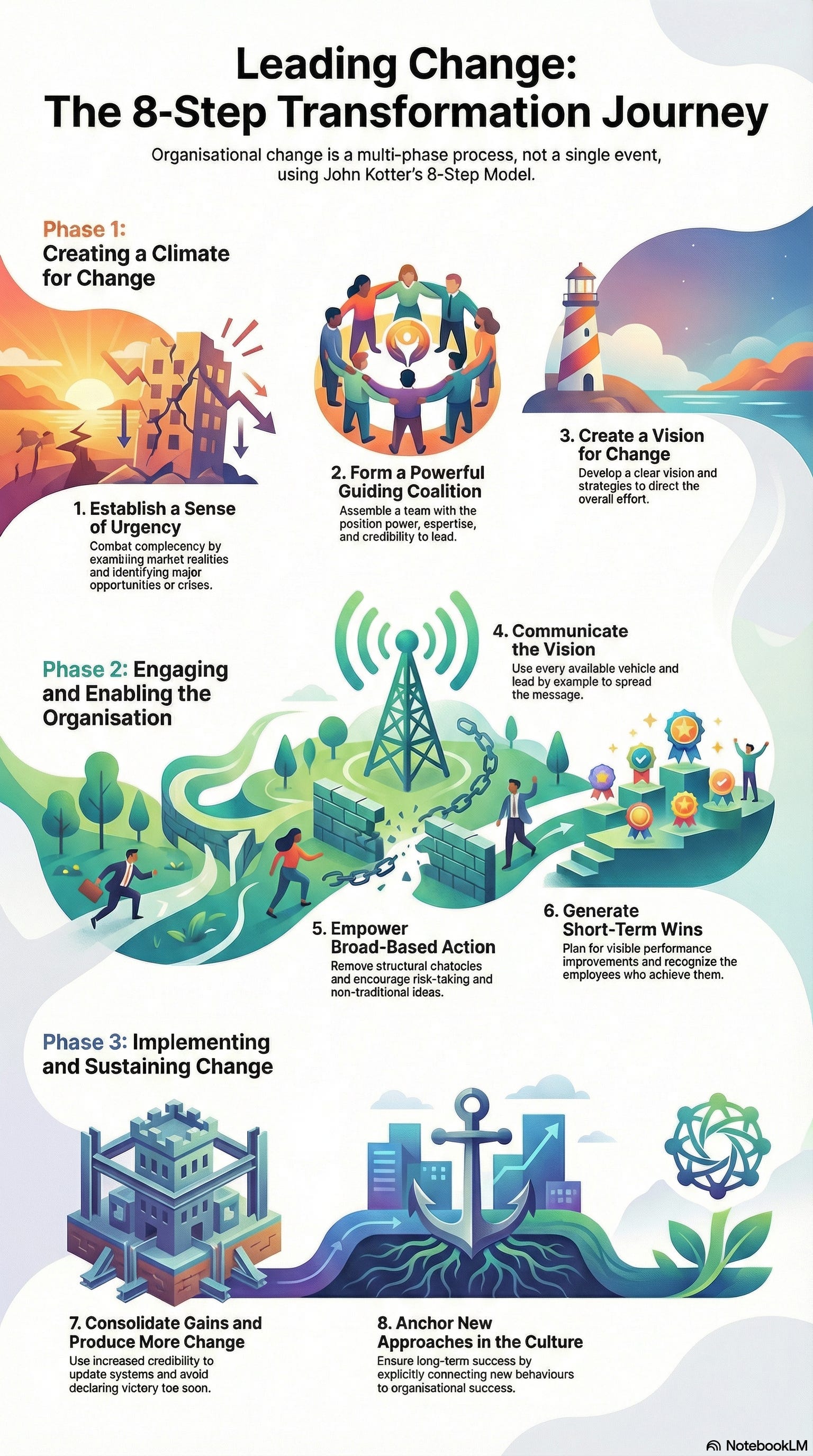
Kotter’s 8-Step Model for Leading Change, published in 1996 and refined in Accelerate in 2014, remains the default operating system for enterprise transformation. If your organisation has a change management office, it is almost certainly running some version of Kotter. If your AI transformation programme has a phased roadmap with “create urgency” in Phase 1 and “anchor in the culture” in Phase 8, it is running Kotter. If the leadership team believes that transformation requires a guiding coalition, a compelling vision, and a communication plan that repeats the message through every available channel, it is running Kotter.
The model is not wrong. It is incomplete. And its incompleteness is not random; it has a specific shape. Kotter’s framework is a product of talking to CEOs. It describes the world as it looks from the executive floor: a place where leaders create urgency, form coalitions, craft visions, and drive transformation through the organisation. This is the view from the balcony with the stairs removed.
CEOs do not drive change in organisations. They frame it. Middle management enables it. The people on the front line actually enact it.
Every thinker in this series, from radically different starting points, converges on this insight. What follows is not a demolition of Kotter but something more useful: a precise diagnosis of what he describes well, what he cannot see, and what the thinkers in this series provide that his framework lacks.
Before the change management scholars object: yes, Kotter refined his model significantly in Accelerate, moving from a sequential process to a “dual operating system” that runs the eight steps continuously through a network structure alongside the traditional hierarchy. The refinements are real and acknowledged. But the underlying assumptions, that change requires top-down vision, that urgency is the precondition, that culture changes last, remain intact. And it is these assumptions that the series thinkers challenge.
1. The Model: What Kotter Actually Says
Kotter’s framework deserves a fair hearing, not least because it crystallised real observations about why transformation fails. His argument organises change into three phases.
Creating a climate for change: establish a sense of urgency, form a powerful guiding coalition, and create a vision for change. Kotter argues that transformation requires roughly 75% of leadership genuinely convinced that business-as-usual is unacceptable. The guiding coalition needs position power, expertise, credibility, and leadership capability. The vision must be communicable in five minutes or less.
Engaging and enabling the organisation: communicate the vision through every available channel, empower broad-based action by removing obstacles, and generate short-term wins to build momentum. Kotter emphasises that under-communication is the norm, by a factor of 10 to 100. Short-term wins serve multiple functions: they reward change agents, undermine cynics, and build the credibility that sustains momentum.
Implementing and sustaining change: consolidate gains by using increased credibility to change systems and structures that do not fit the vision, and anchor new approaches in the culture. Culture changes last, not first. New practices must be proven superior before they embed in cultural norms.
Kotter also identifies common failure modes: allowing too much complacency, failing to create a sufficiently powerful guiding coalition, underestimating the power of vision, under-communicating, permitting obstacles to block the vision, failing to create short-term wins, declaring victory too soon, and neglecting to anchor changes in the culture.
These are genuine observations. Anyone who has watched a transformation programme stall because leadership lost interest, or because nobody could articulate what the change was for, will recognise the patterns Kotter describes. The question is not whether these patterns are real. The question is whether the framework that explains them is adequate.
2. The CEO’s-Eye View: Why the Model Sees What It Sees
The first limitation is perspectival. Kotter’s model describes how transformation looks to a senior leader. It assumes that change is initiated at the top, designed at the top, and cascaded through the organisation by the top. The primary actors are the CEO, the guiding coalition, and the leadership team. Everyone else is an object of change: recipients of the vision, targets of the communication plan, participants in the empowerment programme.
Stacey rejects this entirely. In his theory of Complex Responsive Processes, there is no position outside the web of interaction from which to design and direct change. The CEO publishing an AI strategy is not programming a machine; she is making a gesture from within a web of relationships, and that gesture will be received, interpreted, distorted, resisted, and adapted by thousands of people whose responses she cannot predict. The belief that she is “driving transformation” is not strategic confidence. It is a defence mechanism against the anxiety of not being in control.
Mintzberg provides the empirical evidence. His decades of research on strategy formation demonstrated that most realised strategy is emergent: it arises not from deliberate planning but from the accumulation of decisions and actions that form a pattern over time. What the organisation actually does is always a combination of what leadership intended and what emerged from responses to events, opportunities, and surprises that the planners never anticipated. In Kotter’s framework, the guiding coalition crafts the vision and the organisation implements it. In Mintzberg’s research, the teams quietly using Claude to solve real problems outside the governance framework are not insubordinate. They are the emergent strategy trying to tell you where the value is.
Tom Peters would put it more directly. If you want to know what your AI transformation is actually achieving, cancel the next steering committee meeting and go sit with a team that is trying to use AI on a real problem. Watch them work. The distance between the steering committee’s view and the team’s experience is the distance between Kotter’s model and reality.
This is not to say that leadership does not matter. It is to say that Kotter’s model dramatically overestimates what leadership can do and systematically underestimates what the rest of the organisation is already doing. The most important transformation activity in most enterprises is happening in the informal conversations, workarounds, and experiments that the governance framework does not see, that the communication plan does not describe, and that the guiding coalition does not know about.
3. The Linearity Problem: Why Sequential Steps Do Not Describe Complex Change
Kotter’s model is sequential. Steps cannot be skipped. Each phase builds on the one before. This assumes a level of predictability that Stacey would place in the “zone of the predictable,” suitable for technical problems with known solutions, and entirely inadequate for adaptive challenges where the destination is discovered through the journey.
Weick inverts the sequence entirely. Kotter says: create the vision, then act. Weick says: act first, then discover the vision retrospectively. “How can I know what I think until I see what I say?” is not whimsy; it is a precise description of how sensemaking works in complex environments. You cannot know what your AI transformation vision should be until you have experimented enough to discover what AI makes possible in your specific context. The organisation that spends twelve months crafting the perfect vision before anyone touches an AI tool is not being prudent. It is performing the appearance of leadership while systematically preventing the only kind of learning that matters: the learning that comes from doing something and paying close attention to what happens.
Kahneman explains why the sequential model feels so compelling despite its inadequacy. The planning fallacy leads people to focus on the specifics of their plan rather than the base rates of similar projects. WYSIATI (”What You See Is All There Is”) means that the coherent story of eight sequential steps suppresses awareness of what the model leaves out. And narrative fallacy means that successful transformations are retrospectively reconstructed as having followed a logical sequence, even when the actual path was messy, recursive, and full of surprises. Kotter’s model is System 1 candy: it offers a coherent, simple, compelling story about how change works. System 2, if anyone activated it, would note that the base rate of transformation success has not improved since the model was published.
Richard Normann would add that the linearity conceals a deeper problem. Kotter’s model operates within an existing mental map. It assumes that the organisation knows what it needs to change into; the task is merely to execute the transition. But for AI transformation, the destination itself is unclear. The landscape has shifted. AI is not automating existing value chains; it is enabling entirely new value constellations that the current map cannot represent. A sequential change programme that executes brilliantly against a vision derived from the wrong map will arrive at the wrong destination with great efficiency.
4. The Urgency Problem: Why Burning Platforms Produce Compliance, Not Learning
Kotter’s Step 1, “establish a sense of urgency,” is the most widely applied and the most consistently counterproductive element of the framework. The logic is seductive: people will not change unless they believe the status quo is unacceptable. Therefore, leaders must manufacture urgency, identify crises, surface threats, create the burning platform that forces action.
Seligman would recognise this immediately as a formula for producing learned helplessness, not engagement. People who have been through previous change programmes, who have seen urgency manufactured and then forgotten, who have watched the burning platform extinguished and replaced by the next burning platform, have learned something: the urgency narrative is not the real story. It is a management technique. And responding to a management technique with genuine emotional commitment is a mistake that experienced professionals do not make twice.
Ron Heifetz provides a more precise diagnosis. Urgency works for technical problems: the server is down, the deadline is tomorrow, the regulator is at the door. In these situations, the problem is clear, the expertise to solve it exists, and urgency accelerates the application of known solutions. But AI transformation is an adaptive challenge: it requires people to change their values, beliefs, and ways of working. For adaptive challenges, manufactured urgency produces fight-or-flight responses that narrow attention, trigger defensive routines, and prevent the exploratory learning that adaptation requires. The burning platform does not produce transformation. It produces compliance disguised as transformation: people who follow the new process without adopting the new thinking.
Argyris showed that urgency amplifies defensive routines rather than dissolving them. When the heat rises, people default to Model I behaviour: unilateral control, suppress negative feelings, maximise winning, minimise losing. These are precisely the behaviours that prevent the double-loop learning, questioning the assumptions beneath the actions, that adaptive challenges demand. The leader who creates urgency and then wonders why the organisation has become more defensive, more political, and less honest has misdiagnosed the relationship between pressure and learning.
Dweck’s research adds the mechanism. Under threat, people with a fixed mindset retreat to the performance goals that protect their sense of competence: prove what I can do, avoid revealing what I cannot. Urgency framed as threat (”if we do not adopt AI, we will be left behind”) activates exactly this defensive posture. The same urgency framed as opportunity (”AI creates possibilities we have not yet imagined, and your domain expertise is what makes those possibilities real”) invites the learning goals that growth mindset enables. Kotter’s model does not distinguish between these framings. But the difference between them determines whether the organisation learns or merely complies.
5. The Culture Problem: Why Kotter Gets the Sequence Right but the Mechanism Wrong
Kotter’s insight that culture changes last, not first, is genuinely valuable. Attempts to “change the culture” directly through values statements, posters, and town halls reliably fail. Culture follows practice; it does not precede it. On this, Kotter and the series thinkers agree.
But Kotter’s mechanism for cultural change, anchor new approaches through demonstrated success and leadership reinforcement, is inadequate. It treats culture as something that forms around successful practices, like sediment deposited by a river. The series thinkers reveal that culture is far more actively reproduced, and far more resistant to change, than this metaphor implies.
Anthony Giddens shows that culture is not sediment; it is structure, reproduced in daily practice through three dimensions simultaneously. Signification: how people interpret what is happening. Domination: who controls resources and decisions. Legitimation: what counts as right and proper. If you change the practices (Kotter’s Step 7) but leave the domination structures unchanged, if the people who control budgets, hiring, and promotions still reward the old way of working, the new practices will not survive. And if the legitimation remains unchanged, if “real engineering” still means writing code rather than writing specifications, the new practices will be experienced as illegitimate regardless of their demonstrated success.
Pierre Bourdieu goes deeper. Culture is not just structural; it is embodied. The habitus, the set of durable, transposable dispositions that generate practice without conscious deliberation, was formed through years of professional socialisation. The senior developer’s body knows how to write code. Their professional reflexes are calibrated to a world where coding is the work. New practices, however successful, bounce off the habitus like rain off glass until the embodied dispositions themselves begin to shift. And habitus change requires sustained immersion in new conditions, not a demonstration project followed by a communication campaign.
Max Weber would observe that Kotter’s model operates entirely within the logic of the iron cage. It uses bureaucratic methods, coalitions, communication plans, governance structures, to produce change within a bureaucratic system. This can reconfigure the cage. It cannot open it. The deeper question, whether the bureaucratic logic itself is the obstacle, is one that Kotter’s framework has no mechanism for asking.
6. The Communication Problem: Why Vision Cascades Fail
Step 4, “communicate the vision,” assumes that the obstacle to change is information deficit. If people understood the vision, they would support it. Therefore, communicate more: every channel, every meeting, every town hall, every email, repeated by a factor of 10 to 100.
Argyris would point out that the obstacle is rarely information deficit. It is the gap between espoused theory and theory-in-use. The leader who communicates “we embrace AI innovation” while the governance framework requires six approvals before anyone can use an AI tool is not under-communicating. They are sending two messages simultaneously: one in words and one in structure. People are extraordinarily skilled at reading the structural message and ignoring the verbal one. Increasing the volume of the verbal message while leaving the structural message unchanged does not produce alignment. It produces cynicism.
Weick adds that sensemaking is not a receptive process. People do not receive a vision and then act on it. They interpret the vision through the lens of their existing identity, their current anxieties, and their local politics. The same vision statement means something entirely different to the CTO, the senior developer, the business analyst, and the graduate hire. Communicating more does not resolve this; it amplifies the divergence. What resolves it is shared experience: people who have done something together and made sense of it retrospectively develop shared meaning that no communication plan can manufacture.
7. The Short-Term Wins Problem: When the Proxy Becomes the Purpose
Step 6, “generate short-term wins,” is Kotter’s most practically useful prescription and his most dangerous. Short-term wins do build momentum, reward change agents, and undermine cynics. They also create a powerful incentive to optimise for visible, measurable successes at the expense of the deeper, slower, less visible learning that transformation actually requires.
Kahneman’s work on the narrative fallacy applies directly. Short-term wins construct a story of progress. System 1 endorses the story; System 2 is not activated to question whether the wins represent genuine transformation or merely the selection of easy targets that produce impressive metrics. The AI Centre of Excellence that reports “200 use cases identified, 50 pilots launched, $2M in estimated savings” has generated an impressive collection of short-term wins. Whether any of those pilots changed how anyone actually works is a question the metrics do not answer.
Drucker warned against exactly this corruption: the reduction of Management by Objectives to cascaded KPIs that measure activity rather than value. The short-term win that demonstrates AI generating code faster is a win within the existing map. The deeper transformation, the one where domain experts learn to write specifications that reshape what the organisation can offer its customers, is slower, harder to measure, and does not fit on a dashboard. Kotter’s model creates structural pressure to pursue the first at the expense of the second.
8. What Kotter Cannot See: The View from the Dance Floor
The deepest limitation is not any individual step but the perspectival assumption that runs through all of them. Kotter describes what leaders should do. He does not describe what the organisation is doing while the leaders are doing it.
Stacey insists that the patterns of interaction that constitute the organisation, the shadow conversations in corridors and messaging channels, the informal networks that actually coordinate work, the anxieties and ambitions that shape how people respond to change, are not noise to be managed by the change programme. They are the organisation. The change programme is one gesture within this web of interaction. Its effect is determined not by its design but by the responses it provokes, responses that Kotter’s framework has no vocabulary for describing because they are not visible from the CEO’s office.
Giddens would say that Kotter’s model addresses discursive consciousness, what people can articulate, while leaving practical consciousness, the tacit knowledge that actually governs daily behaviour, untouched. You can communicate the vision until it is recited in every meeting. If the practical consciousness of the people doing the work has not shifted, if their hands still reach for the old tools, their instincts still follow the old processes, their bodies still inhabit the old routines, the vision is wallpaper.
Heifetz would frame it as the distinction between the balcony and the dance floor. Kotter’s model is a balcony framework: it describes what leaders should see and do from a position of observation. But adaptive leadership requires oscillating between balcony and dance floor, between the pattern-recognition that reveals systemic dynamics and the proximity that reveals what those patterns actually mean for the people living them. A leader who never leaves the balcony is Mintzberg’s disconnected strategist. The eight steps, executed from the balcony alone, produce the appearance of leadership without the craft.
Westrum’s typology reveals the information dynamic. In pathological cultures, the change programme tells leadership what leadership wants to hear. In bureaucratic cultures, the change programme follows the process. Only in generative cultures does information about what is actually happening, about the gap between the plan and the reality, flow freely enough for the programme to learn. Kotter’s model assumes generative information flow without explaining how to create it.
9. What Kotter Gets Right, and What Must Be Added
Kotter’s contributions are real and should not be discarded. His observation that organisations are over-managed and under-led is validated by every thinker in this series. His insistence that change requires political work, building coalitions, removing obstacles, rewarding progress, is pragmatically sound. His insight that culture follows practice, not the reverse, is confirmed by Giddens, Bourdieu, and Weick. His identification of common failure modes, complacency, weak coalitions, under-communication, declaring victory too soon, reflects genuine patterns that transformation leaders encounter.
What must be added is everything this series provides some structure for. We have already discussed the first 4 sources and you can consider this as a simple route map for what is coming next…
From Argyris: the framework for surfacing the defensive routines that make vision communication performative rather than genuine. The change programme that cannot make the undiscussable discussable will produce compliance, not learning.
From Weick: the reversal that places action before understanding, and the concept of small wins that accumulate into pattern change through sensemaking rather than through cascaded implementation.
From Stacey: the ontological correction that the organisation is not a machine to be reprogrammed but a web of interaction to be participated in. Plans are gestures, not blueprints.
From Heifetz: the distinction between technical and adaptive challenges, and the discipline of giving the work back to the people who must live with the consequences rather than solving it on their behalf.
From Giddens: the structural analysis that shows why changing only one dimension of structure, whether signification, domination, or legitimation, always fails. Practical consciousness, not discursive consciousness, is where change lives or dies.
From Bourdieu: the embodied dimension that explains why even successful new practices do not persist without sustained conditions that allow new dispositions to form. Habitus does not change through communication. It changes through prolonged immersion in new conditions of practice.
From Beer: the diagnostic that cuts through every stated intention. If your change programme is producing change programme artefacts but not changed practice, then producing artefacts is its purpose. Redesign the information architecture, not the communication plan.
From Drucker: the reminder that the knowledge worker must define the task. Transformation that defines the task on behalf of the workforce has undermined the very autonomy that makes knowledge work productive.
From Weber: the structural warning. The eight-step model is a bureaucratic tool for producing change within a bureaucratic system. It can reconfigure the iron cage. It cannot open it.
The synthesis is not a new model to replace Kotter’s. It is a set of corrections that make Kotter’s practical instincts more honest. Lead, yes, but from within the interaction, not above it. Build coalitions, yes, but include the people who are already doing the adaptive work informally. Communicate, yes, but only after ensuring that the structures say the same thing as the words. Generate wins, yes, but measure the learning, not just the outcomes. And anchor in the culture, yes, but understand that culture is not wallpaper to be applied at the end. It is the practical consciousness that is either changing, moment by moment, in the daily practice of the organisation, or it is not.
(An Organisational Prompt is something you can do now...)
Organisational Prompt
Kotter’s model assumes the leader designs the change. The thinkers in this series argue that the leader participates in change that is already happening, whether the leader knows it or not.
Identify the most recent executive announcement about your AI transformation. Now find three unplanned consequences of that announcement. Not the planned outcomes, the metrics, the dashboards.
These unplanned consequences are not noise. They are the emergent strategy responding to the leader’s gesture. They are what Stacey describes: the unpredictable responses that determine what the gesture actually means.
Further Reading
John Kotter: Leading Change - The original statement of the 8-Step Model. Read it for the practical observations about why change fails. Read the thinkers in this series for what it leaves out.
John Kotter: Accelerate: Building Strategic Agility for a Faster-Moving World - Kotter’s refinement of the model into a “dual operating system” that runs the eight steps continuously through a network structure alongside the traditional hierarchy. Significantly more sophisticated than the original, and worth reading alongside Stacey for what the “network” model still assumes about control.
Ronald Heifetz, Alexander Grashow, and Marty Linsky: The Practice of Adaptive Leadership - The essential complement to Kotter. Where Kotter tells you how to run a change programme, Heifetz tells you what to do when the programme encounters an adaptive challenge that the programme was not designed to handle. Start here if you are running Kotter and finding that compliance is not producing learning.
Disclaimer
I write about the industry and its approach in general. None of the opinions or examples in my articles necessarily relate to present or past employers. I draw on conversations with many practitioners and all views are my own.


