
In 1925, a woman who had never run a company gave a lecture to a group of businessmen in New York on how to handle disagreement. She told them that every conflict has three possible outcomes: one side wins, both sides lose a little, or both sides get what they actually need. She told them that the first is unstable, the second is mediocre, and the third is the only one worth pursuing. She told them that the third option requires something most managers will not do: stop arguing about positions and start asking what each party genuinely wants.
The businessmen were polite. Within ten years of her death in 1933, Mary Parker Follett was almost entirely forgotten. It took six decades for Peter Drucker to call her his guru. She was rediscovered not because the world caught up with her ideas but because the problems she diagnosed became impossible to ignore. Those problems are now on your desk. They arrive whenever business leaders and technology leaders sit in a room and try to agree on what AI should do. They arrive whenever a transformation produces winners and losers instead of shared capability. They arrive whenever someone with positional authority overrides someone with situational knowledge. Follett addressed all of this before cybernetics, before systems thinking, before complexity theory. She is the positive vision for what this series has been diagnosing as failure: she describes what it looks like when the interaction works.
1. Integration: The Resolution That Produces Learning
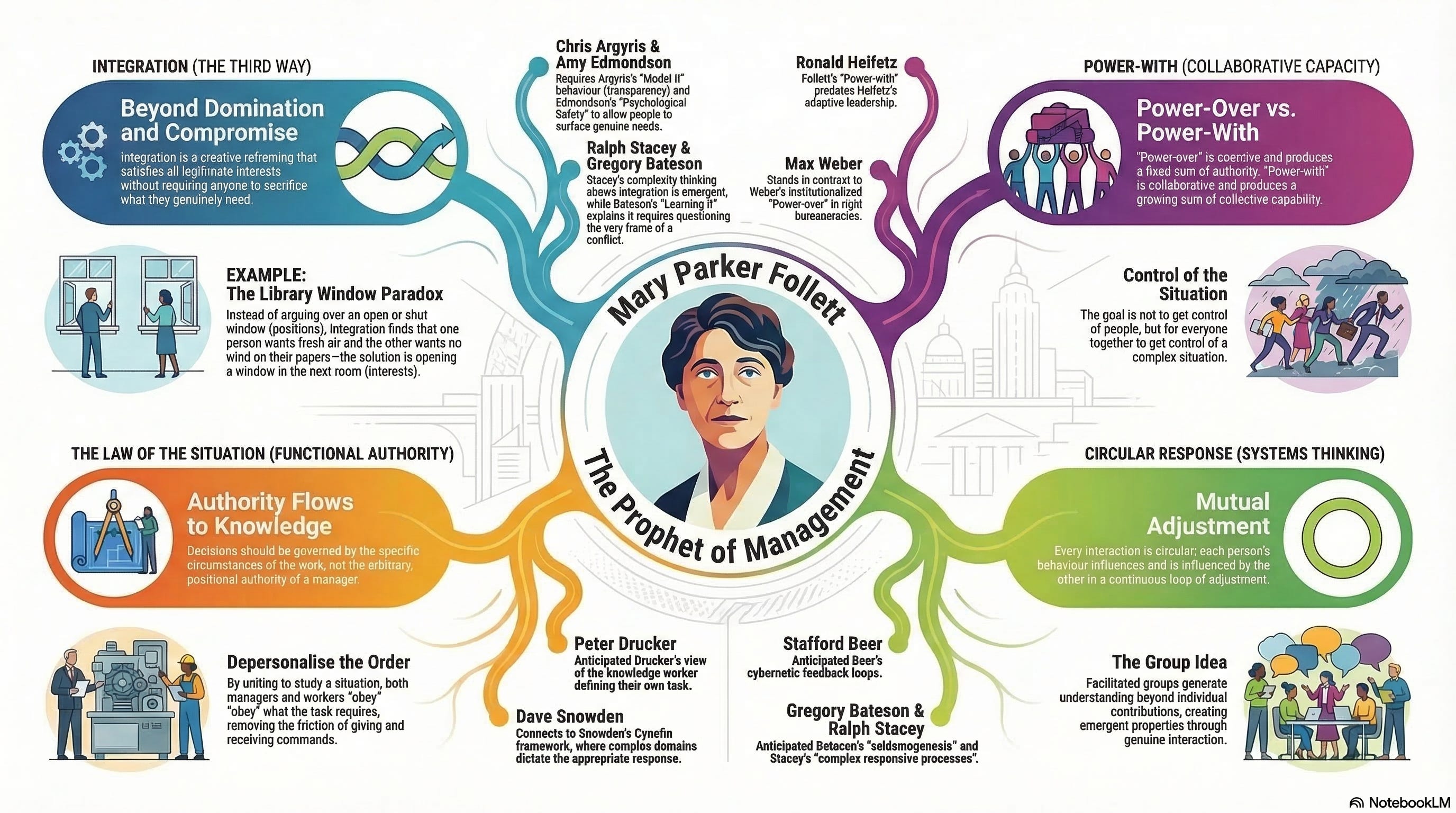
Follett identified three responses to conflict. Domination: one side wins. Compromise: both sides sacrifice something. Integration: a creative reframing that satisfies all legitimate interests without requiring anyone to surrender what they actually need.
Her example was a library window. Two people: one wants it open, the other wants it closed. Compromise is to open it halfway, which satisfies neither. Domination is whichever person is louder or more senior. Integration requires asking why: one wants fresh air; the other does not want wind on their papers. The solution is to open a window in the next room. Both get what they need. Neither compromises. The solution was invisible until the positions were replaced by interests.
This is not a negotiation technique. It is an epistemological claim about how organisations should process difference, and it is the observable test for the conflict integration probe that runs through this series: can the organisation hold competing perspectives in tension long enough for a solution neither party had imagined to emerge? Or must it resolve conflict through hierarchy (domination) or negotiated surrender (compromise)?

Argyris would recognise integration immediately: it is Model II behaviour applied to conflict. Model I (unilateral control, win, suppress negative feelings) produces domination. The institutional default produces compromise. Integration requires the willingness to make reasoning transparent, to test assumptions publicly, and to treat the other party’s needs as data rather than obstacles. Bateson’s levels framework shows why integration is so rare: it operates at Learning II. Domination and compromise work within the existing frame (who has more power? what is each willing to give up?). Integration requires questioning the frame: what do we each actually need, and is there a configuration of the situation that serves both? The frame-questioning is what makes integration generative and what makes it so difficult.
Apply this to AI transformation. Technology teams dominate by choosing tools without meaningful input from business domains. Business teams dominate by mandating outcomes without understanding constraints. The compromise is a governance committee that satisfies nobody. Integration would require both sides jointly studying the situation, surfacing what each genuinely needs, and constructing a way of working that serves both without requiring either to sacrifice what matters most. The reason this almost never happens is structural: Edmondson’s psychological safety is the precondition (people will not surface genuine interests where honesty is punished), and Stacey’s complexity thinking shows it cannot be designed in advance (it emerges from genuine interaction between people who hold different knowledge).
2. Power-With: How Parts Should Relate
Follett distinguished between power-over and power-with. Power-over is coercive: one party exercises authority over another. It produces compliance, not commitment. It generates resistance, hidden or overt. Power-with is collaborative: jointly developed power that grows through interaction. Follett’s formulation was precise: the question is not how to get control of people but how all together to get control of a situation.
The distinction is structural, not sentimental. Power-over produces a fixed sum: if I have more authority, you have less. Power-with produces a growing sum: when people develop power together, the total capacity increases. A problem that requires knowledge from multiple domains cannot be solved by any single authority. It can only be solved by people who hold different knowledge working together in a way that increases their collective capability.

Weber’s rational-legal authority is power-over institutionalised. The bureaucratic hierarchy gives decisions to role-holders regardless of whether the role-holder has the knowledge the decision requires. Follett does not reject hierarchy; she insists that authority within hierarchy should flow to knowledge, not to position. Heifetz makes the same argument: the leader’s job is not to provide solutions but to create the conditions in which people with relevant knowledge can work the problem. Heifetz is describing power-with applied to adaptive challenges. Follett got there first.
For AI transformation, the diagnostic is direct. Who decides how AI is used in any given domain? If a central technology team decides about domains they do not understand: power-over. If domain experts decide about technology they do not understand: power-over inverted. If domain experts and technology practitioners jointly study the situation, each contributing what they know, with authority flowing to whoever has the most relevant knowledge at each decision point: power-with. The third option is harder, slower, and more uncertain. It is also the only one that produces outcomes fitted to the actual situation rather than to the organisational chart. Bourdieu would add that power-with requires a field in which different forms of capital are recognised as legitimate: the domain expert’s practical consciousness and the technologist’s technical knowledge must both count as currency. In a field where only technical capital is valued, power-with collapses back into power-over exercised by the technically dominant.
3. The Law of the Situation
Follett’s most radical idea was also her most practical. She called it the law of the situation: decisions should be governed by the specific circumstances of the work, not by the arbitrary authority of a manager. Her instruction was blunt: depersonalise the giving of orders; unite all concerned in a study of the situation; discover the law of the situation and obey that.
When orders are part of the situation, the question of someone giving and someone receiving does not arise. Both manager and worker accept the orders given by the situation itself. Authority becomes situational, not positional.

This anticipated Drucker by three decades: the knowledge worker must define the task, and the definition must come from the work itself. It anticipated Snowden by seven decades: in a complex domain, the appropriate response is determined by the situation, not by a pre-existing plan. It anticipated the entire argument of this series: AI transformation fails when decisions are made by people distant from the work, and succeeds when they are made by people who understand the situation well enough to discover what it requires. Weick’s deference to expertise in high-reliability organisations is the law of the situation operationalised: when a crisis occurs, authority migrates to whoever has the most relevant knowledge, regardless of rank.
Follett’s four principles of coordination remain strikingly contemporary: coordination by direct contact between the responsible people (not through intermediaries), in the early stages (not after decisions are made), as a reciprocal relationship (not one-way instruction), and as a continuous process (not a periodic review). Every one of these is routinely violated in how large organisations manage transformation. Decisions are made centrally and communicated downward. Feedback flows upward through filtered channels. Review happens quarterly rather than continuously. Follett would diagnose this as an organisation obeying the hierarchy when it should be obeying the situation.
4. Circular Response: The Systems Thinker Before Systems Thinking
Follett rejected linear cause-and-effect models. Every interaction, she argued, is circular: each person’s behaviour influences and is influenced by the other’s. The relationship between manager and worker is not one-way transmission but continuous mutual adjustment.
This insight, published in 1924, anticipated cybernetics by two decades and complexity theory by six. Stafford Beer’s feedback loops formalise what Follett described in plain language. Bateson’s schismogenesis, escalating division through unchecked circular patterns, is the pathological case Follett identified when circular response goes wrong: without corrective feedback, circular processes amplify rather than stabilise. Stacey’s complex responsive processes are an updated framework for what Follett called the group idea: the insight that genuine interaction produces understanding beyond what any individual brings, not by summing contributions but through the emergent properties of the interaction itself.
The group idea connects integration to learning. Every barrier this series has identified, defensive routines, fixed mindset, learned helplessness, pathological information flow, bureaucratic rigidity, is a barrier to integration. And every condition the series has identified as necessary for learning, psychological safety, high standards, growth mindset, honest feedback, situational authority, is a condition for integration. Integration is what it looks like when the Interaction lever is working: when the parts of the organisation relate to each other in a way that produces capability neither part could generate alone. Domination and compromise are what it looks like when the lever is broken: when the parts relate through power or through mutual surrender rather than through genuine engagement with each other’s knowledge.
Follett saw both the barriers and the conditions a century ago. Her misfortune was to be right too early. The rest of us have no such excuse.
On placement: this is a Learning article, the first of the series' four phases, ahead of Deciding, Building and Transforming. Follett belongs here because integration is a perceptual discipline before it is a negotiating technique; you cannot integrate what neither side has yet said out loud. What an organisation gets out of Learning is that saying. In Deciding the question becomes what can be designed from it, and From Learning to Clarity sets out the turn.
(An Organisational Prompt is something you can do now....)
Organisational Prompt
Pick one active conflict between business and technology in your AI transformation: a disagreement about tooling, scope, governance, or ownership. Before the next meeting, ask each side separately: “What do you actually need from this; not what you have asked for, but what would genuinely serve your work?” Write both answers down. Bring them to the meeting and put them side by side.
The gap between what people are arguing for and what they actually need is where integration lives. You will not find it by asking people to compromise. You will find it by asking people to be honest about what matters, and by taking both sets of needs seriously enough to look for a solution that serves them all. If neither side can articulate what they actually need, that itself is diagnostic: the positions have hardened into identities, and the conflict has become undiscussable in exactly the way Argyris described.
Further Reading
Mary Parker Follett, Creative Experience (1924). Her most sustained theoretical argument. The chapters on integration and circular response remain startlingly modern. Freely available on the Internet Archive.
Henry Metcalf and Lyndall Urwick (eds.), Dynamic Administration: The Collected Papers of Mary Parker Follett (1941). The most accessible collection of her management lectures, including “The Giving of Orders” and “Constructive Conflict.”
Pauline Graham (ed.), Mary Parker Follett: Prophet of Management (1995). The book that rediscovered Follett. Includes original papers alongside commentary by Drucker, Mintzberg, and others.
Joan C. Tonn, Mary P. Follett: Creating Democracy, Transforming Management (2003). The definitive biography. Essential for the intellectual and political context.
I write about the industry and its approach in general. None of the opinions or examples in my articles necessarily relate to present or past employers. I draw on conversations with many practitioners and all views are my own.
Feels like most AI transformations fail exactly where Follett warned: arguing positions instead of understanding needs. Integration sounds simple, but structurally most orgs aren’t built to allow it.