
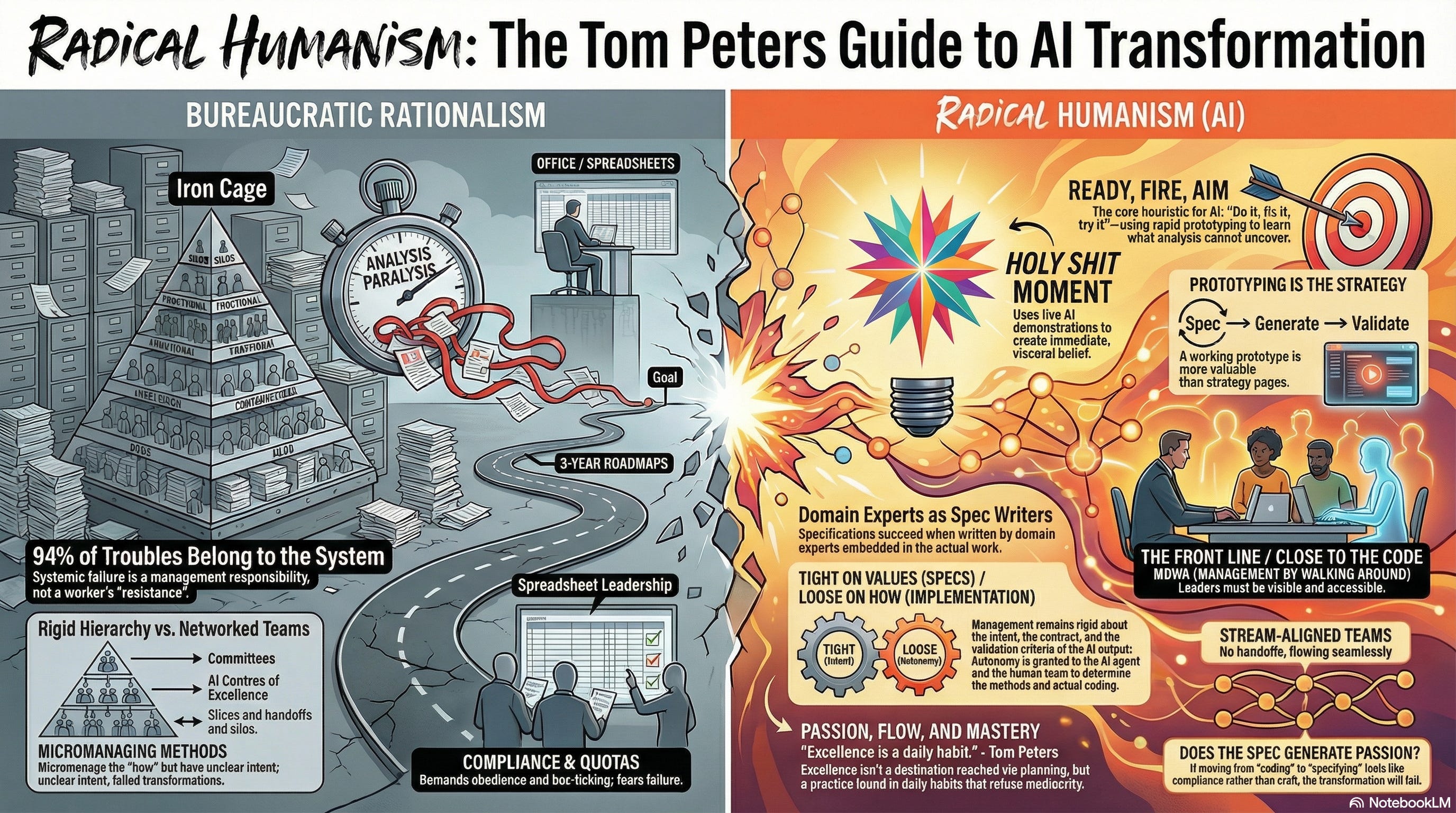
Tom Peters is the anti-bureaucrat. While Taylor optimised the machine and Fayol coordinated it, Peters wants to liberate the humans trapped inside it. His premise, first articulated in In Search of Excellence and radicalised across four decades of subsequent work, is a direct assault on the rational-analytic model of management: excellence does not come from perfect planning. It comes from a bias for action, closeness to the work, and the release of human energy from the dead hand of procedure.
Peters’ work has methodological problems. Several of his “excellent” companies subsequently failed. His research was retrospective and based on reputation as much as data. His later work tips from provocation into evangelism. These criticisms are real. But Peters provides something the more rigorous thinkers in this series sometimes miss: the emotional and motivational dimension of organisational life, without which no transformation framework, however analytically precise, will produce any change at all. The energy to act is not a soft concern. It is the fuel.
1. A Bias for Action: Why Doing Beats Analysing
Peters’ most enduring insight is his simplest. Excellent organisations act. Mediocre organisations analyse. The disease of the mediocre organisation is analysis paralysis: substituting the appearance of rigour for the reality of learning.

Weick provides the cognitive theory: action precedes understanding. Stacey provides the complexity science: in complex domains, you must probe before you can sense. Mintzberg provides the empirical evidence: most realised strategy is emergent. Peters arrived at all of these conclusions decades before the academic frameworks were published. He expressed them as practitioner wisdom rather than theory, and this is both his strength and his limitation. The strength is emotional force. The limitation is that undisciplined action produces noise, not signal. Snowden’s probe-sense-respond includes the “sense” step for a reason. Peters provides the energy for the probe. Weick provides the discipline for the sense. The organisations that learn combine both.
The barrier to action is not individual timidity. It is structural obstruction. The governance framework that requires a risk assessment, a business case, a steering committee review, and an approved pilot before anyone touches a new practice is not malice. It is the process that was created to support the work, which has become the work that must be supported. When this inversion is complete, the organisation serves the governance rather than the governance serving the organisation. Every layer of approval between a team and an experiment is a structural barrier to the learning that transformation demands. Peters would strip the layers. Bateson would diagnose the result: the governance apparatus locks the organisation at Learning I (optimising within the existing frame) by preventing the action that would produce Learning II (questioning whether the frame is right).
For AI transformation, the organisation that commissions a twelve-month readiness assessment before anyone touches a tool is performing the appearance of diligence while systematically preventing the only learning that produces understanding. A live demonstration, a team writing a specification and watching AI generate working code, bypasses intellectual debate. It is what Weick would call a sensemaking event and what Peters would call getting off your arse.
2. Close to the Work
Peters scorned the manager who leads from a spreadsheet. He championed Management by Walking Around: the insistence that leaders must be visible, accessible, and connected to the front line where the work happens. This connects to the proximity probe that runs through the series. Specification quality is directly proportional to domain proximity. Specifications written by people who understand the problem deeply, who have Giddens’s practical consciousness of the domain, who know the edge cases because they live with them daily, are qualitatively different from specifications written by analysts working from requirements documents three levels removed from the actual work.

Kahneman explains why proximity matters at the cognitive level. The further you are from the work, the more WYSIATI operates: the coherent story in the leader’s head suppresses awareness of what the story leaves out. The leader reading a dashboard has a simpler, more confident, and less accurate picture than the leader who has sat with a team and watched them struggle. Peters provides the prescription: go and see. Normann provides the strategic frame: question whether your map describes the landscape you actually inhabit. Bourdieu provides the structural warning: the leader whose habitus was formed at a distance from the work will generate distance-from-work responses automatically. Proximity is not a technique to be applied. It is a disposition to be formed, and it is formed by sustained practice, not by a single management walkabout.
3. Loose-Tight: The Governance Paradox Resolved
Peters’ most sophisticated insight is that excellent organisations are simultaneously centralised and decentralised. They are tight on core values and standards, and loose on methods and implementation. Everyone knows what matters. Nobody is told how to achieve it.
This resolves the central tension in AI governance: how do you control AI without killing innovation? Be tight on the specification, the intent, the contract, the validation criteria, and loose on the implementation method. Define what the system must do, what constraints it must respect, what quality standards it must meet. Then leave the how to the team’s judgement. This is Drucker’s Management by Objectives as originally intended: clear objectives that liberate autonomy rather than constrain it. And it is the opposite of what most organisations implement. Most AI governance is loose on outcomes (unclear about what the output must achieve) and tight on methods (prescribing tools, approval processes, review boards). Teams comply with the method while producing outputs that fail to meet any coherent standard.

Stacey would recognise this as the organisation’s defence against the anxiety of not being in control. The governance framework exists not because it produces better outcomes but because it makes leaders feel they are managing the risk. The specification, by contrast, actually manages the risk by making intent explicit and validation automated.
4. The Destruction of Accretion
Most organisations respond to AI by adding governance layers without removing anything else. Every new requirement is additional. Nothing is abandoned. Peters would identify this as the central pathology: bureaucratic accretion, the progressive layering of process upon process until the weight of governance prevents the movement it was designed to guide.
Weick’s heavy tools metaphor applies: the organisation refuses to drop the tools that are slowing its escape, because the tools are identity markers. The architecture review board that adds three weeks to every initiative was created to solve a real problem. But the problem may have changed, and nobody has asked whether the board still serves the work or whether the work now serves the board. This connects directly to one of the observable probes in this series: can the organisation stop doing what no longer works? Most cannot, because the activities that should be stopped have accumulated constituencies whose identity depends on their continuation.

Drucker’s systematic abandonment is the disciplined version of Peters’ instinct: regularly ask “if we were not already doing this, would we start now?” If the answer is no, stop. The freed capacity is the space in which exploration becomes possible. Peters provides the courage to ask the question. Drucker provides the discipline to act on the answer.
5. Excellence Requires Passion
Peters insists that excellence is an emotional state. It requires passion, pride, and ownership. Bureaucracy systematically destroys all three. Procedure replaces intrinsic motivation with compliance. Initiative gives way to obedience. Ownership gives way to box-ticking. This is the managerial expression of what Deci and Ryan demonstrated: when autonomy, competence, and relatedness are thwarted, intrinsic motivation collapses, and no amount of extrinsic reward compensates.
This raises a question most AI transformation programmes never consider: does the new way of working generate passion? Developers experience flow while coding. Csikszentmihalyi’s conditions, clear goals, immediate feedback, challenge matched to skill, must be met by the new practice. The specification-generate-validate loop has flow potential: the specification provides the clear goal, the generated output provides immediate feedback, and increasingly complex specifications provide progressive challenge. But the potential is realised only if the work feels meaningful, not merely efficient.

Seligman’s learned helplessness is the condition that accumulates when passion has been repeatedly crushed by institutional indifference. The teams that have sat through previous transformations, watched their enthusiasm absorbed by governance, and learned that caring is not rewarded, will not be moved by another strategy deck. They need a different kind of evidence: a mastery experience, in Bandura’s terms, that reconnects effort with outcome. Peters intuited this: his “show me” is the practitioner’s version of Bandura’s mastery experience. The live demonstration that produces a result people can see, argue about, and build on is worth more than any amount of strategic communication.
6. Disciplined Liberation
Peters must be read with his limitations visible. His bias for action can become a bias against thinking. His anti-bureaucratic passion can tip into anti-structural nihilism. Stacey would agree that formal structure is less important than interaction patterns but would add that you cannot destroy structure and expect better patterns to emerge. Coordination, accountability, and alignment require formal mechanisms. The question is not structure versus no structure but what kind of structure enables both action and learning.
The synthesis this series points toward is what might be called disciplined liberation: Peters’s energy combined with Drucker’s discipline, Weick’s sensemaking rigour combined with the emotional commitment that makes people care enough to do the sensemaking well, the structural awareness of why organisations resist change (Giddens, Bourdieu, Argyris) combined with the refusal to accept that resistance as the final word. Normann’s conceptual elegance combined with Peters’s insistence that elegance without action is decoration. The discipline of the specification combined with the liberation of the people who write it.
On placement: Learning, the first of four phases, ahead of Deciding, Building and Transforming. Peters is here for a specific reason, which is that energy is a condition of perception; nobody looks hard at something they have stopped caring about. What comes out of it is the caring as much as the seeing. Peters returns in Transforming, where excellence is read as a rhetoric that travels, and From Learning to Clarity is the bridge out of this phase.
(An Organisational Prompt is something you can do now....)
Organisational Prompt
Cancel your next AI steering committee meeting. Instead, go sit with a team that is trying to use AI to solve a real problem. Watch them work for thirty minutes. Do not speak for the first twenty. Then ask one question: “What is the most pointless process standing between you and shipping this?”
Listen to the answer. Then ask yourself: does that process serve the work, or does the work serve the process? If the answer is the second, you have found the structural obstruction that no amount of strategy will overcome. Remove it. See what happens. The freed capacity is where learning lives.
Further Reading
Tom Peters and Robert Waterman, In Search of Excellence (1982). The book that started the revolution against rational-analytic management. Read it for the energy and the original insight, not for the methodology.
Tom Peters, Thriving on Chaos (1987). The shift from “excellence” to “survival” through radical adaptability. More relevant now than when it was published.
Tom Peters, Liberation Management (1992). The blueprint for the networked, de-bureaucratised organisation.
Tom Peters, Re-imagine! (2003). The most passionate and most polarising of Peters’s books. Read it for the conviction that bureaucracy is not merely inefficient but morally intolerable.
I write about the industry and its approach in general. None of the opinions or examples in my articles necessarily relate to present or past employers. I draw on conversations with many practitioners and all views are my own.
(heart)
In Search of Excellence was probably the first business book i ever read. It has left an indelible impression on me. I know it is flawed but i have always loved the premise and messaging.
It is never wrong to be excellent.