
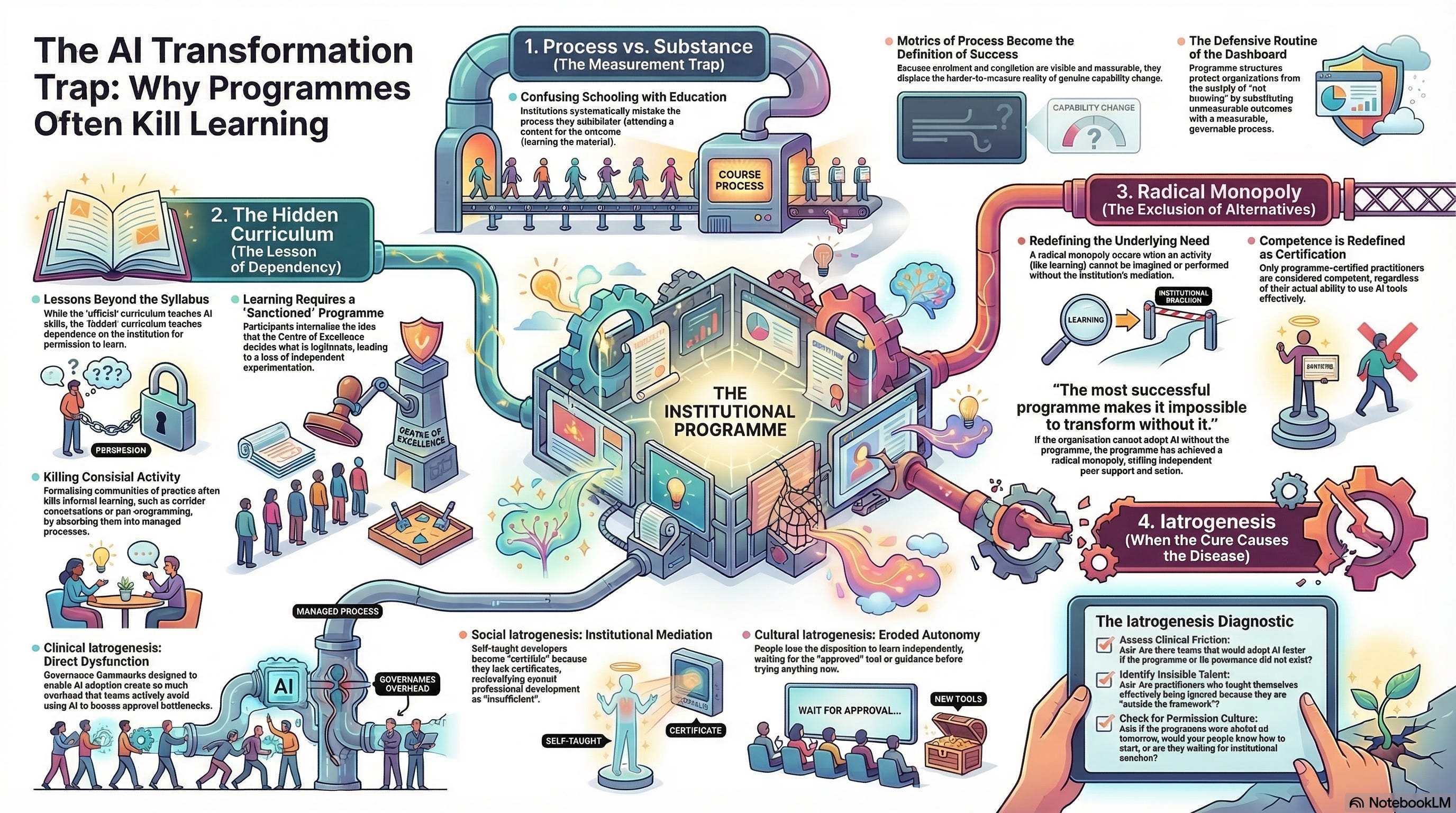
Your transformation programme has a learning component. It has modules, certifications, completion rates, and a dashboard that shows how many people have been trained. The numbers look good. And when you walk the floors, the people who completed the training are not doing anything differently. They have the certificate. They attended the sessions. They can speak the language. But the actual work is unchanged. The programme has produced graduates without producing learning.
Ivan Illich would not be surprised. His argument, developed most forcefully in Deschooling Society (1971) and Tools for Conviviality (1973), is that this outcome is not a failure of the programme. It is the programme working exactly as institutions work. The institution designed to produce learning replaces learning with the consumption of its own services. The certificate becomes the goal. Attendance becomes the evidence. The dashboard becomes the product. And the thing the institution was created to enable, genuine change in practice, is quietly displaced by the thing it actually produces: compliance with its own requirements. Illich called this institutional inversion: the point at which an institution becomes counterproductive to its own stated purpose. It is the theoretical foundation for every observation in this series about structures that obstruct the work they were designed to serve, and it is where the Learning articles put their questions about interaction. Interaction is one of three levers this series keeps returning to, alongside identity and information: who an organisation takes itself to be, what it can therefore see, and how its parts talk to each other. Interaction is the one you can reach directly, which is why intervention starts there.
1. Institutional Inversion: When the Structure Serves Itself
Illich’s sharpest insight is that institutions systematically confuse the process they administer with the outcome they were created to achieve. Schooling is confused with education. Treatment is confused with health. Attending a course is confused with learning. The institutional process, because it is visible, measurable, and governable, displaces the substantive outcome, which is often none of these things.
This confusion is structural, not accidental. The institution must justify its existence, its budget, its headcount. It does so by measuring what it can control: enrolment, completion, certification. The substance, genuine capability change, is harder to measure and slower to materialise. Over time, the metrics of process become the definition of success, and anyone who questions the equation (”but are people actually learning?”) is treated as questioning the institution itself.
Institutional inversion explains every case in this series where the way the parts connect is the thing at fault. Structures obstruct when they have inverted: the governance framework that was created to enable AI adoption now prevents experimentation, because the framework’s survival depends on the continuation of the problem it was designed to solve. The organisation cannot stop what no longer works because the activity has become self-justifying: the architecture review board continues to meet because the board exists, and the board exists because it meets. Conflict cannot be integrated because the institution’s survival depends on suppressing challenges to its own logic: the team that succeeds without the programme threatens the programme’s necessity, so their success is either absorbed (retrospectively certified, claimed as a programme outcome) or ignored (it happened outside the framework, so it does not count).

Bateson’s levels framework diagnoses the epistemological damage. The programme operates at Learning I: it teaches new procedures and vocabulary within the existing frame. What the organisation needs is Learning II: a change in how people learn, a shift in the context that governs how they generate new practice. But Learning II cannot be taught. It emerges from sustained engagement with real problems in conditions where old patterns are genuinely insufficient. The programme, by providing a structured path through pre-digested content, actively prevents the disorientation from which Learning II arises. Argyris diagnosed the same mechanism: the programme’s structure is itself a defensive routine, protecting the organisation from the anxiety of not knowing whether people are actually learning by substituting a measurable process for an unmeasurable outcome.
2. The Hidden Curriculum and Radical Monopoly
Every institution, Illich argued, teaches two things. The official curriculum is the content listed in the syllabus. The hidden curriculum is the implicit lesson about the proper relationship between the learner and the institution: that learning requires a programme, that progress is measured by certification, that the centre of excellence decides what is legitimate, and that the practitioner’s role is to consume, not to experiment independently.

Bourdieu would recognise this as symbolic violence: the hidden curriculum is internalised by the people it constrains, so that the programme’s authority appears natural. The developer who waits for the centre of excellence to approve a new approach before trying it has learned the hidden curriculum perfectly. They are not being cautious. They have been taught that unsanctioned action is illegitimate. The programme has produced the dependency it was designed to prevent.
Illich’s most powerful concept deepens this: radical monopoly, the condition in which an institution has so thoroughly colonised the activity it serves that the activity cannot be imagined without the institution. The car restructured cities so that walking became impractical. The hospital redefined health so that self-care became insufficient by definition. The AI transformation programme redefines competence so that only programme-certified practitioners are considered competent, regardless of what they can actually do. The test is brutal: if you abolished the programme tomorrow, would the organisation be able to adopt AI? If the answer is no, the programme has achieved radical monopoly. The conditions for independent learning have been consumed by the institution that was supposed to create them.

Stacey’s warning connects: formalising communities of practice kills them, because formalisation converts a living pattern of interaction into a managed process. Illich generalises this: every convivial activity, when captured by an institution, undergoes the same conversion. The informal learning that was already happening, the corridor conversation, the team that figured out AI on a real problem without permission, does not survive institutionalisation. Weick’s small wins are the natural enemy of radical monopoly: every informal success demonstrates that capability exists without the institution. Peters’ bias for action is the antidote, but only if the organisation protects the space for unsanctioned success.
3. Iatrogenesis: The Three Levels of Institutional Harm
Illich’s study of medicine introduced iatrogenesis: harm caused by the institution designed to help. He identified three levels that apply to transformation with disturbing precision.
Clinical iatrogenesis is direct harm. The governance framework creates so much overhead that teams avoid using AI for anything requiring approval. The centre of excellence becomes a bottleneck that prevents practice entirely. Beer would recognise this instantly: the purpose of the system is what it does, and what this system does is prevent the adoption it was created to enable. Beer is the foundational thinker for the Interaction lever in Deciding, the one Deciding draws on for it, and he provides the architecture (the Viable System Model) that diagnoses and corrects inversion. Illich diagnoses the pathology. Beer provides the remedy. POSIWID is the diagnostic that connects them: if the programme is producing programme artefacts but not changed practice, then producing artefacts is its purpose.
Social iatrogenesis is the redefinition of normal activity as requiring institutional mediation. The developer who taught themselves AI effectively is invisible because they have no certificate. The team that built a working integration is unrecognised because they did not follow the approved methodology. Normal professional development, learning by doing, has been reclassified as insufficient.
Cultural iatrogenesis is the deepest. The programme destroys the organisation’s capacity for autonomous learning. After years of governance frameworks, approved tool lists, and mandatory training paths, people have lost the disposition to learn independently. They wait to be told. They wait for the programme. They have internalised the hidden curriculum so completely that learning without institutional mediation seems irresponsible. This is the deepest damage, and it is largely invisible, because the people who have suffered it do not know that anything has been taken from them.
Giddens’s structuration theory explains why cultural iatrogenesis is so resistant to correction. The programme is not merely a set of rules. It is a structure reproduced through daily practice: the habitual consultation of the approved tool list, the automatic referral to the centre of excellence, the reflex to check governance before acting. Bourdieu would say the programme has inscribed itself in the habitus. The dependency is no longer institutional. It is embodied.

4. From Programme to Conditions
The question every transformation leader must ask is not “How do I build a better programme?” but “How do I create the conditions from which learning emerges without a programme?”
Illich called the alternative a convivial institution: one that provides tools and access without dictating use, that increases the capacity for autonomous action rather than replacing it with managed consumption. Heifetz’s holding environment is the leadership practice that creates convivial conditions: holding the distress of not knowing, protecting the space for experimentation, giving the work back to the people who must do it. Weick’s small wins are the mechanism: concrete, visible changes that establish new practice before the old institutional logic can reassert itself. Drucker’s systematic abandonment is the discipline: regularly asking “if we were not already running this programme, would we start it now?”
The forward connection to Deciding is direct. Illich diagnoses the pathology of institutional inversion: the point at which structures become counterproductive. Beer, the foundational thinker for the Interaction lever in Deciding, provides the cybernetic architecture that prevents or corrects the inversion. His Viable System Model ensures that each part of the organisation has the autonomy to respond to its environment while remaining coordinated with the whole. POSIWID (the Purpose Of a System Is What It Does) is Beer’s operationalisation of Illich’s diagnosis: if the system is producing programme artefacts, not learning, then the system’s purpose is programme artefacts, regardless of what the strategy says. Redesign the system, not the communication plan.
The deepest lesson Illich offers this series is that the institutional form itself, the programme, the centre of excellence, the governance framework, is not a neutral container for transformation. It is an active force that shapes what transformation can become. If the institution is convivial, it amplifies autonomous capability. If it has inverted, it replaces autonomous capability with institutional dependency. Every structure in the organisation is doing one or the other, at every moment, in every interaction. The leader’s task is to know which.
Illich sits in Learning, the first of the series' four phases. The Learning articles ask how an organisation comes to know anything at all; Deciding turns what it knows into a description precise enough to act on; Building makes that description real; Transforming settles what the result means. Illich belongs here because an institution that has inverted cannot learn: it is busy measuring the thing it has replaced.
(An Organisational Prompt is something you can do now....)
Organisational Prompt
Run the iatrogenesis diagnostic on one programme, one initiative, one governance structure created to support your transformation.
Clinical: is the programme directly preventing the thing it was designed to enable? Are there teams that would adopt AI faster if the programme did not exist?
Social: has the programme redefined competence so that only programme-certified activity counts? Are there practitioners who have taught themselves effectively but are invisible because they are outside the framework?
Cultural: have people lost the disposition to learn independently? Do teams wait for permission, for the approved tool, for the centre of excellence to publish guidance, before trying something new? If you abolished the programme tomorrow, would your people know how to start?
If you find iatrogenesis at any level, the response is not to fix the programme. It is to ask Drucker’s question: “If we were not already doing this, would we start now?” And if the answer is no, to have the courage to stop, and to trust that the conditions for learning are more productive than the institution that has been consuming them.
Further Reading
Ivan Illich, Deschooling Society (1971). The foundational text. Short, radical, and immediately applicable beyond education. Freely available as a PDF.
Ivan Illich, Tools for Conviviality (1973). The more general statement: the distinction between convivial and manipulative institutions, and the criteria for assessing which a given institution has become. Freely available as a PDF.
Ivan Illich, Medical Nemesis: The Expropriation of Health (1976). The iatrogenesis argument. Demonstrates the pattern across domains: the institution replaces the activity it was designed to support with the consumption of its own services.
Paulo Freire, Pedagogy of the Oppressed (1970). The complementary critique. The “banking model” of education is the pedagogy of Illich’s manipulative institution. Problem-posing education is what convivial learning looks like in practice.
I write about the industry and its approach in general. None of the opinions or examples in my articles necessarily relate to present or past employers. I draw on conversations with many practitioners and all views are my own.