
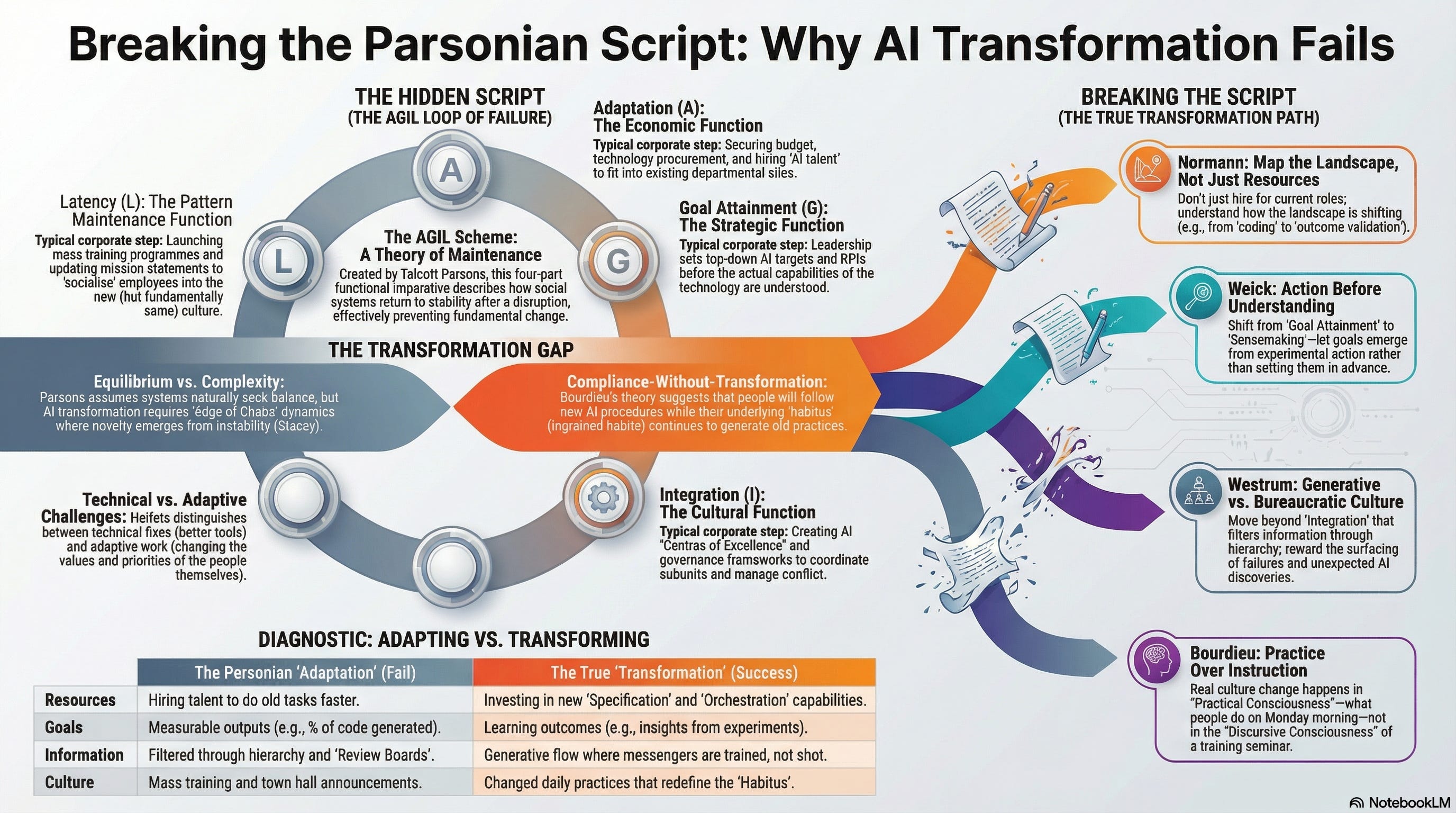
There is a script that every large enterprise follows when it adopts a new practice. A disruption appears. Leadership declares a strategic response. Goals are set, resources are allocated, teams are restructured, training programmes are launched. The organisation absorbs the new technology, adjusts its processes, updates its language, and settles into a new steady state that looks different on the surface but operates according to exactly the same underlying logic as before. The transformation programme is declared a success. Nothing fundamental has changed.
This pattern is so universal that it cannot be explained by individual failure. It is structural. And it was codified by the most influential sociologist of the twentieth century: Talcott Parsons. When your AI adoption programme secures resources, sets strategic goals, coordinates teams, and retrains staff, it is executing a Parsonian script. And the script is designed, at every level, to restore equilibrium rather than to produce change. Parsons’ framework was criticised as conservative, teleological, and incapable of accounting for power, conflict, or agency. This article focuses not on whether it is right but on why it matters: it is the invisible operating system of enterprise change management, and understanding it is the first step toward interrupting it.
1. The AGIL Scheme: The Template You Are Already Following
Parsons’ most influential contribution was the AGIL scheme: four functional imperatives that every social system must fulfil.
Adaptation: secure resources from the environment.
Goal Attainment: define objectives and direct energy toward them.
Integration: coordinate internal parts and manage conflict.
Latency (Pattern Maintenance): maintain and transmit the values and cultural patterns that hold the system together.
Compare this to the last transformation programme you witnessed. Secure budget and hire talent (Adaptation). Set the strategy and declare targets (Goal Attainment). Restructure teams and establish coordination (Integration). Launch training and update role descriptions (Latency). The correspondence is not coincidental. AGIL is the deep grammar of enterprise change management: the template that programme managers follow without knowing they are following it.
The problem is not that AGIL is wrong. At the descriptive level, it is accurate: organisations genuinely need to perform all four functions. The problem is that AGIL is a theory of system maintenance, not system transformation. It describes how organisations absorb disruption and return to stability. It has no vocabulary for the possibility that the system itself might need to become something fundamentally different.

Stacey would identify the core error: AGIL assumes the system knows what functions it needs to perform. But in genuine transformation, the functions themselves are uncertain. AI does not slot into the existing architecture. When AI can generate code from specifications, the Adaptation function is no longer about securing developer talent in the traditional sense. Goal Attainment cannot set targets for a capability whose possibilities are still being discovered. Integration must coordinate forms of work that do not yet have stable definitions. And Latency is being asked to transmit a culture that does not yet exist.
2. Socialisation and Social Control: The Reproduction Engine
For Parsons, system stability depends on two mechanisms. Socialisation transfers norms, values, and expectations to members. Social control ensures that people who deviate are brought back into alignment. In an organisation: onboarding, mentoring, code reviews, architecture reviews, performance evaluations, promotion criteria, the stories told about heroes and failures. These are the mechanisms by which the organisation produces people who reproduce the organisation.
Bourdieu called this habitus. Giddens called it practical consciousness. Parsons called it the product of socialisation. The developer socialised for ten years into a culture that values code elegance and individual problem-solving does not carry knowledge. They carry an identity, a set of reflexes, a way of seeing that makes certain actions natural and others unthinkable. The habitus was formed by the socialisation, and the habitus reproduces the field that formed it.
Social control operates alongside: the peer pressure that discourages deviation, the performance review that rewards conformity, the governance framework that channels innovation into approved patterns. And here is where the series delivers its sharpest critique of Parsons.

Argyris demonstrates that what Parsons calls social control is the same mechanism that produces defensive routines: the patterns that prevent people from surfacing the information the system most needs. The performance review that enforces existing standards is the same review that punishes experimentation. The architecture board that maintains consistency is the same board that blocks novel approaches. The governance framework that ensures predictability is the same framework that prevents the exploratory probes that Weick and Snowden identify as essential for learning.

Westrum’s typology makes the distinction Parsons cannot. All three culture types, pathological, bureaucratic, and generative, perform Parsons’ Integration function. But only the generative culture performs it in a way that enables learning. Parsons asks only whether the function is being performed. He cannot ask whether it is being performed in a way that serves the system’s capacity to change. Bateson would say Parsons is locked at Learning I: he can describe the correction of errors within the existing frame but has no vocabulary for questioning the frame itself.
3. The Equilibrium Assumption: Why “Adaptation” Is Not Change
Parsons’ deepest influence is his equilibrium assumption: social systems naturally tend toward balance, and disruptions are resolved through mechanisms that restore stability. This assumption is embedded in the language of change management: “managing resistance,” “navigating the transition,” “landing the change.” All assume transformation is a journey from one stable state to another.
The Parsonian response to AI follows the pattern precisely. Fit AI into existing roles (differentiation: create an “AI team”). Make existing processes AI-enhanced (adaptive upgrading: add AI review to the code pipeline). Include AI tools in existing workflows (inclusion: give everyone a licence). Generalise values (update the mission statement to say “AI-enabled”). The system adapts. Equilibrium is restored. Nothing fundamental has changed.
Stacey rejects the equilibrium assumption directly. Organisations operate at the edge of chaos. Genuine novelty emerges from instability, not from equilibrium-seeking. The Parsonian script actively prevents emergence by treating every disruption as a problem to be resolved rather than a possibility to be explored. Heifetz’s distinction cuts to the core: Parsons treats all change as technical (the system identifies a requirement and develops mechanisms to meet it). AI transformation is adaptive: it asks people to change themselves, their values, and their ways of working. Parsons’ framework has no vocabulary for this.

Weber, whom Parsons translated into English and whose critical pessimism Parsons systematically softened, saw the endpoint clearly. The iron cage is Parsons’ equilibrium achieved: a system so thoroughly rationalised that the people inside it cannot imagine an alternative. Parsons’ value-generalisation, where values become more abstract to accommodate diversity, produces the meaningless abstractions the series has consistently identified: “We value innovation,” “We are a learning organisation,” “We embrace AI.” These accommodate everything and constrain nothing.
4. Each Function Fails at Precisely the Point Where Learning Is Needed
Understanding Parsons means understanding why your programme produces adaptation rather than transformation. Each AGIL function fails at a specific point, and the series provides the diagnostic for each.
The Adaptation function fails when the organisation secures resources for the wrong landscape. Normann’s map-landscape dialectic is the diagnostic: investing in AI talent to accelerate code production is perfect adaptation to a landscape that is ceasing to exist. The real landscape requires specification capability and domain articulation.
Goal Attainment fails when goals precede action. Weick’s sensemaking provides the alternative: in uncertain environments, goals emerge from action, not before it. The Parsonian sequence, set the goal then allocate resources, reverses the order learning requires. Peters’ bias for action is the correction: act, learn, then rationalise the goal retrospectively.
Integration fails when it suppresses information. Westrum’s typology is the diagnostic: if your integration mechanisms channel information through hierarchy or punish its delivery, the more effectively you integrate, the less you learn. Argyris’s Model II, the capacity to surface and test assumptions publicly, is the integration that Parsons cannot theorise.
Latency fails when it reproduces the culture that needs to change. Bourdieu’s habitus explains why: the training programme updates what people can say (discursive consciousness) without touching what their hands do (practical consciousness). The more effective your socialisation, the more reliably you reproduce the culture you already have. This is the Parsonian trap at its deepest: the mechanism designed to maintain the system is the mechanism that prevents the system from becoming something new.

Dweck’s mindset research reveals the individual dimension. Parsons’ Latency function, through performance reviews, promotion criteria, and recognition practices, reproduces fixed mindset in every cycle by treating ability as static and measurable. Bateson would diagnose the entire AGIL logic as a Learning I system: it can correct errors within its existing frame, optimising each function for efficiency, but it cannot question whether the functions themselves need to change. That questioning is Learning II, and nothing in Parsons’ framework supports it.
5. The Script You Must Interrupt
Parsons is valuable not because he is right but because he is diagnostic. When you recognise AGIL logic operating in your transformation programme, you have identified the mechanism that will convert your transformation into adaptation. The intervention is not to abandon the functions; the organisation does need resources, direction, coordination, and culture. The intervention is to interrupt the equilibrium-seeking at each stage.
At Adaptation: secure resources for the landscape that is emerging, not the one that is familiar. At Goal Attainment: create conditions for experimentation before setting targets, because the targets worth setting can only be discovered through action. At Integration: build generative information flow, not bureaucratic coordination, so that the weak signals of what is actually working can reach the people who need them. At Latency: design socialisation that forms new dispositions through practice, not training that reproduces old ones through instruction.
The thinkers in this series provide what Parsons could not: a theory of organisational learning, not merely organisational maintenance. Action before understanding contradicts rational goal attainment. Surfacing the undiscussable contradicts social control. Addressing identity contradicts role-based socialisation. Ungovernable learning contradicts the latency function. The question is: at which point in the AGIL sequence will you interrupt the script and do something different?
Where this sits: Learning, the first of four phases; Learning, Deciding, Building, Transforming. Parsons is here as the counter-case, because AGIL describes an organisation that maintains itself rather than one that learns, and Learning is precisely the phase that asks whether maintenance is all that is happening. What an organisation gets out of that work is the ability to tell adaptation from transformation. From Learning to Clarity is the bridge into Deciding.
(An Organisational Prompt is something you can do now....)
Organisational Prompt
Map your current transformation programme onto the AGIL framework. Be specific. What have you done to secure resources (Adaptation)? What goals have you set (Goal Attainment)? How are you coordinating teams (Integration)? What training and socialisation have you launched (Latency)?
If your honest mapping reveals AGIL logic at every level, you have identified the structural reason your transformation will produce adaptation rather than change. Now ask at each stage: are we performing this function in a way that maintains the current system, or in a way that enables something genuinely new? The difference between those two questions is the difference between Parsons and everything this series has been arguing for.
Further Reading
Talcott Parsons, The Social System (1951). The core statement of structural functionalism and the AGIL scheme. Dense and abstract. Read it as a diagnostic: it describes, with extraordinary precision, the logic that enterprise change management follows by default.
C. Wright Mills, The Sociological Imagination (1959). The most influential critique of Parsons. Mills argued that grand theory disconnected from real problems serves to legitimate the status quo. The counter-argument that social theory should reveal how systems might be changed, not merely describe how they maintain themselves.
Anthony Giddens, The Constitution of Society (1984). Developed explicitly to overcome Parsonian functionalism. Where Parsons treats structure as an external framework, Giddens shows it exists only in its instantiation in practice.
I write about the industry and its approach in general. None of the opinions or examples in my articles necessarily relate to present or past employers. I draw on conversations with many practitioners and all views are my own.