
Watch the room during the strategy town hall. Really watch it. The senior technology leader presents the vision. Heads nod. Questions are asked: the right kind of questions, calibrated to demonstrate engagement without exposing ignorance. Afterwards, in the corridor, in the Teams DM, in the pub, a different conversation occurs. “This will never work.” “They have no idea what we actually do.” “I’ll wait this one out.” The public performance and the private assessment are not merely different. They are structurally opposed. And everyone there knows it. Including, probably, the person presenting.
Erving Goffman, the Canadian-born sociologist who spent decades observing the micro-mechanics of human interaction, explains what is happening here. It is not hypocrisy. It is not cynicism. It is the ordinary, necessary, deeply human work of managing the impression one gives in different social situations. Goffman called it impression management, and his dramaturgical framework remains the sharpest account we have of why the gap between what organisations say and what they do is so persistent, so universal, and so resistant to the interventions that every other thinker in this series prescribes.
1. Front Stage and Back Stage
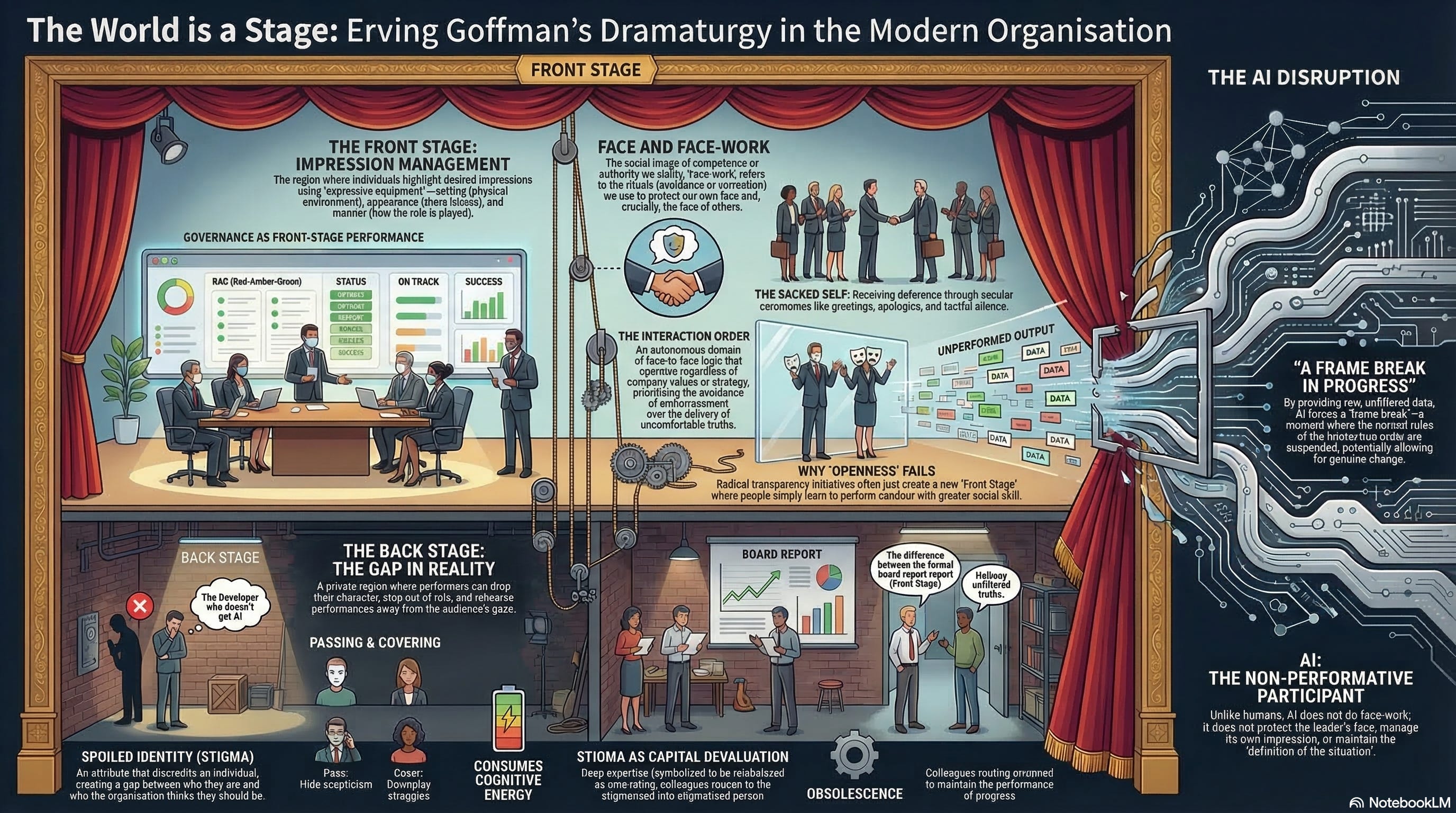
Goffman’s most immediately recognisable contribution is the distinction between front stage and back stage. Front stage is where performances are given: the town hall, the steering committee, the sprint review. Here, people present a version of themselves that conforms to the expectations of the audience. Back stage is where the mask comes off: the private channel, the team retrospective with the door closed, the lunch table, the car park after the meeting.
The maintenance of the front stage is a collaborative achievement. Everyone participates. The leader performs confidence in the strategy. The engineering leads perform willingness to adopt. The product managers perform curiosity about the new tooling. And each party tacitly agrees not to expose the others’ performances, because exposing someone else’s front stage risks having your own exposed in return. Goffman called this dramaturgical loyalty: the mutual agreement to sustain the definition of the situation, even when everyone privately doubts it.
Bourdieu’s habitus explains what people carry in their bodies. Goffman explains what they do with their faces. These are complementary mechanisms. The habitus produces practice below the threshold of awareness; impression management produces performance above it. The developer whose habitus generates code rather than specifications (Bourdieu) will, when challenged, perform enthusiasm for specification-driven development in the sprint planning meeting (Goffman), and then revert to coding the moment the back stage is restored. The performance is not a deliberate deception. It is a habitual response shaped by the field, as automatic in its way as the habitus itself. Goffman is Bourdieu at the microsociological level: impression management is what habitus looks like in face-to-face interaction.

Giddens borrowed from Goffman directly. His concept of regionalisation, the division of social life into front and back regions, was extended into structuration theory to show that the real work of reproducing social structure happens in the back stage of organisational life: where decisions are actually made, opinions actually formed, commitments actually tested. Change programmes that operate only on the front stage, the official communications, the governance frameworks, the mandated processes, miss the space where the organisation actually constitutes itself. Stacey’s shadow conversations are Goffman’s back stage seen through a complexity lens: the informal, ungoverned interactions where the real assessment of the transformation occurs.
2. Face-Work: Why People Will Sacrifice Honesty to Preserve Dignity
Goffman’s concept of face is subtler and more consequential than the front/back stage distinction. Face is the positive social value a person claims in an interaction. It is not vanity. It is the basic social currency that makes interaction possible. When someone “loses face,” the interaction itself is threatened.
Face-work is the set of practices by which people maintain their own face and, critically, help others maintain theirs. When a senior architect makes a statement about AI that reveals they have not understood the technology, nobody corrects them directly. Someone changes the subject, or reframes the statement, or asks a question that allows the architect to gracefully revise. This is not politeness. It is the structural requirement for continued interaction.
The implications for transformation are severe. If adopting AI means publicly acknowledging that one’s existing expertise is insufficient, then adoption requires losing face. And face-work, the collaborative effort to prevent face-loss, will actively obstruct the acknowledgment. The organisation will protect its members from public inadequacy, not because people are cowards, but because face-work is the oil that keeps the social machinery running.

Argyris diagnosed exactly this dynamic as a defensive routine: the pattern by which organisations avoid embarrassment at the cost of learning. Goffman provides the micro-mechanism. Defensive routines are face-work at scale. The undiscussable topic is undiscussable because raising it would cause someone with power to lose face. This is why the truth-telling probe in this series is so difficult even when psychological safety is nominally present. Edmondson’s psychological safety addresses whether people believe they can speak honestly without punishment. Goffman reveals a deeper obstacle: people manage impressions automatically, and the performance itself becomes the barrier to honest disclosure, regardless of whether the environment is formally safe. You can create the conditions where truth-telling is not punished. You cannot, through policy alone, override the face-work reflexes that make truth-telling feel like a social violation.
Every transformation programme must answer a question most never ask: where in your adoption plan is it safe for a senior person to be publicly incompetent? If the answer is “nowhere,” your programme will produce performance, not learning.
3. Stigma: What Transformation Does to Identity
Goffman’s Stigma (1963) addresses what happens when an attribute becomes discrediting. Stigma is not inherent in the attribute. It is produced by the relationship between the attribute and the social expectations of the setting.
AI transformation is a stigma-producing event. The practitioner who cannot write effective specifications, who struggles with the shift from implementation to articulation of intent, risks being marked as obsolete. And the marking is not merely professional. It is, in Goffman’s terms, a spoiled identity: an identity that can no longer sustain the performance the field requires.

Bourdieu’s capital devaluation is the structural equivalent. Goffman shows what capital devaluation looks and feels like in daily interaction: the moment when your contribution is politely acknowledged and then ignored, when the meeting you used to chair is now chaired by someone else, when the conversation pauses uncomfortably after you speak. These are the micro-interactions through which the field communicates that your capital has been devalued, and they operate with devastating precision because they are never explicit. Nobody says “you are no longer relevant.” The interaction order says it for them, through a thousand small signals that the person reads in their body before they process them in their mind.

Kegan’s developmental theory adds the structural dimension. A person at the socialised mind derives identity from the expectations of valued others. If the community begins to mark “non-AI-fluent” as discrediting, the socialised person experiences this as an identity crisis, not a skills gap. Heifetz would say: name the loss. The person whose face is being threatened needs to hear that what they built has value, that what is being lost deserves acknowledgment, and that there is a credible path from the old identity to a new one. Without that, the person will manage the stigma through impression management: performing adoption while privately preserving the old practice. Goffman calls this passing: adopting the appearance of the non-stigmatised identity without actually making the transition. It looks like adoption. It is theatre.
4. Frame Breaks: When the Performance Collapses
Goffman’s later work on Frame Analysis (1974) introduced frames: the interpretive structures through which people make sense of what is happening. A frame break occurs when the agreed definition of the situation collapses. A junior engineer points out that the AI-generated code is better than the principal engineer’s. A client asks why the team is still manually writing what a machine could produce in minutes. The frame that sustained the interaction, the shared understanding of what we are doing and who we are to each other, fractures.

Weick would recognise this as a cosmology episode: the moment when shared sense of what is happening dissolves. Bateson would see the frame break as a moment when logical types collide: the performance (”we are transforming”) and the reality (”we are performing transformation”) exist at different logical levels, and the frame break is the moment when the levels become visible simultaneously. For a brief, uncomfortable moment, everyone can see both: the performance and the reality behind it.
For leaders, the strategic question is not how to prevent frame breaks but how to use them. A frame break, handled well, can be the moment of genuine learning that Argyris’s double-loop model describes: the governing assumptions become visible because the performance that concealed them has collapsed. Handled badly, it produces retrenchment, embarrassment, and intensified impression management. The difference lies in whether the leader treats the break as a threat to be contained or as information to be explored. The frame break is the moment when the back stage truth has forced its way onto the front stage. What the leader does in the next sixty seconds determines whether the organisation learns from it or buries it deeper.
Placement: Learning, the first of the four phases; Learning, Deciding, Building, Transforming. Goffman sits here because the front stage is where an organisation performs perception and the back stage is where perception actually happens, and Learning is the phase that asks which of the two you are reading. What it produces is access to the second. In Deciding the question becomes what can be designed once the backstage account is on the table, and From Learning to Clarity is where the question changes.
(An Organisational Prompt is something you can do now....)
Organisational Prompt
Pick one initiative in your transformation. Identify what is said about it in official settings (town halls, steering committees, status reports) and what is said in unofficial settings (corridor conversations, DMs, retrospectives with closed doors). Write both versions down. Put them side by side.
The gap is not noise. It is signal. It is the most accurate diagnostic you have, because the back stage is where people tell the truth. If the two versions are broadly consistent, your programme is working. If they are structurally opposed, you are not leading a transformation. You are hosting a theatrical production.
Now choose one element of the back stage truth and bring it, carefully, onto the front stage. Not as accusation. Not as confession. As information: “I have heard concerns about X. I want to understand them.” Goffman would tell you this is risky because it threatens the face of everyone performing compliance. Argyris would tell you it is essential because nothing changes while the real assessment remains undiscussable. Both are right. The skill is in creating conditions where truth-telling does not require face-loss: where saying “this is not working” is treated as professional judgement, not as disloyalty.
Further Reading
Erving Goffman, The Presentation of Self in Everyday Life (1959). The foundational text. Short, vivid, and startlingly applicable to organisational life.
Erving Goffman, Stigma: Notes on the Management of Spoiled Identity (1963). Essential for understanding what happens to professional identity when the field’s definition of competence shifts. The concepts of “passing” and “covering” apply directly to how people manage the transition from old expertise to new.
Erving Goffman, Interaction Ritual: Essays on Face-to-Face Behavior (1967). The essay “On Face-Work” is the single most useful piece for understanding why honest conversation about transformation is so difficult.
Erving Goffman, Frame Analysis: An Essay on the Organization of Experience (1974). Dense but rewarding. The concept of frame breaks is directly applicable to the moments when organisational pretence collapses and genuine learning becomes possible.
I write about the industry and its approach in general. None of the opinions or examples in my articles necessarily relate to present or past employers. I draw on conversations with many practitioners and all views are my own.