
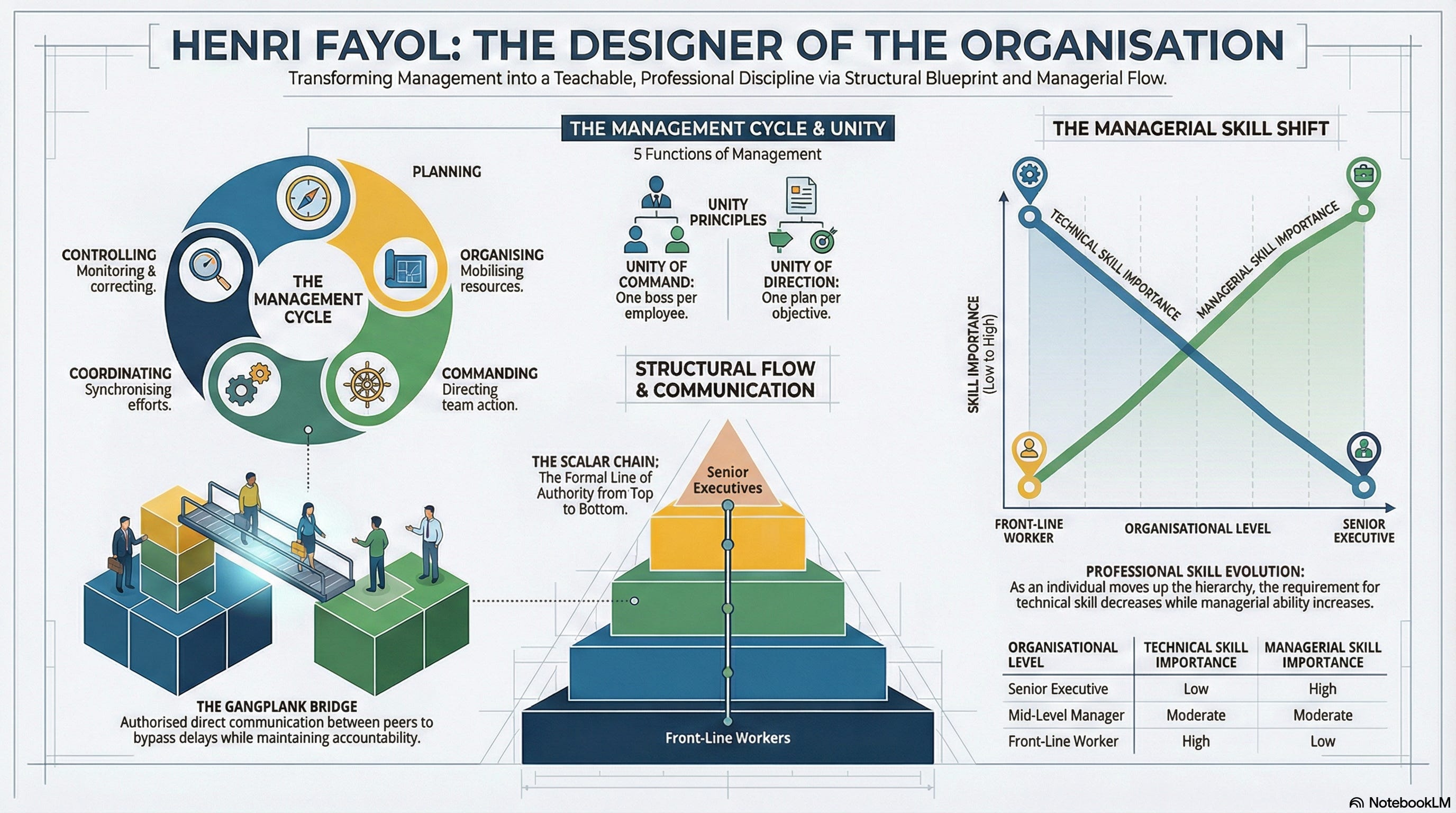
While Taylor looked up from the shop floor to optimise the task, Henri Fayol looked down from the boardroom to optimise the enterprise. Writing in 1916, his premise was radical for its time but is now the water we swim in: management is a universal, teachable skill distinct from technical expertise. Together with Taylor’s task-level optimisation and Weber’s bureaucratic structures, Fayol’s enterprise-level integration produced the classical management model that dominated the twentieth century and that every subsequent thinker in this series has either refined or rejected.
Unlike Taylor, Fayol was studying the work of managers themselves. His principles were explicitly offered as flexible guidelines, not rigid laws; he warned against dogmatic application and insisted that “seldom do we have to apply the same principle twice in identical conditions.” This flexibility is routinely forgotten by the organisations that have hardened his guidelines into governance frameworks so rigid that Fayol himself would have rejected them. His most practically useful insights remain startlingly relevant to anyone trying to coordinate an AI transformation across organisational boundaries.
1. Unity of Direction: The Alignment Problem Technology Cannot Solve
Fayol distinguished between two principles that are often confused. Unity of command means each employee receives orders from one superior only. Unity of direction means there is one head and one plan for each group of activities with the same objective. Many organisations have solved the first. They fail spectacularly at the second.
The Data Science team optimises for model accuracy. Infrastructure optimises for cost and reliability. Product optimises for time-to-market. Each team meets its own targets while the system as a whole underperforms. Deming diagnosed exactly this: his ninth point, “break down barriers between departments,” addresses the coordination failure Fayol identified. But Deming’s solution is trust and shared purpose rather than hierarchical authority. Optimising the parts sub-optimises the whole, and the barriers between departments are not merely structural but psychological: each department develops its own culture, its own definition of quality, and its own defensive routines.

Stacey would add that unity of direction cannot be achieved through planning alone. If organisations are patterns of interaction, then the “one plan” Fayol prescribed is not a document that coordinates from above. It is a shared orientation that emerges through the quality of conversations between the people doing the work. Weick would agree: the plan’s value lies partly in the sensemaking process that produces it, not just in the document that results.

Bourdieu reveals what Fayol’s framework cannot model: power. Unity of direction assumes departments can be aligned through rational coordination. But departments are also fields where actors deploy their capital to maintain position. The Data Science team does not resist alignment because they fail to see the logic. They resist because alignment would require subordinating their priorities, which threatens the capital they have accumulated. The coordination problem is simultaneously a structural problem and an identity problem, and Fayol’s framework addresses only the first.
2. The Gangplank: Speed Without Accountability Is Noise
Fayol respected hierarchy for accountability, but he recognised it was too slow for operational reality. If a message from Department A had to travel up to the CEO and back down to Department B, the business would die of latency. His solution was the “gangplank”: authorised direct communication between peers across silos, with the condition that peers inform their superiors of what was decided. The gangplank gave speed. The accountability condition gave alignment.
Modern organisations have the gangplank without the condition. Cross-functional teams, messaging channels, working groups, direct email between peers: all gangplanks. But the accountability that Fayol insisted on has been lost. The result is shadow decisions, fragmented architecture, and choices made in threads that nobody else knows about until they collide with choices made in other threads.

Westrum’s typology illuminates why the gangplank works in some cultures and fails in others. In a generative culture, the gangplank is natural: information flows to where it is needed. In a bureaucratic culture, the gangplank requires formal authorisation, which reintroduces the latency it was designed to eliminate. In a pathological culture, the gangplank is dangerous: information shared laterally can be used as a weapon.
Giddens explains why the accountability condition is so hard to maintain. Daily communication practices are reproduced through practical consciousness, not through formal rules. People do not consult the governance policy before sending a message. They do what feels natural, and what feels natural is shaped by the habitus. Fayol’s condition, “inform your superiors,” requires conscious effort that works against how organisations actually communicate. This is why the condition is almost universally violated and the coordination failures Fayol predicted are almost universally observed.
3. The Governance Trap: When Everyone Is in Charge, Nobody Decides
Fayol was adamant: dual command is a perpetual source of conflict. Yet the modern matrix organisation, where you report to a functional lead and a delivery lead simultaneously, is the standard violation of his principle. Who owns AI risk? The CISO? The CTO? The Head of Legal? The AI Centre of Excellence? When everyone is in charge, no one is. Fayol would predict exactly the paralysis visible in enterprise AI adoption: each authority can veto, none can approve.

Heifetz provides the deeper diagnosis. The governance trap is not merely structural. It is an adaptive challenge masquerading as a technical one. The people in the matrix are managing the anxiety of a situation where nobody knows the right answer, and the matrix provides the appearance of distributed authority that allows everyone to defer the difficult decision. This is work avoidance: the organisation creates a structure that absorbs the anxiety without confronting it. Fayol’s unity of command is not just an efficiency principle. It is the structural condition that forces decisions to be made rather than endlessly deferred.

Peters would recognise this as bureaucratic ossification at its most destructive: the governance apparatus designed to manage risk becomes the primary risk, because it prevents the experimentation from which learning comes. Bateson’s levels framework diagnoses the epistemological cost: the matrix keeps the organisation at Learning I (navigating the governance) when the challenge demands Learning II (questioning whether the governance itself is the obstacle).
4. Initiative and Esprit de Corps
Fayol is often caricatured as a cold bureaucrat. This is a misreading. He listed initiative, “the ability to think out and execute a plan,” as a primary source of organisational strength and argued that a manager who inspires initiative is infinitely superior to one who cannot. He warned explicitly against dividing one’s own team, calling it “a grave sin” that destroys esprit de corps. He understood that technical structure is useless without social cohesion.

Deci and Ryan provide the psychological framework for Fayol’s intuition. Initiative requires autonomy: the felt experience of choosing rather than being controlled. Esprit de corps requires relatedness: connection to others that sustains commitment. Fayol grasped, without the vocabulary, that an organisation of rule-followers without initiative is brittle. Dweck’s mindset research connects initiative to beliefs about ability: in a growth mindset culture, initiative is valued because mistakes are learning. In a fixed mindset culture, initiative is punished because mistakes are evidence of inadequacy. Fayol’s principle, tolerate mistakes to encourage initiative, requires the cultural precondition Dweck describes.
5. Fayol’s Limits and What Must Be Added
Fayol must be read with his limitations visible. His framework assumes a stable environment where planning is possible and coordination can be achieved through regular conferences. Stacey provides the most fundamental challenge: you cannot plan in a complex domain because outcomes emerge from interactions you cannot predict. You cannot command because the people receiving commands hold the knowledge that determines how the command is interpreted. Normann challenges Fayol’s assumption that organisational boundaries are fixed: value is increasingly co-produced across boundaries that no single manager can command.
Yet Fayol remains indispensable. Coordination must happen. Direction must be unified. Command must be clear. Initiative must be cultivated. These are structural necessities, not optional features. The question is not whether Fayol’s functions are needed but how they can be achieved in conditions he could not have anticipated. Coordination through conversation rather than conference (Stacey). Direction through shared sensemaking rather than central planning (Weick). Command through adaptive leadership that gives the work back (Heifetz). Initiative through environments that satisfy autonomy, competence, and relatedness (Deci and Ryan). And esprit de corps through cultures where information flows generatively (Westrum). Fayol identified the problems. The modern thinkers identify what it actually takes to solve them.
Placement: Learning, the first of four phases; Learning, Deciding, Building, Transforming. Fayol is here as inherited furniture rather than as a diagnosis, because his functions are what most organisations still take management to be, and noticing that is the work these articles do. What an organisation gets out of Learning is the distinction between a structural necessity and a habit. In Deciding the question becomes what can be designed under the constraint that remains, and From Learning to Clarity is the route.
(An Organisational Prompt is something you can do now....)
Organisational Prompt
Identify two teams critical to your AI initiative that sit in different reporting lines. Perhaps Data Science and Legal. Perhaps Platform Engineering and the business domain team. Ask two questions.
First: do they have a functioning gangplank? Can they communicate directly, without going through their respective hierarchies, when a decision needs to be made quickly? Second: do they share a single plan for the objective they both serve, or is each executing its own strategy that nominally supports the same goal?
If they have speed without alignment (gangplank but no unity of direction), they will produce fragmentation. If they have alignment without speed (unity of direction but no gangplank), they will produce latency. Fayol’s diagnosis is a century old. It is almost certainly operating in your organisation right now.
Further Reading
Henri Fayol, General and Industrial Management (1916/1949). The original text, still surprisingly readable. Pay attention to the nuance: these are principles to be applied with judgement, not laws to be followed mechanically.
Henry Mintzberg, The Nature of Managerial Work (1973). The empirical challenge to Fayol’s rational framework. What managers actually do bears little resemblance to Fayol’s tidy functions. Together they illuminate the gap between what management aspires to be and what it actually is.
W. Edwards Deming, Out of the Crisis (1986). Deming’s ninth point, “break down barriers between departments,” is Fayol’s coordination problem addressed through systems thinking rather than hierarchical authority.
I write about the industry and its approach in general. None of the opinions or examples in my articles necessarily relate to present or past employers. I draw on conversations with many practitioners and all views are my own.